Neil Welch, Continuous Resonance Project
Date: 01/03/2014
Instrument: Tenor saxophone
Location: Home studio in Clinton, WA (Whidbey Island)
About the project:
Continuous Resonance is an ongoing process of musical documentation from saxophonist Neil Welch. It is not a daily project, but rather a long-term tool for the development of new ideas, improvisatory concepts, or finished work in need of recording. In other words it is an outlet for current work, and the daily work of improvisation which might otherwise only exist within the practice space or public performance.
01/02/2014 Continuous Resonance
Neil Welch: Continuous Resonance Solo Project
Date: 01/02/2014
Instrument: Tenor saxophone
Location: Home studio in Clinton, WA (Whidbey Island)
About the project:
Continuous Resonance is an ongoing process of musical documentation from saxophonist Neil Welch. It is not a daily project, but rather a long-term tool for the development of new ideas, improvisatory concepts, or finished work in need of recording. In other words it is an outlet for current work, and the daily work of improvisation which might otherwise only exist within the practice space or public performance.
01/01/2014 Continuous Resonance
Neil Welch: Continuous Resonance Solo Project
Date: 01/01/2014
Instrument: Tenor saxophone
Location: Home studio in Clinton, WA (Whidbey Island)
About the project:
Continuous Resonance is an ongoing process of musical documentation from saxophonist Neil Welch. It is not a daily project, but rather a long-term tool for the development of new ideas, improvisatory concepts, or finished work in need of recording. In other words it is an outlet for current work, and the daily work of improvisation which might otherwise only exist within the practice space or public performance.
12/31/2013 (12 Moons Solo Project Day 365)

12 Moons Solo Saxophone Project Day 365
Date: 12/31/2013
Instrument: Tenor saxophone
Location: Home studio in Clinton, WA (Whidbey Island)
Notes:
Today is the last day of the 12 Moons Project. My morning began, as so many tend to do, working in my practice room at home. The first few days and the last few days of the project began much the same. My students are on Winter Break and so I’m afforded time off as well. In the first few months of this year in particular, my days were so tightly packed that it became a daily fight to maintain my practice schedule, a calm and focused mind, and to include the necessary time to document. It seems ironic to me now that I find myself ending the project with the luxury of time on my hands. This morning I felt calm and relaxed. I slept in for a hour longer than I had intended and practiced for a few hours before recording. I searched for a specific improvisational model or fingering system during my practice session to use in today’s piece, but in the end a freer, more liberated improvisation took shape.
During this improvisation I do stick to a few selected mutiphonic fingerings, but I began with no pre-thought concept aside from the opening fingering. I maintained this mutliphonic or some close version of it throughout the piece. This was as follows:
(Left Hand) 1-2-3, Octave, Low B // (Right Hand) 2-3
I trilled the F key in the right hand continuously during the improvisation. There was an amazing range of sound with the above fingering, but I also worked between the upper register and the lower tones by taking away the octave key to dig further into its inner parts. About half way into the improvisation I began using my voice as a tool to add more color to the sound spectrum. I kept the trill tempo as static as possible, waiting until the last 1/3 or so of the improvisation to abruptly increase the tempo. It was at this point that the volume and intensity is abruptly ratcheted up. I also began intermittently putting down the Low Bb key, which added in a second multiphonic. I created aggressive punctuations in the sound spectrum by flicking closed and open the Low C key in the right hand while exploring these two multiphonics.
This project has been an extraordinary journey for me, personally and artistically. Thank you for listening, reading and supporting my music. I am truly grateful to have shared it with you.
-Neil
December 31st, 2013
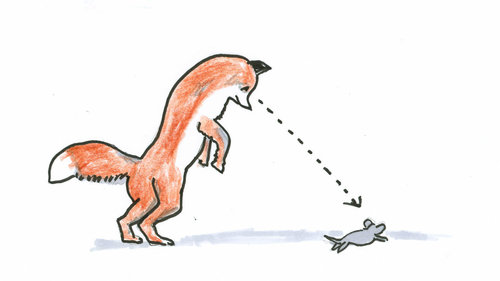
The image accompanying today’s post by Hiroshi Yamazaki.
12/30/2013 (12 Moons Solo Project Day 364)
12 Moons Solo Saxophone Project Day 364
Date: 12/30/2013
Instrument: Tenor saxophone
Location: Home studio in Clinton, WA (Whidbey Island)
Notes:
I rose early today and spent the morning with my family. With the holidays drawing to a close, my brother was heading back out of town and those of us with the morning free got together to say goodbye. Well before sunrise, and an hour before leaving the house, I went into my practice space to see if the morning could grant anything to me in artistic inspiration. Traveling to my families house requires a total time commitment of about an hour and a half, this despite the fact that they live only about 15 miles away as the crow flies. This is in no way a burden, as the long time required for travel is just a reality and now affords me time for different kinds of productivity. I always have a book with me, a small horn or a few albums that need listening to. This can make an hour trip seem like 10 minutes. Reflecting on this during my brief practice session this morning, the theme of “malleable time” became my inspiration for today’s improvisation.
During this piece I played continuous strains of melodic activity, all done with a quiet, but firmly pressed articulation against the reed. I allowed the tones of the horn to speak, but never at full volume–just enough for them to “ping” with legato phrasing in the moment of articulation. I approached the improvisation by making pairs of multiphonic fingerings, each pair selected at will, with their individual multiphonics repeated several times before moving onto the next. I then articulated free-flowing melodic lines from the mid to upper register before settling on another repeated multiphonic pair. Working with the theme of malleable time, I performed a longer, 10 minute improvisation that began with rapid single tonguing, and I attempted to gradually slow the piece down throughout the duration of the improvisation. During this process I tried to explore in my own mind the duration of time that had passed, and to fold myself into this gradually diminishing world. I was specifically interested to see if time passed more quickly for me during the faster portions or the slower portions. Not to my surprise at all, I found that the slower portions seemed to move at an infinitely slower rate.
-Neil
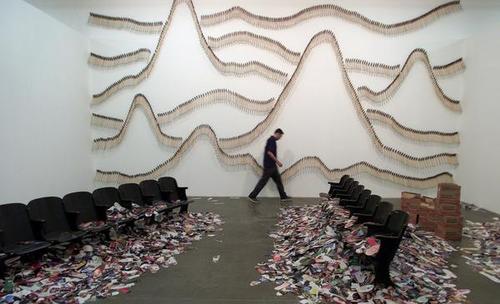
The image accompanying today’s post by Jose Damasceno.