12/29/2013 (12 Moons Solo Project Day 363)

12 Moons Solo Saxophone Project Day 363

Date: 12/29/2013

Instrument: Tenor saxophone

Location: Home studion in Clinton, WA (Whidbey Island)

Notes:

I explored partial voice exchange and melodic shapes within multiphonics for today’s improvisation.  It was a beautiful, calm morning on this island.  The weather was mild, with light, misting rain and greenish hue about the forest.  To reflect this I found two chords that laid well together, and tried to create an atmosphere of calm in my practice space.  I approached the improvisation freely after having gained some control with the two fingerings.  

I was struck by the subtle beauty of the two chords.  Within their internal pitch structure was one example of voice exchange. Chord 1 used the two pitches F# and C.  When moving to Chord  2, the F# moves up to a cluster of the pitches A and B (each a quarter step flat).  The upper register C from Chord 1 moves up to become an upper register F# in Chord 2.  Even though the voices both move upward from Chord 1 to Chord 2, the common exchange of the F# from the mid to high register binds the two chords together.  These two shapes are written as follows:

Chord 1.  Pitches F# and C

(Left Hand) 1-2-3, Octave, Low B // (Right Hand) 1-2-3, Low C

Chord 2.  Pitches A, B (each a quarter step flat) and F# 

(Left Hand) 1-2, Octave, Low Bb // (Right Hand) 1-2-3, Low C

I also wanted to explore a combination of controlled and indeterminate elements during this improvisation.  I did so by choosing a few spots during the improvisation to simply lift a key to see what harmonic colors the horn itself could add.  I then incorporated these into the overall improvisation.  For example, at the 1:00 mark, I decide to open and close the side Bb key during the then established tempo.  This helped to transform the two simple chord shapes into more of a melodic statement.   Another example of this indeterminacy can be heard at 2:03 where the harmonic language abruptly shifts upward.  I thought this was an incredibly beautiful bit of unplanned material that truly added a color to the improvisation I would likely not have otherwise chosen.  Once it was played, I then briefly incorporated it into the chord cycles.

During this piece I used a medium-light reed and played at an extremely quiet volume.  Even though I recorded early this morning, for some reason there were more people driving out on the road than usual.  The comparative volume of a few cars driving by shows how quiet my dynamic level was.  

-Neil

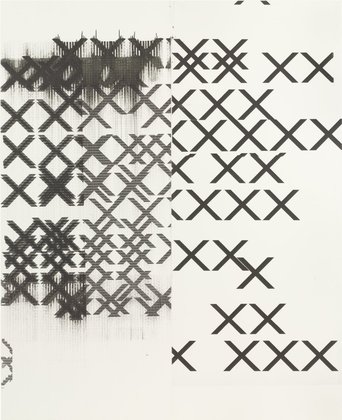
The image “Untitled” accompanying today’s post by Wade Guyton (2006).  The artist “typed the characters onto a sheet of paper. He made this painting by folding a piece of linen in half vertically and pulling it through an inkjet printer, so the two halves were created autonomously and successively. In this way, the artist relinquished control over smudges, streaks, blurs, overlaps, and alignment” (moma.org).
12/28/2013 (12 Moons Solo Project Day 362)

image

12 Moons Solo Saxophone Project Day 362

Date: 12/28/2013

Instrument: Tenor saxophone

Location: Home studio in Clinton, WA (Whidbey Island)

Notes:

This morning I practiced for several hours before beginning the process of recording.  This was an intentional choice.  The 12 Moons project itself has, from day 1, become the center of my creative life each day this year.  I’ve made every effort to relieve myself of feeling any kind of burden with this daily task.  Each day I try and make the process of recording as relaxed as possible, taking advantage of my mood, physical location, and my practice session itself.  As the project is drawing to a close, I’ve specifically thought about the patterns that have emerged in my artistic process from day to day.  

More often than not I record during my practice session.  I’ve come to recognize a flat-out reality that once I’ve recorded, I feel a sense of artistic and personal accomplishment that often makes me loose focus on my instrument for the rest of my practice session.  Even if I urge myself to continue practicing, I often feel less reward at the end of the session, finding that the peak of my accomplishment was the recording itself.  This is of course diametrically opposed to the all important snails-pace of progress through focused, daily practice.  For this reason, in the last 1/3 or so of the project I’ve begun recording towards the end of my practice session.  Most days this works fine, but in others days, particularly when my artistic fluidity is slower than usual or if I feel pressured for time, this can lead to a heavy stress load, and often take much longer than usual.  However, even in these situations, at the end the day I feel fulfilled knowing that I’ve devoted even more time to the horn.  Today was one of the days when my artistic process moved slower than it general does.  It took time, but the piece eventually came.  

During today’s improvisation I used 2 fingerings and sang into the horn using upward pitch bends.  The improvisation was centered around a Concert Db fundamental, with the second fingering moving the piece into moments with an Ab fundamental.  I used continuous loops of the gesture as well as silence, soft and abrupt cut-offs.  I initially decided to use a single fingering, but during the mid point of the improvisation I felt the piece needed stronger contrast.  While singing in the upper side of a pitch bend I decided to move to a Low Bb fingering.  I chose this moment because this particular fingering would require a looser sub-tone embouchure in order to match the timbre of the Concert Db.   These fingerings were as follows:

Concert Db fundamental:

(Left Hand) 1-2-3, Low Bb // (Right Hand) 1-2-3, Low Eb

Concert Ab fundamental:

(Left Hand) 1-2-3, Low Bb // (Right Hand) 1-2-3, Low C

-Neil

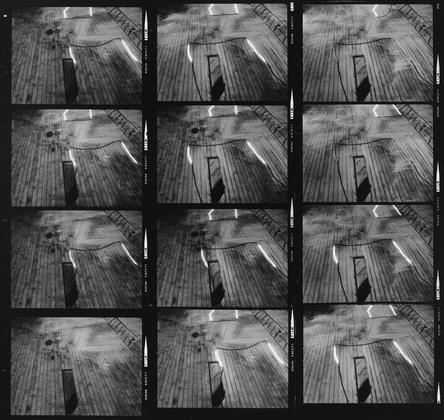
The image “March 28, 1973"  accompanying today’s post by Charles Hagen (1973).

12/27/2013 (12 Moons Solo Project Day 361)

12 Moons Solo Saxophone Project Day 361

Date: 12/27/2013

Instrument: Tenor saxophone

Location: Home studio in Clinton, WA (Whidbey Island)

Notes:

Caught between holidays, I have the week off from teaching until after the New Year.  I went to bed early last night and woke up around 5am ready to start the day.  I leisurely went about my tasks this morning, interspersing the day’s obligations with reading, working on album material and practicing.  This relaxed but productive atmosphere highly influenced today’s piece.  I decided to work with two themes in this improvisation: Constant Resonance and Air Flow Articulation.

The term Constant Resonance comes directly from the 12 Moons project itself.  My wife and I recently discussed my use of the phrase as something that appeared fairly often early on in the project.  This is an evolving term for me, and in many ways is just an ever-present focal point in my playing.  I view Constant Resonance as a focus more on liquid, undulating tone textures as the main source for an improvisation, versus rhythm or melody, or harmony.  I worked to incorporate this theme with the physical technique of using my Air Flow as an articulation source verses my tongue.  During this improvisation I used a single fingering, and relied on the tongue movement inside my mouth, mouth shapes and air flow to explore pushing a pulling tones out of the horn.  

The fingering used today was as follows:

Multiphonic fingering with the following primary tones: F# (quarter step flat) G (quarter step sharp) and C#.  Many other pitches in the upper register emerged during the improvisation as well.

(Left Hand) 1-2-3, Low Bb, Octave // (Right Hand) 2-3

-Neil

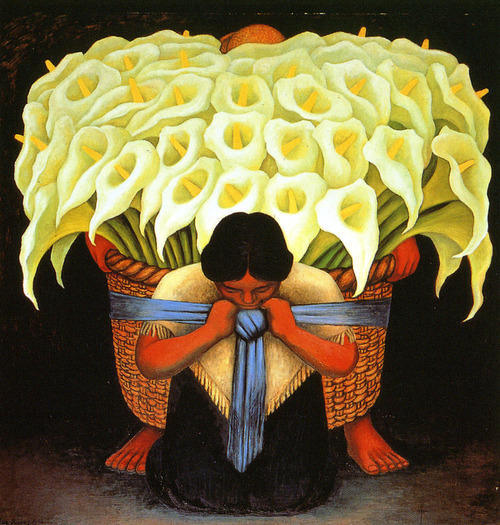
The image “El Vendedor de Alcatraces” accompanying today’s post by Diego Rivera.

12/26/2013 (12 Moons Solo Project Day 360)

12 Moons Solo Saxophone Project Day 360

Date: 12/26/2013

Instrument: Tenor saxophone

Location: Home studio in Clinton, WA (Whidbey Island)

Notes:

This improvisation makes use of de-tuned multiphoinc chords, played in dominant to tonic fashion as harmonic gestures.   These multiphonics, written below as Chords 1-3, were very unstable and required a tight embouchure with very focused control to maintain them.  When I would pull the air flow away to dip down the volume, Chord 2 had a tendency to naturally evaporate into a Concert C, and Chord 3 into a Concert D.    I decided to approach these pitches as “melodic byproducts” from the multiphonics, and allowed them to speak once the horn and my embouchure let go of the multiphonic chords.  This simple two-note figure used tempered tuning, despite the fact that they originated within to very de-tuned multiphonic chords.  This provided me a link between the chordal movement and the simple melodic pitches.

As can be heard during the improvisation, the Concert C and D rang with precise control, and I took advantage of this by using diminuendo shapes from medium-loud to whisper soft.  The three chords used during this improvisation, as well as the two resultant “Melodic byproduct” pitches are notated below.

Chord 1: De-tuned D dominant chord

(Left Hand) 1-2-3, Octave // (Right Hand) 1-2, Low C

Chord 2: De-tuned G Major Chord.  Chord included the Melodic Concert C pitch.

(Left Hand) 1-2-3, Octave, Low C# // (Right Hand) 2, Side F#, Low C

Chord 3: De-tuned D dominant chord (new voicing).   Chord included the Melodic Concert D pitch.

(Left Hand) 1-2-3, Octave, Low C# // (Right Hand) 2, Side F#, High F#, Low C

-Neil

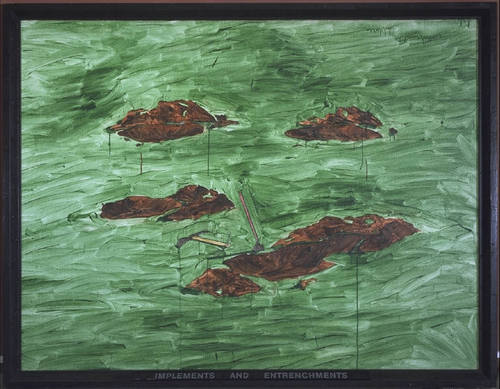
The image “Implements and Entrenchments” accompanying today’s post by Neil Jenney (1969).

12/25/2013 (12 Moons Solo Project Day 359)

12 Moons Solo Saxophone Project Day 359

Date: 12/25/2013

Instrument: Tenor saxophone

Location: The rec room of my childhood home in Edmonds, WA 

Notes:

This improvisation uses a static drone figure played quietly, with melodic gestures above it that independently shifted in dynamic level from quiet to medium loud.  The concept of voice independence has been a continuous theme in my playing for some time now, but I’m now working towards adding a new level of depth to this concept by isolating fingering systems that allow for volume independence within the separate parts.  I used a single fingering gesture, which had a mid-register drone.   The melodies above it were approached freely and used a total of 4 pitches from the fingering’s overtone series, in addition to a 5th tone added by flexing my embouchure.  The fingering system was as follows:

(Left Hand) 1, Palm Key F only, Octave // (Right Hand) 2-3, Low C.  Trill the F key (1) in the right hand continuously.  

The static drone created by this fingering system was an F (quarter step high) in middle octave.  I worked to maintain this drone at all times at a consistent dynamic level, though there were a few moments when it unintentionally dropped out.  Above this drone were the 4 melodic pitches C#, F#, C, and E, all in the upper to extreme upper register.  The F# functioned as a central pivot point in the melodies, with improvised phrases moving towards and away from it.  A 5th tone, an upper register E was played by shifting my embouchure and scooping up into the F#.  As stated above, a central theme during this piece was to maintain a duality of thought–maintaining the static volume in the drone, and freely shaping the volume level of the melodies.  At a single point during the improvisation, I did pull the drone out intentionally to draw the focus to a single upper register melodic pitch, which was played at the high point of volume during the improvisation.  

-Neil

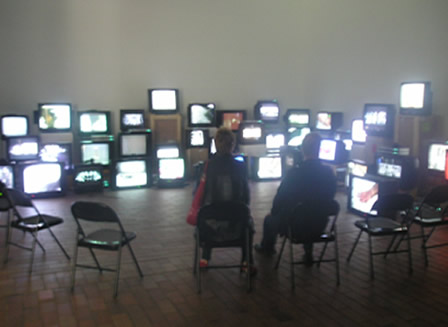
The image “Pretty much every” accompanying today’s post by Douglas Gordon (1992-?).