12/24/2013 (12 Moons Solo Project Day 358)

12 Moons Solo Saxophone Project Day 358

Date: 12/24/2013

Instrument: Tenor saxophone

Location: Home studio in Clinton, WA (Whidbey Island)

Notes:

In today’s improvisation I wanted to explore quiet bursts of sound energy.  To do this I used a nontraditional hand position that worked its way from an open fifths chord, and would break through into various sound clusters.  These sound clusters seemed to speak fully at a quiet to medium-quiet dynamic level, allowing their full colors to push through.  I felt that my emotional state played less a role in the sculpting of this piece than did the horn’s own willingness to offer up a beautiful range of sound.  

This improvisation used a series of progressively thickening layers of sound.  It opens with a single Concert E pitch in middle octave, which is then joined by a Concert B a fifth above.  To create each of these tones I used the following fingerings:

Concert E:

(Left Hand) 1-2-3, Octave // (Right Hand) 2-3

Concert E/B

(Left Hand) 1-2-3, Octave // (Right Hand) 2-3

For the E and D keys in the right hand (notated above as 2-3) I used my thumb and pinky instead of the Middle and Ring finger.  This freed up my middle finger to reach across and begin trilling the Low Bb bell key manually.  This began the third phase of the overall sound structure, which included an exploration of pitch clusters in the upper register.  At the mid point of the improvisation I moved back into the single Concert E, but took away the octave key.  This dropped the pitch by an octave and added a further expansion of range while incorporating the open Fifth (Concert E/B) and the upper register pitch clusters.  Despite the limited overall volume, I tried to create a wide dynamic spectrum, allowing the single pitches and clusters to rise and fall in volume between executions.

-Neil

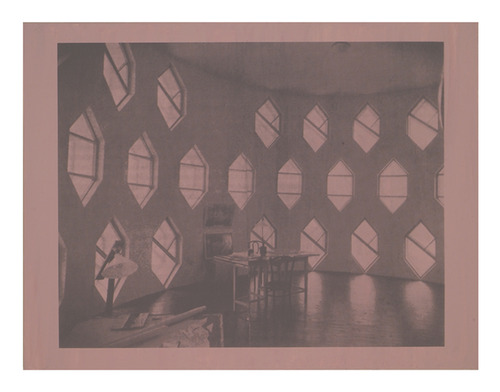
The image “Melnikov Studio” accompanying today’s post by David Diao (2012).
12/23/2013 (12 Moons Solo Project Day 357)

image

12 Moons Solo Saxophone Project Day 357

Date: 12/23/2013
Instrument: Tenor saxophone
Location: Home studio in Clinton, WA (Whidbey Island)

Notes:

During my practice session this morning, my time was dedicated specifically towards long tones, intonation, and the use of “pitch imagination,” a term familiar to me from Sigurd Rascher’s excellent book “Top-Tones for the Saxophone.” After a few hours of focus in these areas, I decided to freely improvise a piece that was influenced not so much by this practice session but by my natural improvisational impulses these past few days. I’ve been transfixed on the use of short, puckish tones of all sorts–controlled sounds, junk sounds, multiphonic and straight-toned, all played short. In order to draw my focus elsewhere, I focused heavily this morning on long-tones. However, when I decided to record today’s 12 Moons improvisation, my gut impulse still swayed towards short-pitched melodies.

In this piece I focused heavily on 3 fingerings, the first two for the mid register aggressive sounds, and the third for the high register pitch dots and chirps. These three fingerings were as follows:

Fingering 1 (Concert G)
(Left Hand) 1-2, Octave, Low Bb // (Right Hand) 1-2-3

Fingering 2 (Concert Db)
(Left Hand) 1-2, Octave, Low Bb // (Right Hand) 1-2-3, Low C

Fingering 3 (Altissimo Bb, and other altissimo pitches)
(Left Hand) 1-2, Octave, Palm Eb only, Low Bb // (Right Hand) 1-2-3, Low C

Fingering 1 centered around a Concert G, which I played loosely, incorporating a wide variety of tones and textures. I moved between Fingering 1 and 2 freely, exploring the Augmented 4th interval among other pitch material. With the addition of the Palm Eb, I would move into Fingering 3, which centered around an altissimo range Bb, also among many other determined and indeterminate pitch dots. I used single and double tonging during this improvisation, with occasional breaks into moments of sustained sound. I also used silence as a tool to elevate the intensity of the improvisation.

-Neil

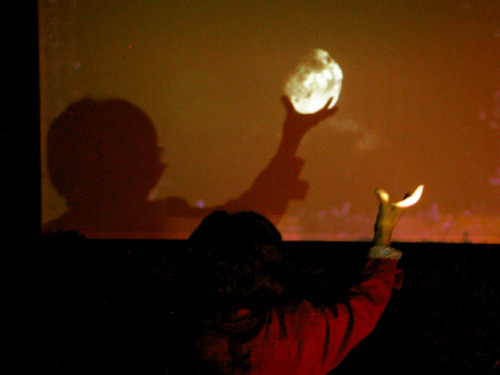
The image “Moon Viewing Box” accompanying today’s post by Keigo Yamamoto.

12/22/2013 (12 Moons Solo Project Day 356)

12 Moons Solo Saxophone Project Day 356

Date: 12/22/2013

Instrument: Tenor saxophone

Location: Home studio in Clinton, WA (Whidbey Island)

Notes:

Yesterday’s improvisation focused on buzzing and pitch clusters created by making use of a slight disfunction in my tool–lost motion from a key on the horn itself.  Today I decided to directly augment my tool by using a harmon mute in my bell, and approached another “buzzing and pitch cluster” improvisation with a much different sound profile.  Both improvisations used static, held pitch material with momentary interruptions in the established sound flow.  But today I explored  two fingerings with much more resonant sound possibilities, and a particular focus on pitch clusters rather than buzzing.

This is I believe my 6th time using the harmon mute during the 12 Moons project, and each time I learn a bit more about about the amazing array of sound possibilities with it.  I approached this improvisation freely after having decided on two fingerings.  I worked to phase in and out of pitch material and tried to explore a wide variety of thin and thicker clusters.  There were extraordinary moments for me during this piece, one of which took place in the first 10 seconds.  The air flow grabbed onto an upper register Concert B, which then pulled the note around chromatically for just a few moments, creating the melodic shape B—-C-B-Bb.   The two fingerings used during this improvisation were as follows:

(Left Hand) 1-2, Octave, Palm D, Low Bb // (Right Hand) 2-3

(Left Hand) 1-2, Octave, Palm D, Low Bb // (Right Hand) 2-3

-Neil

The unedited photograph of land and sea, entitled “I Live in a Rothko Painting” that accompanies  today’s post by Marion Boddy-Evans, Mad Cat Art Studio.

12/21/2013 (12 Moons Solo Project Day 355)

12 Moons Solo Saxophone Project Day 355

Date: 12/21/2013

Instrument: Tenor saxophone

Location: Home studio in Clinton, WA (Whidbey Island)

Notes:

At the end of my practice session this afternoon I decided to revisit a specific sound texture that I work with from time to time.  My Side C key has a small bit of lost motion in it.  This results in an incredibly short delay in the pressing of the key to finally its preferred immediate opening.  The lost motion is so slight that under normal circumstances it is almost unnoticeable.  However, a year or so ago I discovered that if I use the Low D fingering with the Low C# key open, and just slightly press the Side C key, a reverberation occurs that causes a few changes to occur, including a distinct buzzing sound and natural “warble” oscillations in the pitch.  This is really only possible if I use a loose sub-tone embouchure shape.  If I then press the Side C with still the smallest bit of additional pressure, a magical transformation can take place, where the low D adds a second D, but a full octave below.  

As in the human voice, with training a saxophonist or vocalist can push their range further up, but we are told there is an impassible low point at which a saxophone or vocalist can go no lower based on the limitations of their instrument, that is, without employing extended techniques that can break this “rule."  During this improvisation I used the Low D fingering while opening 1 of  three other bell keys, the C#, B, or Bb.  The first appearance of the sub-octave D is at :20, and it is then frequently used again throughout.  There was no singing into the horn whatsoever during this piece, but the moments of pitch oscillation and even a split-tone with a C# a major 7th above were all the result of slight differences in key pressure, embouchure, and air flow.

I used no tonging during this improvisation until a slight entrances at 2:45, and finally actual double-tonging at 3:55.  After the brief use of this technique, I then omitted tonging once again and instead focused on air flow and embouchure.  Beginning at 4:30 I started using an extremely loose sub-tone mouth shape with much more air.  This resulted in far grittier tones and much better pitch oscillation than with the use of my tongue.

-Neil

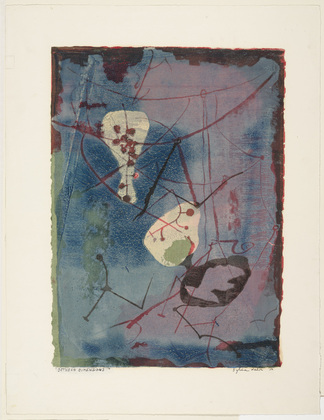
The image "Between Dimensions” accompanying today’s post by Sylvia Wald (1950).

12/20/2013 (12 Moons Solo Project Day 354)

12 Moons Solo Saxophone Project Day 354

Date: 12/20/2013

Instrument: Tenor saxophone

Location: Home studio in Clinton, WA (Whidbey Island)

Notes:

Today I worked with a liquid figure, a sweeping gesture that moved from the lower register to the upper with muted tones and multiphonics.  I used a recurring arpeggiated shape, played in the same order in ascending and descending fashion.  The shape itself used “false” fingerings and two multiphonics.  This arpeggio used the following 7 pitches (in ascending order and in the tenor key of Bb): D, F#, A#, D, F#, A# (quarter step flat), F (quarter step flat).  The 5th and 7th pitches also incorporated multiphonics, which I placed there specifically to interrupt the flow of the melody, as the larger multiphonic structure of the 5th pitch (F#) gives the impression that the arpeggio descends when moving to the 6th pitch, but then ascends again in the final multiphonic of the 7th pitch/multiphoinc F.  

Structurally, I approached this improvisation freely, and after having established the general tone and pace of the ascending arpeggio, I would change tempos or isolate specific areas of the arpeggio and cycle them continuously.  The fingerings used for this arpeggio are notated below in ascending order and in the tenor key of Bb.  The descending shape uses the same fingerings beginning with the 7th pitch and moving backwards to the 1st (reverse order).

Pitch 1: D (Left Hand) 1-2-3, Low Bb // (Right Hand) 1-2-3

Pitch 2: F# (Left Hand) 1-2-3, Low Bb // (Right Hand) 2-3

Pitch 3: A# (Left Hand) 1-3, Low Bb // (Right Hand) 2-3

Pitch 4: D (Left Hand) 1-2-3, Octave, Low Bb // (Right Hand) 1-2-3

Pitch 5: F#/Multiphonic Chord using F#, G, C, D# (Left Hand) 1-2-3, Octave, Low Bb // (Right Hand) 2-3

Pitch 6: A#(quarter step flat) (Left Hand) 1-3, Octave, Low Bb // (Right Hand) 2-3

Pitch 7: F (quarter step flat)/Multiphonic using D#, F#, F (quarter step flat) (Left Hand) 1-2-3, Octave, Low Bb // (Right Hand) 2-3, High F#

-Neil

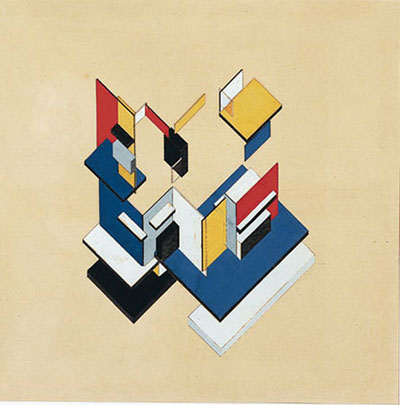
The image “Contra-Construction.  Project, 1923 Axonometric” accompanying today’s post by Theo van Doesburg and Cornelis van Eesteren (1923).