12/21/2013 (12 Moons Solo Project Day 355)

12 Moons Solo Saxophone Project Day 355

Date: 12/21/2013

Instrument: Tenor saxophone

Location: Home studio in Clinton, WA (Whidbey Island)

Notes:

At the end of my practice session this afternoon I decided to revisit a specific sound texture that I work with from time to time.  My Side C key has a small bit of lost motion in it.  This results in an incredibly short delay in the pressing of the key to finally its preferred immediate opening.  The lost motion is so slight that under normal circumstances it is almost unnoticeable.  However, a year or so ago I discovered that if I use the Low D fingering with the Low C# key open, and just slightly press the Side C key, a reverberation occurs that causes a few changes to occur, including a distinct buzzing sound and natural “warble” oscillations in the pitch.  This is really only possible if I use a loose sub-tone embouchure shape.  If I then press the Side C with still the smallest bit of additional pressure, a magical transformation can take place, where the low D adds a second D, but a full octave below.  

As in the human voice, with training a saxophonist or vocalist can push their range further up, but we are told there is an impassible low point at which a saxophone or vocalist can go no lower based on the limitations of their instrument, that is, without employing extended techniques that can break this “rule."  During this improvisation I used the Low D fingering while opening 1 of  three other bell keys, the C#, B, or Bb.  The first appearance of the sub-octave D is at :20, and it is then frequently used again throughout.  There was no singing into the horn whatsoever during this piece, but the moments of pitch oscillation and even a split-tone with a C# a major 7th above were all the result of slight differences in key pressure, embouchure, and air flow.

I used no tonging during this improvisation until a slight entrances at 2:45, and finally actual double-tonging at 3:55.  After the brief use of this technique, I then omitted tonging once again and instead focused on air flow and embouchure.  Beginning at 4:30 I started using an extremely loose sub-tone mouth shape with much more air.  This resulted in far grittier tones and much better pitch oscillation than with the use of my tongue.

-Neil

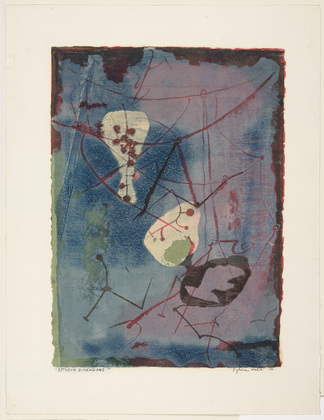
The image "Between Dimensions” accompanying today’s post by Sylvia Wald (1950).
12/20/2013 (12 Moons Solo Project Day 354)

12 Moons Solo Saxophone Project Day 354

Date: 12/20/2013

Instrument: Tenor saxophone

Location: Home studio in Clinton, WA (Whidbey Island)

Notes:

Today I worked with a liquid figure, a sweeping gesture that moved from the lower register to the upper with muted tones and multiphonics.  I used a recurring arpeggiated shape, played in the same order in ascending and descending fashion.  The shape itself used “false” fingerings and two multiphonics.  This arpeggio used the following 7 pitches (in ascending order and in the tenor key of Bb): D, F#, A#, D, F#, A# (quarter step flat), F (quarter step flat).  The 5th and 7th pitches also incorporated multiphonics, which I placed there specifically to interrupt the flow of the melody, as the larger multiphonic structure of the 5th pitch (F#) gives the impression that the arpeggio descends when moving to the 6th pitch, but then ascends again in the final multiphonic of the 7th pitch/multiphoinc F.  

Structurally, I approached this improvisation freely, and after having established the general tone and pace of the ascending arpeggio, I would change tempos or isolate specific areas of the arpeggio and cycle them continuously.  The fingerings used for this arpeggio are notated below in ascending order and in the tenor key of Bb.  The descending shape uses the same fingerings beginning with the 7th pitch and moving backwards to the 1st (reverse order).

Pitch 1: D (Left Hand) 1-2-3, Low Bb // (Right Hand) 1-2-3

Pitch 2: F# (Left Hand) 1-2-3, Low Bb // (Right Hand) 2-3

Pitch 3: A# (Left Hand) 1-3, Low Bb // (Right Hand) 2-3

Pitch 4: D (Left Hand) 1-2-3, Octave, Low Bb // (Right Hand) 1-2-3

Pitch 5: F#/Multiphonic Chord using F#, G, C, D# (Left Hand) 1-2-3, Octave, Low Bb // (Right Hand) 2-3

Pitch 6: A#(quarter step flat) (Left Hand) 1-3, Octave, Low Bb // (Right Hand) 2-3

Pitch 7: F (quarter step flat)/Multiphonic using D#, F#, F (quarter step flat) (Left Hand) 1-2-3, Octave, Low Bb // (Right Hand) 2-3, High F#

-Neil

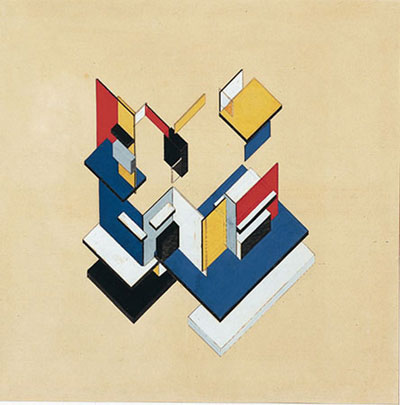
The image “Contra-Construction.  Project, 1923 Axonometric” accompanying today’s post by Theo van Doesburg and Cornelis van Eesteren (1923).

12/19/2013 (12 Moons Solo Project Day 353)

12 Moons Solo Saxophone Project Day 353

Date: 12/19/2013

Instrument: Tenor saxophone

Location: Home studio in Clinton, WA (Whidbey Island)

Notes:

During a brief practice session this morning I worked with extreme dynamic shifts with abrupt texture changes.  In what eventually became today’s improvisation, I isolated two lower register pitches and two upper register textures, and paired each of the lower tones with the same upper texture each time.  I used the powerful bell tone pitches B and Bb, and played each of them at a high volume with a wide vibrato and faster oscillation.  The upper textures were played with no vibrato and were held at an extremely low volume.  The Low B was paired with a split-tone Ab/Bb in the upper register, and the Low Bb was paired with a muted single Bb pitch in the upper register.   These fingerings were as follows:

Low Register B

Standard Low B fingering

Upper register texture: Ab/Bb split-tone

(Left Hand) 1-2, Octave, Low Bb // (Right Hand) 1-2-3, Low Eb

Low Register Bb

Standard Low Bb fingering

Upper register texture: Muted Bb

(Left Hand) 1-2, Octave, Low B // (Right Hand) 1-2-3, Low Eb

In performing this improvisation, I tried my best to execute the low register pitches with a common vibrato, constant vibrato oscillation, and common dynamic level.  I was moderately successful at this.  I tried to follow suit with the upper register tones as well, attempting to play each sound in turn with a constant dynamic level.  For the upper register Bb (paired with the Low Bb), I attempted to play this pitch as quietly as possible.  However the Ab/Bb split tone pitch (paired with the Low B), I played at a slightly higher volume.  Again, I was only moderately successful at maintaining consistency.  With the extreme dynamic and texture changes, I recognized an opportunity to use silence as a compositional component.  With this in mind I used abrupt cut-offs when moving between octaves and when finishing phrases.  This was done to heighten the potency of the silence when it was utilized.

-Neil

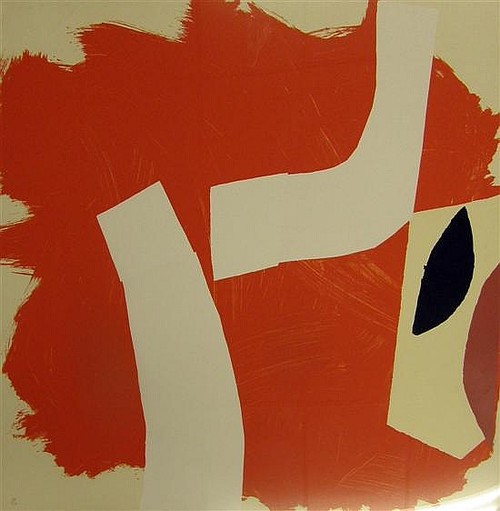
The image “Through and Beyond” accompanying today’s post by Sandra Blow.

12/18/2013 (12 Moons Solo Project Day 352)

12 Moons Solo Saxophone Project Day 352

Date: 12/18/2013

Instrument: Tenor saxophone

Location: Home studio in Clinton, WA (Whidbey Island)  

Notes:

My improvisation today is a textural exploration of a single fingering, with a constant trill in the mid register, the sound of which remains stable while the textures above it morph and evolve. This single fingering was as follows:

(Left Hand) 1, Octave, F palm key only (played with the pinky) // (Right Hand) 2.  Trill the side F# constantly.

I entered the improvisation with a blast of color and immediately established a high level of energy.  From this point forward I worked to create a wide array of textures that I found to be possible with this simple fingering.  My reed today was particularly stiff, which contributed to the range of possible sounds.  I incorporated a Concert C trill to function as a drone beneath the far denser material above it, which I feel provided a center point for the improvisation to pivot around.  A great challenge for me was to maintain clarity in this trill while establishing unity between these binary worlds.  This was particularly challenging when the upper textural material was less static and more of a sound exploration.  

-Neil

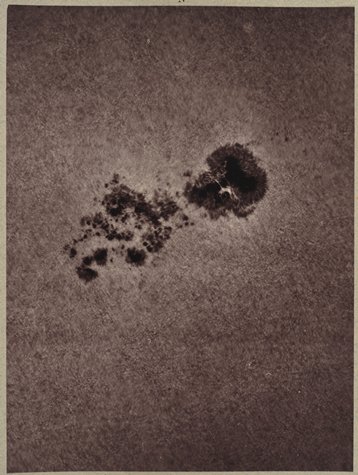
The image “Surface of the sun” accompanying today’s post by Pierre Jules Cesar Janssen (1885).

12/17/2013 (12 Moons Solo Project Day 351)

image

12 Moons Solo Saxophone Project Day 351

Date: 12/17/2013

Instrument: Tenor saxophone

Location: Main performance hall at Chief Sealth High School.  Seattle, WA 

Notes:

Today will likely be my last available day to record in the Chief Sealth performance hall during the 12 Moons project.  This improvisation has eluded me all year.  Each week I’ve been on the lookout for it–a quiet, melodic landscape with open harmonic language.  As I’ve described in past posts regarding this hall, the space is a difficult room for me to record in.  The room sounds absolutely magnificent, but my own deficiencies as a player often creep up when I walk into it.  It’s a large room with tall ceilings, only 5 or so years old.  The stage is enormous, and from the center of it the empty seats point inward with remarkable uniformity, their vivid, blood-red fabric has yet to fade with time.  An old ghost in me waited patiently for the right moment to record this improvisation, and I’m grateful it came today.  

I approached this piece freely, opening myself to the wonderful quietness and crystal-clear resonance of the room.  There were some melodic themes that crept up unexpectedly.  The opening figure for example seemed to want to recapitulate at the end of the improvisation within my really focusing on it whatsoever.  This was not intentional, but perhaps a testament to the simple melodies the room was offering me today.

-Neil

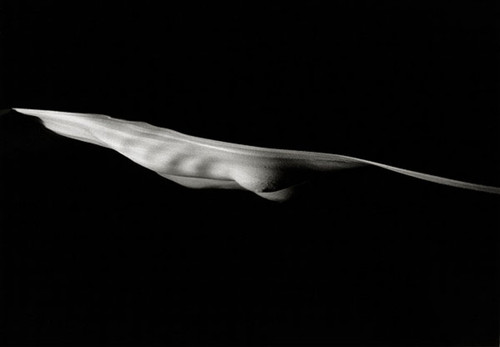
The image accompanying today’s post by Connie Imboden.