12/16/2013 (12 Moons Solo Project Day 350)

12 Moons Solo Saxophone Project Day 350

Date: 12/16/2013

Instrument: Tenor saxophone

Location: Home studio in Clinton, WA (Whidbey Island)

Notes:

This morning I worked with consonant, B Major chord textures while singing the fixed pitch B into the horn.  I used a series of 4 fingerings, each of which contained pitches found in the chord, or tonicized the chord through a dominant function.  These fingerings were as follows:

Fingering 1:

(Left Hand) 1-2-3, Octave, Low B // (Right Hand) 1-2-3, Low C

Fingering 2:

(Left Hand) 1-2-3, Octave, Low B // (Right Hand) 1-2-3, Side F, Low C

Fingering 3:

(Left Hand) 1-2-3, Octave, Low B // (Right Hand) 1-3, Low C

Fingering 4:

(Left Hand) 1-2-3, Octave, Low B // (Right Hand) 1-3, Side F Low C

I approached these fingerings freely during the improvisation, exploring their inner parts and trying to maintain a road map of my harmonic discoveries along the way.  There are subtler, more tender moments when voice exchange can clearly be herd between the fingerings.  At other times the my embouchure shape and the shear force of air briefly pulled tones from outside the established B Major tonality.  A good example of this is Fingering 2, which functioned as an F# dominant chord.  It enters for the first time at about half way into the piece, but because this was a pliable chord shape as far as the physical execution was concerned, it seemed to bend to its own will at times and pull away from this dominant function.

-Neil

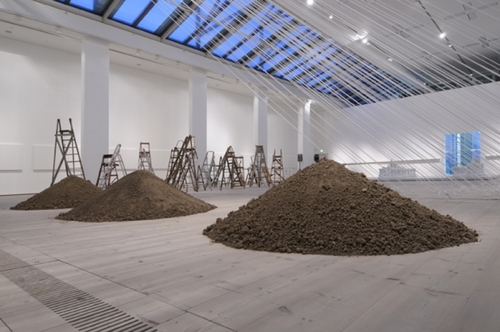
The image “Three Mounds and Skyladders” accompanying today’s post by Yoko Ono (1999-2008).
12/15/2013 (12 Moons Solo Project Day 349)

12 Moons Solo Saxophone Project Day 349

Date:12/15/2013

Instrument: Tenor saxophone

Location: Home studio in Clinton, WA (Whidbey Island)

Notes:

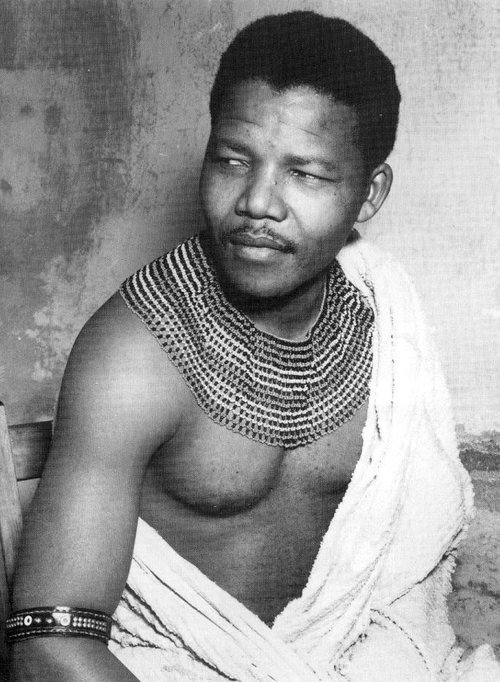
On December 5th, the world lost a powerful icon for freedom, activism, and humanity.  Nelson Mandela died at the age of 95 in Johannesburg, South Africa.  As with millions of people throughout the world, I’m saddened by his passing but so thankful for the living legacy his work has given us.  So many leaders of men are expected to be effective yet remain clean of controversial opinions and actions.  Madiba showed me that activism, diversity of political thought and a clear vision can effect change in so many lives.  My improvisation today was inspired by and dedicated to the memory of Nelson “Madiba” Mandela.

Today I did my sincere best to impart a loving, radiant atmosphere.  In this piece I worked with primarily the major pentatonic scale in D Major, creating a sound profile that I felt  had an almost dance-like quality to it.  I recorded many versions of this improvisation, most of considerably longer length than the piece chosen today.  I used the recording process to whittle down extemporaneous material, and arrived at a very simple, melodic piece.  I used traditional fingerings as well as a split-tone sound, and a multiphonic fingering.  The split-tone was approached with false fingerings to create a sound cycle with the pieces D, E and F#.  This is the texture that opens the improvisation.  I also used this same fingering to create the split tone chord E and C# that is held near the 1 minute mark.  The multiphonic fingering was a simple D major chord that I began incorporating at the mid point of the piece.   These two fingerings were as follows:

Sound Cycle (D, E and F#) and Split-tone chord (E and C#)

(Left Hand) 1-2-3, Octave, Palm Eb only, Low Bb // (Right Hand) 1-2.  To create the Sound Cycle, take away the F key, Palm Eb, each in turn, exploring a total of 3 pitches: D, E, and F#.

D Major Chord/Multiphonic

(Left Hand) 1-2-3, Low Bb, Octave // (Right Hand) 2-3, 

Rest in peace Madiba.

-Neil

The image accompanying today’s post is Nelson Mandela at the Rivonia Trial. 

12/14/2013 (12 Moons Solo Project Day 348)

12 Moons Solo Saxophone Project Day 348

Date: 12/14/2013

Instrument: Tenor saxophone

Location: Home studio in Clinton, WA (Whidbey Island)

Notes:

In this improvisation I wanted to evoke a quiet storm of activity that maintained a central theme from start to finish.  I tried to push my ego aside and explore brighter, less nuanced sound clusters towards the end of the piece, all the while keeping my mind bent on the central theme.  This theme was a simple, four-note gesture in the altissimo range that used the pitches F–Db–F–Eb– and began the piece.  This was done using a single fingering and careful manipulation of my embouchure and air flow.  It was fingered as follows:

(Left Hand) Fork F, C, Octave, Low Bb // (Right Hand) 1-2

This is also a multiphonic chord, and during the piece I worked to control the entrance of various part of this chord.  For example, the piece opens with the main theme, and I then began incorporating “resting points” where an F/F# cluster would oscillate before entering back into the theme.  At other points I also began incorporating an F in the mid register, and eventually took away the octave key to let this F dip down a whole step to become an Eb.   During this piece I also progressively added more percussive sounds such as key trilling, and tried to orchestrate a long-range build.  I thickened the textures from the quiet, controlled beginning of the piece to the more aggressive, bright-toned high point at the end.  In the last 30 seconds, I tried to quickly and progressively remove the additional orchestrations such as the key clacking and mid octave Eb to return very briefly back to the original theme.

-Neil

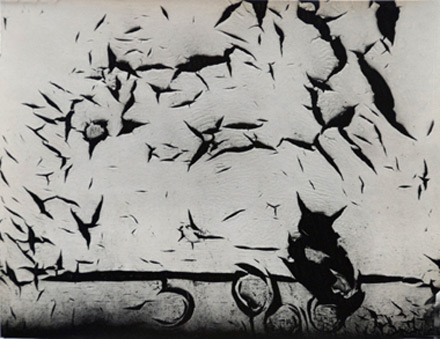
The image “Untitled (Cracking Painting)” accompanying today’s post by Minor White.

12/13/2013 (12 Moons Solo Project Day 347)

12 Moons Solo Saxophone Project Day 347

Date: 12/13/2013

Instrument: Tenor saxophone

Location: Home studio in Clinton, WA (Whidbey Island)

Notes:

In today’s improvisation I worked with pulsating, cyclical gestures that faded in and out dynamically, while flexing upward and downward in pitch.  I approached the piece with a number of varying fingerings, but each contained a similar sound profile.  I used these fingerings to add subtle differences to the harmonic progressions each time I swelled in and out of a cycle.  With my main focus on the flexing pitch centers, I felt these variations in harmony enhanced the flexing.  At times during this improvisation I also cut directly to the upper octave, or would gradually flex the pitch upwards to this new range, or downward back into the original range.

During this piece there was no set meter, but I tried to remain award of my phrasing and the pacing of the piece while gravitating towards centers of rhythmic motion.  I tried to let the landscape ebb and flow naturally.  The physical technique of the pitch flexing was extremely challenging and required a great deal of flexibility in my mouth shapes and in my air flow. At the same time, I needed to keep the front part of my lips very tight against the mouthpiece in order to be hold onto the cycles.  With even the slightest misapplication of pressure the sound cycles would abruptly stop and interrupt the mood. Because of this I practiced these sounds for about a half hour before beginning my recording process, just to be sure I could maintain this focus and flexibility in the improvisation from start to finish.

Though there are many slight differences in fingerings used during this piece, the core fingering action was as follows:

(Left Hand) 1-2-3, Low Bb // (Right Hand) 2-3, Low C. 

I tended to focus on cycling open and closed two keys at a time, each one in turn, back and forth between the two.  These pairs included: G key/Side C // B key, Side Bb // C key, Side C, among many others.  I also changed the “core” fingering from time to time, and allowed myself the flexibility to do this at will.  Some of the fingerings that come to mind are:

(Left Hand) 2-3, Low Bb // (Right Hand) 2-3, Low C.

(Left Hand) 2-3, Low Bb // (Right Hand) 1-2, Low C.

(Left Hand) 1-3, Low Bb // (Right Hand) 2-3, Low C.

(Left Hand) 1-3, Low Bb // (Right Hand) 1-2, Low C.

-Neil

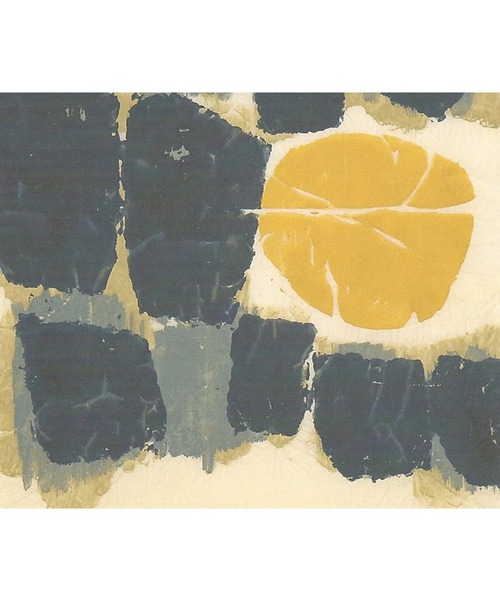
The image “Le P'tit Tore” accompanying today’s post by Raoul Ubac.

12/12/2013 (12 Moons Solo Project Day 346)

12 Moons Solo Saxophone Project Day 346

Date: 12/12/2013

Instrument: Tenor saxophone

Location: Home studio in Clinton, WA (Whidbey Island)

Notes:

My improvisation today is inspired by the solo techniques of drummer Chris Icasiano.  Chris is my longtime musical partner, and I’ve spent countless hours and many years now listening to his playing in rehearsals, shows, albums, and performances.  In the past couple of years Chris has started performing solo drum improvisations more and more, and I’ve really come to be particularly inspired by his solo brush techniques.  There are of course many, many ways Chris approaches improvisation, but today I decided to hone in a few of the selected techniques I hear him explore very often with brushes.  These include: 

1.  Sections of spacious, extended phrases followed by interruptions of much denser material.  

2.  The omission of elements of his instrument with later inclusion.  For example, in a 10 minute piece Chris will often play only on the snare drum for the first 3 minutes before allowing a second, much more jarring texture, such as a symbol, to enter.  Chris talks about this quite a bit with me as “orchestrating” the drums.

3.  Abrupt dynamic changes, such as rolling quietly on a symbol, followed by a much louder hit on a different symbol.  

4.  Extreme texture differences.  This could easily be lumped into the concept of “orchestration” from number 2 or “omission of elements” from number 3.  However, the extreme texture I specifically admire is his use of more traditional tools, such as the drums heads and symbols, followed by less traditional tools such as swiping at a symbol with the end of his stick, or clicking and clacking on the rims of the drum, all this while often incorporating his “traditional” techniques inside his broader phrasing.

5.  Long-form development of a broader theme.  Chris is very good at structuring a lengthy piece of music while maintaing his original idea sets.  

During this improvisation I tried my best to interpret an improvisation in Chris’ solo style.  I began with lengthier phrasing, followed by abrupt shifts into quicker, denser material.  I used my air along with very specific fingerings to try and sound like a set of brushes interacting with a snare drum.  I used two multiphonic fingerings, one with a wetter sound, akin to Chris rolling on the symbol with mallets, and another with a dryer sound, as when he strikes a symbol at medium volume with  mallets.  Using the themes of “omission” and “orchestration” I waited until the end of the improvisation to begin incorporating pointillist clicks and swipes.  

-Neil

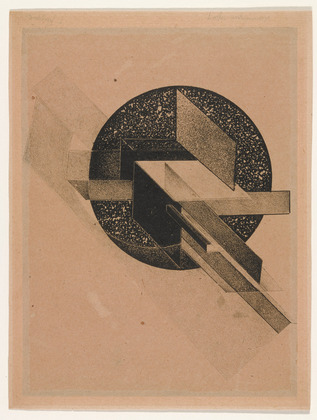
The image “Axionometric Construction” accompanying today’s post by Gustav Klutis (1921).