12/11/2013 (12 Moons Solo Project Day 345)

12 Moons Solo Saxophone Project Day 345

Date: 12/11/2013

Instrument: Tenor saxophone

Location: Home studio in Clinton, WA (Whidbey Island)

Notes:

In today’s improvisation I wanted to evoke the deep, searching mood I felt this morning.  This was not a sorrowful or melancholic mood, but more a sombre one.  I worked with gentle textures that never got above a medium dynamic level.  I used sound cluster fingerings that were very complimentary to one another, and around them I improvised a simple melodies that pushed and pulled against this landscape.  I approached this improvisation as patiently as possible and tried to place each chord, each melodic shape, in precisely the location I wanted it to be.  During this improvisation I used two primary fingerings to create a recurring pattern that the melodies were framed around.  These two fingerings were as follows:

Fingering 1.  Pitch: B

(Left Hand) 1-3, Octave, Low B // (Right Hand) 1-2-3, Low C

Fingering 2 (sound cluster).  Pitches: B and Bb (quarter step sharp).

(Left Hand) 1-3, Octave, Low B // (Right Hand) 1-2-3, Low C, Side Bb

The first fingering seems to in a way melt into the second, as the two share a common upper pitch, the sustained B.  The second fingering also has a number of other pitches possible that can be incorporated into the chord.  As the piece evolved I began adding a Bb in the upper register at times, creating a darker chord with the following pitches (in ascending order) Bb, B, Bb.  I derived the more melodic, single pitched material in part from this 3 note chord voicing.  These improvised melodies included the pitches (in ascending order) B, G#, Bb, and B.  

-Neil

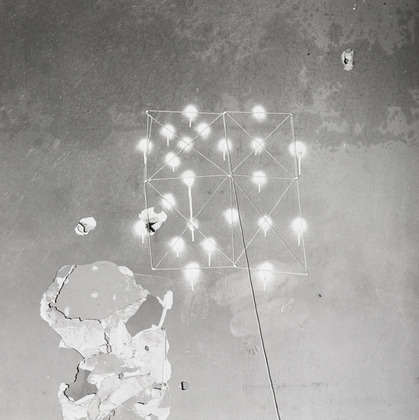
The image “Untitled” accompanying today’s post by John Divola (1974).
12/10/2013 (12 Moons Solo Project Day 344)

12 Moons Solo Saxophone Project Day 344

Date: 12/10/2013

Instrument: Tenor saxophone

Location: The orchestra room at Chief Sealth high school.

Notes:

The theme of sound resonance is on my mind today, both in sustain and projection.  During 15 minute breaks between students and classes, I periodically tested a variety of improvisational models, from extremely loud and aggressive texture pieces to more traditional tempered pitches.  I utilized many of the resonant tools at my disposal as part of this process, from concert chimes, to a full set of steel drums, and finally, a Steinway baby grand which was located in the corner of the room.  I ended up finding the most inspiration within the Steinway today, and worked with a mic placement that allowed for a good amount of sustain out of the strings.

During this improvisation I kept the sustain pedal down at all times, with my mic placement facing directly toward the strings.  The physical barrier of the piano lid was between my horn and this mic placement.  This resulted in more of a stuffy sound from the saxophone but much clearer resonance out of the strings.  I approached this piece freely, but gravitated towards false fingerings that brought out deeper oscillation out of the strings.  I favored the upper register, but began incorporating mid and lower register sound cycles as well at about the mid point of the improvisation.  I then immediately began incorporating more puckish pitch punctuations as well.  Overall, I tried to balance these techniques along with a wide range of dynamic shaping, and tried to remain very focused on the string resonance at all times.

-Neil

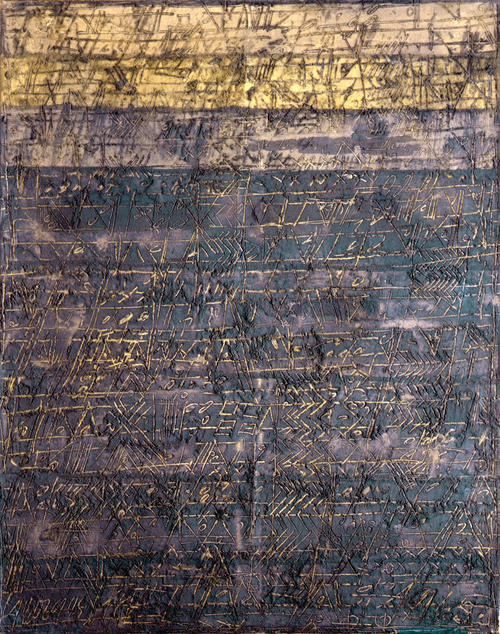
The image “Le Soir” accompanying today’s post by Georges Noel (1965).

12/09/2013 (12 Moons Solo Project Day 343)

12 Moons Solo Saxophone Project Day 343

Date: 12/09/2013

Instrument: Tenor saxophone

Location: Home studio in Clinton, WA (Whidbey Island)

Notes:

This is a piece exploring the mood of morning.  I tried to express the notes not as a series of pitches, but rather as a raga or incantation of a mood.  During this improvisation I used a singe fingering that incanted pitches ranging from the middle octave F (quarter step low) to the Altissimo Bb in the upper register.  Within these pitches were little clusters that would emerge independently while playing, and others which I could very carefully control.  

Several specific melodies were played during this piece which I pulled from the pitch series.  These melodies tended to focus on the following pitch shapes: G to Eb // C to Eb // C-Bb-G (quarter step low).  In total, the pitches I remained constantly aware of were as follows.  They are written below in ascending order of pitch:

F (quarter step high), G (quarter step low), C, Eb, G, Bb.  However, they were sometimes grouped in pairs or could also be independent.  For example, the F (quarter step high) and G (quarter step low) were very clearly linked together as a two-note cluster, as were the Eb and G in the upper register.  However the C in the upper register and Bb in the Altissimo register wanted to speak more independently.  The fingering used for these pitches was as follows:

(Left Hand) 1-2-3, Octave, Low Bb // (Right Hand) 2-3, Low C

-Neil

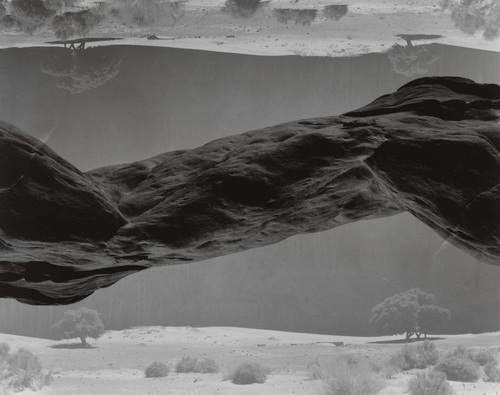
The image “Landscape, Monument Valley” accompanying today’s post by Jeffrey Silverthorne (1968).

12/08/2013 (12 Moons Solo Project Day 342)

12 Moons Solo Saxophone Project Day 342

Date: 12/08/2013

Instrument: Tenor saxophone

Location: Home studio in Clinton, WA (Whidbey Island)

Notes:

The weather has been bitterly cold the past week, with temperatures climbing barely above freezing during the daytime.  This is very challenging for my reed set-up.  Extreme temperatures effect a reed in a number of ways, but the overall issue lies in the unpredictability of how the reed will play from day to day or even hour to hour.  The reed I played on during a show last night was extremely stuffy and on the stiff side, but this morning the same reed is now extremely bright and light.  I decided to document the current condition of this reed in today’s improvisation.  I used the easy-blowing nature of it to record a quiet piece with recurring melodic themes, and intervalic melodies that featured the clarity of sound in this reed.

While beginning this improvisation, I was struck by a beautiful, open fifths chord made with the following fingering:

(Left Hand) 1-2-3, Octave, Low B // (Right Hand) 2, Low C

This chord used the pitches F# and C# in the upper register, creating a very stable, open-ended chord that I set recurring melodies against.  I moved between bluesy and less tonally defined figures, such as: B-A-F#(chord), B-A#-F#(chord), A-A-F#(chord), or A#-A-F#(chord).  The melodic interruptions around these figures/chord, were played freely, but I was careful not to divert attention for too long away from the primary themes.

-Neil

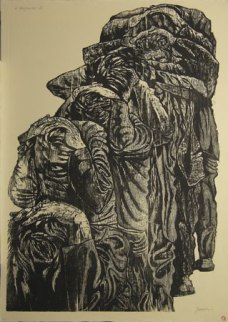
The image “The Disappeared” accompanying today’s post  by Antonio Frasconi (1981-88).

12/07/2013 (12 Moons Solo Project Day 341)

12 Moons Solo Saxophone Project Day 341

Date: 12/07/2013

Instrument: Tenor saxophone 

Location: Home studio in Clinton, WA (Whidbey Island)

Notes:

While practicing this morning I worked with two consonant chords, pairing the two into a variety of contexts spanning quiet, delicate sounds to more aggressive smears in the extreme upper register.  After working for some time without finding any one particular direction that really struck my ear, I began recording to try and stimulate the process.  I eventually settled on a more defined rhythmic pattern, and then worked to control the internal structure of the chords to create more a melodic landscape as well.  After a number of takes, today’s improvisation finally took shape in the form of a dance-like, folk melody.

The upward smears that take place periodically during the improvisation were one of many sound components I explored while in the early stages of sculpting the piece.  After the more defined 6/8 rhythmic pattern took shape, I decided to use these smears inside of the improvisation. My first attempts include more indeterminate executions of the smears, but I eventually came to love the gentle, recurring nature of the 6/8 melody, and instead decided to use the smears as a means to give the rhythm a moment of pause before storming back in.  The melodies had a number of pitches buried internaly within the chords, but I focused my mind of two simple melodic gestures to improvise around.  The first melodic gesture/fingering used the pitches F# and B, and in the second gesture/fingering, C# to A.  The two fingerings are notated as follows:

Fingering 1: F# and B

(Left Hand) 1-2-3, Octave, Low Bb // (Right Hand) 2-3, Low C.  High F# key pressed open, then closed.

Fingering 2: C# and A

(Left Hand) 1-2-3, Octave, Low Bb // (Right Hand) 2-3, Low C.  Palm Eb key pressed open, then closed.

The upward smears were made by using Fingering 2.

-Neil

The image accompanying today’s post by Robert F. Bukaty.