12/13/2013 (12 Moons Solo Project Day 347)

12 Moons Solo Saxophone Project Day 347

Date: 12/13/2013

Instrument: Tenor saxophone

Location: Home studio in Clinton, WA (Whidbey Island)

Notes:

In today’s improvisation I worked with pulsating, cyclical gestures that faded in and out dynamically, while flexing upward and downward in pitch.  I approached the piece with a number of varying fingerings, but each contained a similar sound profile.  I used these fingerings to add subtle differences to the harmonic progressions each time I swelled in and out of a cycle.  With my main focus on the flexing pitch centers, I felt these variations in harmony enhanced the flexing.  At times during this improvisation I also cut directly to the upper octave, or would gradually flex the pitch upwards to this new range, or downward back into the original range.

During this piece there was no set meter, but I tried to remain award of my phrasing and the pacing of the piece while gravitating towards centers of rhythmic motion.  I tried to let the landscape ebb and flow naturally.  The physical technique of the pitch flexing was extremely challenging and required a great deal of flexibility in my mouth shapes and in my air flow. At the same time, I needed to keep the front part of my lips very tight against the mouthpiece in order to be hold onto the cycles.  With even the slightest misapplication of pressure the sound cycles would abruptly stop and interrupt the mood. Because of this I practiced these sounds for about a half hour before beginning my recording process, just to be sure I could maintain this focus and flexibility in the improvisation from start to finish.

Though there are many slight differences in fingerings used during this piece, the core fingering action was as follows:

(Left Hand) 1-2-3, Low Bb // (Right Hand) 2-3, Low C. 

I tended to focus on cycling open and closed two keys at a time, each one in turn, back and forth between the two.  These pairs included: G key/Side C // B key, Side Bb // C key, Side C, among many others.  I also changed the “core” fingering from time to time, and allowed myself the flexibility to do this at will.  Some of the fingerings that come to mind are:

(Left Hand) 2-3, Low Bb // (Right Hand) 2-3, Low C.

(Left Hand) 2-3, Low Bb // (Right Hand) 1-2, Low C.

(Left Hand) 1-3, Low Bb // (Right Hand) 2-3, Low C.

(Left Hand) 1-3, Low Bb // (Right Hand) 1-2, Low C.

-Neil

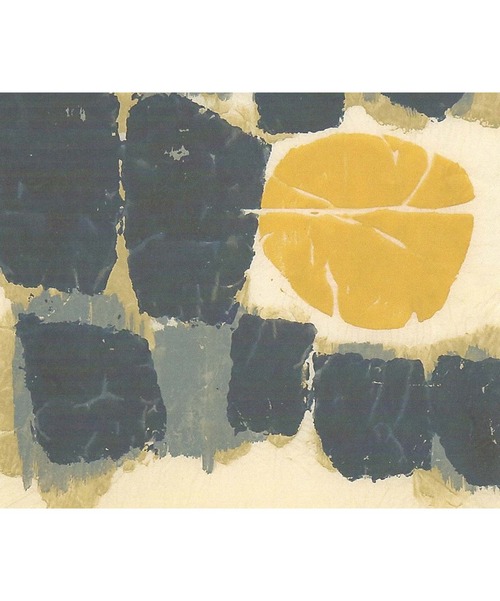
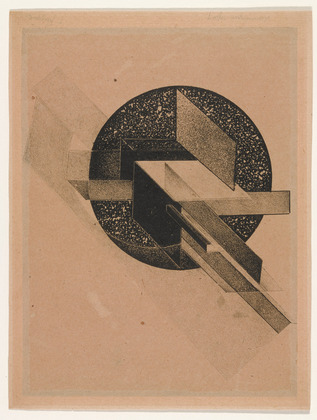
The image “Le P'tit Tore” accompanying today’s post by Raoul Ubac.
12/12/2013 (12 Moons Solo Project Day 346)

12 Moons Solo Saxophone Project Day 346

Date: 12/12/2013

Instrument: Tenor saxophone

Location: Home studio in Clinton, WA (Whidbey Island)

Notes:

My improvisation today is inspired by the solo techniques of drummer Chris Icasiano.  Chris is my longtime musical partner, and I’ve spent countless hours and many years now listening to his playing in rehearsals, shows, albums, and performances.  In the past couple of years Chris has started performing solo drum improvisations more and more, and I’ve really come to be particularly inspired by his solo brush techniques.  There are of course many, many ways Chris approaches improvisation, but today I decided to hone in a few of the selected techniques I hear him explore very often with brushes.  These include: 

1.  Sections of spacious, extended phrases followed by interruptions of much denser material.  

2.  The omission of elements of his instrument with later inclusion.  For example, in a 10 minute piece Chris will often play only on the snare drum for the first 3 minutes before allowing a second, much more jarring texture, such as a symbol, to enter.  Chris talks about this quite a bit with me as “orchestrating” the drums.

3.  Abrupt dynamic changes, such as rolling quietly on a symbol, followed by a much louder hit on a different symbol.  

4.  Extreme texture differences.  This could easily be lumped into the concept of “orchestration” from number 2 or “omission of elements” from number 3.  However, the extreme texture I specifically admire is his use of more traditional tools, such as the drums heads and symbols, followed by less traditional tools such as swiping at a symbol with the end of his stick, or clicking and clacking on the rims of the drum, all this while often incorporating his “traditional” techniques inside his broader phrasing.

5.  Long-form development of a broader theme.  Chris is very good at structuring a lengthy piece of music while maintaing his original idea sets.  

During this improvisation I tried my best to interpret an improvisation in Chris’ solo style.  I began with lengthier phrasing, followed by abrupt shifts into quicker, denser material.  I used my air along with very specific fingerings to try and sound like a set of brushes interacting with a snare drum.  I used two multiphonic fingerings, one with a wetter sound, akin to Chris rolling on the symbol with mallets, and another with a dryer sound, as when he strikes a symbol at medium volume with  mallets.  Using the themes of “omission” and “orchestration” I waited until the end of the improvisation to begin incorporating pointillist clicks and swipes.  

-Neil

The image “Axionometric Construction” accompanying today’s post by Gustav Klutis (1921).

12/11/2013 (12 Moons Solo Project Day 345)

12 Moons Solo Saxophone Project Day 345

Date: 12/11/2013

Instrument: Tenor saxophone

Location: Home studio in Clinton, WA (Whidbey Island)

Notes:

In today’s improvisation I wanted to evoke the deep, searching mood I felt this morning.  This was not a sorrowful or melancholic mood, but more a sombre one.  I worked with gentle textures that never got above a medium dynamic level.  I used sound cluster fingerings that were very complimentary to one another, and around them I improvised a simple melodies that pushed and pulled against this landscape.  I approached this improvisation as patiently as possible and tried to place each chord, each melodic shape, in precisely the location I wanted it to be.  During this improvisation I used two primary fingerings to create a recurring pattern that the melodies were framed around.  These two fingerings were as follows:

Fingering 1.  Pitch: B

(Left Hand) 1-3, Octave, Low B // (Right Hand) 1-2-3, Low C

Fingering 2 (sound cluster).  Pitches: B and Bb (quarter step sharp).

(Left Hand) 1-3, Octave, Low B // (Right Hand) 1-2-3, Low C, Side Bb

The first fingering seems to in a way melt into the second, as the two share a common upper pitch, the sustained B.  The second fingering also has a number of other pitches possible that can be incorporated into the chord.  As the piece evolved I began adding a Bb in the upper register at times, creating a darker chord with the following pitches (in ascending order) Bb, B, Bb.  I derived the more melodic, single pitched material in part from this 3 note chord voicing.  These improvised melodies included the pitches (in ascending order) B, G#, Bb, and B.  

-Neil

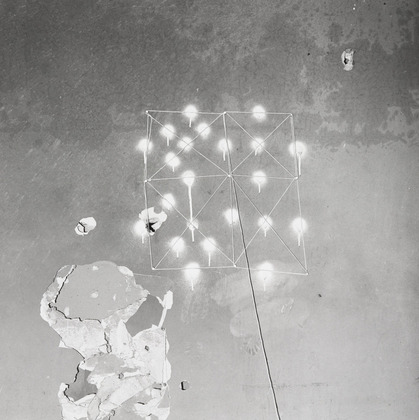
The image “Untitled” accompanying today’s post by John Divola (1974).

12/10/2013 (12 Moons Solo Project Day 344)

12 Moons Solo Saxophone Project Day 344

Date: 12/10/2013

Instrument: Tenor saxophone

Location: The orchestra room at Chief Sealth high school.

Notes:

The theme of sound resonance is on my mind today, both in sustain and projection.  During 15 minute breaks between students and classes, I periodically tested a variety of improvisational models, from extremely loud and aggressive texture pieces to more traditional tempered pitches.  I utilized many of the resonant tools at my disposal as part of this process, from concert chimes, to a full set of steel drums, and finally, a Steinway baby grand which was located in the corner of the room.  I ended up finding the most inspiration within the Steinway today, and worked with a mic placement that allowed for a good amount of sustain out of the strings.

During this improvisation I kept the sustain pedal down at all times, with my mic placement facing directly toward the strings.  The physical barrier of the piano lid was between my horn and this mic placement.  This resulted in more of a stuffy sound from the saxophone but much clearer resonance out of the strings.  I approached this piece freely, but gravitated towards false fingerings that brought out deeper oscillation out of the strings.  I favored the upper register, but began incorporating mid and lower register sound cycles as well at about the mid point of the improvisation.  I then immediately began incorporating more puckish pitch punctuations as well.  Overall, I tried to balance these techniques along with a wide range of dynamic shaping, and tried to remain very focused on the string resonance at all times.

-Neil

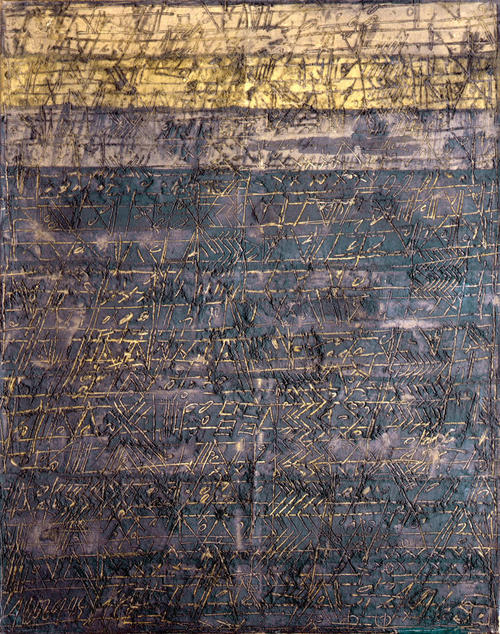
The image “Le Soir” accompanying today’s post by Georges Noel (1965).

12/09/2013 (12 Moons Solo Project Day 343)

12 Moons Solo Saxophone Project Day 343

Date: 12/09/2013

Instrument: Tenor saxophone

Location: Home studio in Clinton, WA (Whidbey Island)

Notes:

This is a piece exploring the mood of morning.  I tried to express the notes not as a series of pitches, but rather as a raga or incantation of a mood.  During this improvisation I used a singe fingering that incanted pitches ranging from the middle octave F (quarter step low) to the Altissimo Bb in the upper register.  Within these pitches were little clusters that would emerge independently while playing, and others which I could very carefully control.  

Several specific melodies were played during this piece which I pulled from the pitch series.  These melodies tended to focus on the following pitch shapes: G to Eb // C to Eb // C-Bb-G (quarter step low).  In total, the pitches I remained constantly aware of were as follows.  They are written below in ascending order of pitch:

F (quarter step high), G (quarter step low), C, Eb, G, Bb.  However, they were sometimes grouped in pairs or could also be independent.  For example, the F (quarter step high) and G (quarter step low) were very clearly linked together as a two-note cluster, as were the Eb and G in the upper register.  However the C in the upper register and Bb in the Altissimo register wanted to speak more independently.  The fingering used for these pitches was as follows:

(Left Hand) 1-2-3, Octave, Low Bb // (Right Hand) 2-3, Low C

-Neil

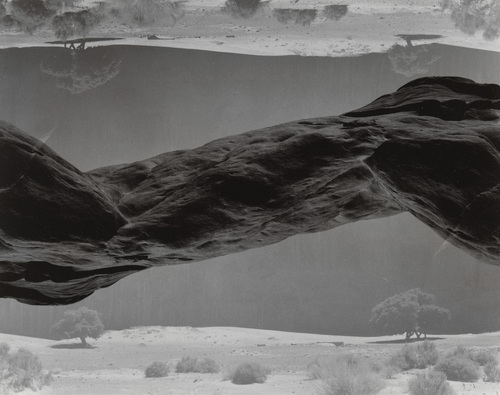
The image “Landscape, Monument Valley” accompanying today’s post by Jeffrey Silverthorne (1968).