12/08/2013 (12 Moons Solo Project Day 342)

12 Moons Solo Saxophone Project Day 342

Date: 12/08/2013

Instrument: Tenor saxophone

Location: Home studio in Clinton, WA (Whidbey Island)

Notes:

The weather has been bitterly cold the past week, with temperatures climbing barely above freezing during the daytime.  This is very challenging for my reed set-up.  Extreme temperatures effect a reed in a number of ways, but the overall issue lies in the unpredictability of how the reed will play from day to day or even hour to hour.  The reed I played on during a show last night was extremely stuffy and on the stiff side, but this morning the same reed is now extremely bright and light.  I decided to document the current condition of this reed in today’s improvisation.  I used the easy-blowing nature of it to record a quiet piece with recurring melodic themes, and intervalic melodies that featured the clarity of sound in this reed.

While beginning this improvisation, I was struck by a beautiful, open fifths chord made with the following fingering:

(Left Hand) 1-2-3, Octave, Low B // (Right Hand) 2, Low C

This chord used the pitches F# and C# in the upper register, creating a very stable, open-ended chord that I set recurring melodies against.  I moved between bluesy and less tonally defined figures, such as: B-A-F#(chord), B-A#-F#(chord), A-A-F#(chord), or A#-A-F#(chord).  The melodic interruptions around these figures/chord, were played freely, but I was careful not to divert attention for too long away from the primary themes.

-Neil

The image “The Disappeared” accompanying today’s post  by Antonio Frasconi (1981-88).
12/07/2013 (12 Moons Solo Project Day 341)

12 Moons Solo Saxophone Project Day 341

Date: 12/07/2013

Instrument: Tenor saxophone 

Location: Home studio in Clinton, WA (Whidbey Island)

Notes:

While practicing this morning I worked with two consonant chords, pairing the two into a variety of contexts spanning quiet, delicate sounds to more aggressive smears in the extreme upper register.  After working for some time without finding any one particular direction that really struck my ear, I began recording to try and stimulate the process.  I eventually settled on a more defined rhythmic pattern, and then worked to control the internal structure of the chords to create more a melodic landscape as well.  After a number of takes, today’s improvisation finally took shape in the form of a dance-like, folk melody.

The upward smears that take place periodically during the improvisation were one of many sound components I explored while in the early stages of sculpting the piece.  After the more defined 6/8 rhythmic pattern took shape, I decided to use these smears inside of the improvisation. My first attempts include more indeterminate executions of the smears, but I eventually came to love the gentle, recurring nature of the 6/8 melody, and instead decided to use the smears as a means to give the rhythm a moment of pause before storming back in.  The melodies had a number of pitches buried internaly within the chords, but I focused my mind of two simple melodic gestures to improvise around.  The first melodic gesture/fingering used the pitches F# and B, and in the second gesture/fingering, C# to A.  The two fingerings are notated as follows:

Fingering 1: F# and B

(Left Hand) 1-2-3, Octave, Low Bb // (Right Hand) 2-3, Low C.  High F# key pressed open, then closed.

Fingering 2: C# and A

(Left Hand) 1-2-3, Octave, Low Bb // (Right Hand) 2-3, Low C.  Palm Eb key pressed open, then closed.

The upward smears were made by using Fingering 2.

-Neil

The image accompanying today’s post by Robert F. Bukaty.

12/06/2013 (12 Moons Solo Project Day 340)

12 Moons Solo Saxophone Project Day 340

Date: 12/06/2013

Instrument: Tenor saxophone

Location: Home studio in Clinton, WA (Whidbey Island)

Notes:

This morning I spent my practice session preparing, of all things, for a presentation of selections from the 12 Moons project thus far.  By last night I was physically exhausted after several day of heavy practicing, and many hours of the day spent on the horn while teaching.  It was extremely taxing to blow just about anything into the horn, but his morning I picked it up feeling renewed and physically strong.  I was immediately drawn to the textures used in today’s improvisation right as the horn entered my hands for the day.  

In this piece I worked with the shaping of clean, crisp articulations with a constant repetition of figures, as well as more gritty shapes incorporated within the continuous lines.  I wanted to maintain a dogged persistence of the Concert E throughout, and I used this as my primary focal point during the piece.  About 2/3 into the improvisation, I began slowing down the figures while maintaining the puckish, pointillist approach.  I maintained a static dynamic level throughout the piece, with the more spacious dots following suit with this approach.  The Concert E was rooted within two fingerings, which are notated below:

(Left Hand) 1-2-3, Octave, Low Bb // (Right Hand) 2-3, Low C.  During rapid articulation, take away the Low C in the right hand to created a second fingering that pulls out more hollow-sounding pitches of a similar sound profile.

-Neil

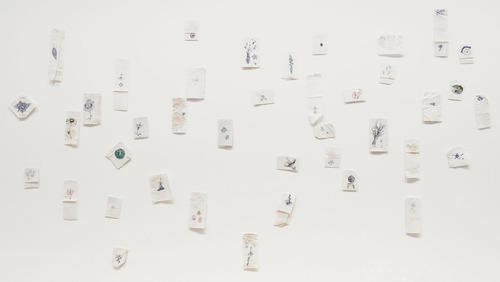
The image “A diary of flowers” accompanying today’s post by Jim Hodges (1993).

12/05/2013 (12 Moons Solo Project Day 339)

12 Moons Solo Saxophone Project Day 339

Date: 12/05/2013

Instrument: Tenor saxophone

Location: Home studio in Clinton, WA (Whidbey Island)

Notes:

This morning I reached for new and less trodden textures during my practice session.  This did not however manifest itself in an inspired idea for recording today until the end of my practice session, when I re-visited an older technique of fingering a pitch while singing with my voice into the horn.  In the past, while using this technique in recording I have stuck primarily to singing a fixed pitch while alternating fingerings around it.  Today I decided to use more fixed fingerings, and allow myself the flexibility to sing a wider range, all the while returning very frequently to established pitch centers.  

While recording this piece today I was amazed at the variety of overtones that the combination of my voice and the horn could cull up.  Around the 2:00 minute mark, and incredible array of pitches in block chords moved up and down the horn along with my voice.  These moments of rich harmonic spectrums offset the otherwise constant motion of the single pitches.  During this improvisation I tried to use as many mouth shapes and syllabic sounds as possible, but I limited my tongue articulations to only single tonging.  Interestingly, while tonging the end result created the phonetic sound “do do do” extremely often whether I was using this sound shape or not.  Other techniques included vibrato made with the back of my mouth and the upward–downward motion of the back side of my tongue.  

I primarily used the traditional Low Bb fingering during this piece, but would also occasionally lift my second finger the right hand (E key), or add the octave key in the left hand.

-Neil

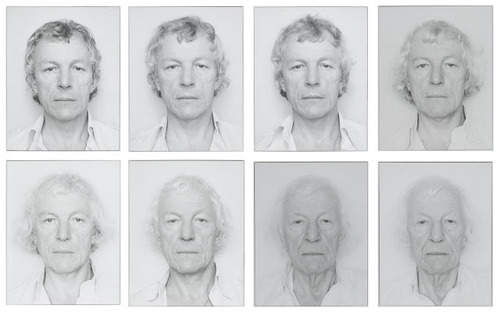
The image accompanying today’s post by Roman Opalka.

12/04/2013 (12 Moons Solo Project Day 338)

12 Moons Solo Saxophone Project Day 338

Date: 12/04/2013

Instrument: Tenor saxophone

Location: Home studio in Clinton, WA (Whidbey Island)

Notes:

During my practice session this morning I worked with tiny texture fragments, weaving them into brief compositions.  I was particularly struck by the solum beauty of two chords I paired together, and I then worked to find a fingering system that would allow for more complex voice leading to compliment them.  The end result became the introductory figured played in today’s improvisation.  In keeping with my practice theme today, I used this simple figure as the platform to sculpt a small improvisation around.  This is the shortest piece yet during the project.

After improvising for some time and intuitively developing a piece, I transcribed the finished product into a fully notated composition, be it a small one, complete with multiphonic fingerings, pitch notations, and phrasing and dynamic markings.  The two primary chords that opened the piece were interpreted twice, written below as Fingering System 1.   I then moved into a brief “Intermediary Chord”, written as such below.  To begin Fingering System 2, I removed the octave key, dropping the chords into the lower register and altering the internal pitch content of the chords.  I then moved back to the “Intermediary Chord,” and finally into a series of dissonant chords labeled as Fingering System 3, which concluded the piece.  These are written below:

-Fingering System 1.  

Fingering a.) Pitches: D (quarter step sharp) and D (quarter step flat)

(Left Hand) 1-2-3, Octave, Palm D, Low Bb // (Right Hand) 1-2, Low C

Fingering b.)  Pitches: F (quarter step sharp) and C (quarter step flat)

(Left Hand) 1-2-3, Octave, Low Bb // (Right Hand) 1-2, Low C

-Intermediary Chord.  Pitches: F (quarter step flat) and D (quarter step sharp)

(Left Hand) 1-2, Octave, Low B, Palm Eb only // (Right Hand) 1, Low C

-Fingering System 2.

Fingering a.) Pitches: C (quarter step sharp) and D

(Left Hand) 1-2-3, Octave, Palm D, Low Bb // (Right Hand) 1-2, Low C

Fingering b.) Pitches: E and F#

(Left Hand) 1-2-3, Octave, Low Bb // (Right Hand) 1-2, Low C

-Fingering System 3.

Fingering a.) Pitches: G (quarter step flat) and F#

(Left Hand) 1-2, Octave, Low B, Palm Eb only // (Right Hand) 2, Low C, High F#

Fingering b.) Pitches: G (quarter step flat) and G (quarter step flat).  

(Left Hand 1-2, Octave, Low B, Palm Eb only // (Right Hand) 1, Low C, High F#

The terms “Fingering Systems 1-3 and "Intermediary Chord” are purely for descriptive purposes only, and were notated in actual manuscript notation on my page at home.

-Neil

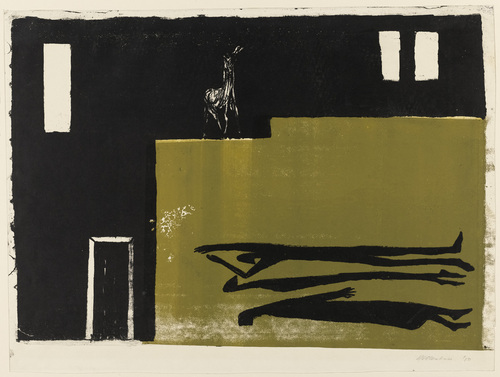
The image “The Executed” accompanying today’s post by Valdemar H. Elenbaas (1950).