12/03/2013 (12 Moons Solo Project Day 337)

12 Moons Solo Saxophone Project Day 337

Date: 12/03/2013

Instrument: Tenor saxophone (and with harmon mute, concert chimes)

Location: The orchestra room at Chief Sealth High School.  Seattle, WA

Notes:

With the project now in its final weeks, I’ve thought quite a bit about the tools at my disposal I have yet to take advantage of.  In the orchestra room at Chief Sealth a set of concert chimes was precariously set up in the center of the room, and this provided as good a time as any to get to work.  I decided to explore resonating tones inside of the pipes, and eventually became curious to see how that instrument would respond to the additional use of a harmon mute in my bell.  I’ve used the harmon two other times during the project, but I had yet to incorporate the saxophone/mute combination along with another instrument.  

During this piece I primarily used the standard Low Bb fingering, which responds extraordinarily well with the harmon mute, and also seemed resonate more freely inside the chime pipes.  I explored upper register overtones, thick and thin clusters and extreme dynamics during this Improvisation.  The harmon vibrated in the bell of my horn during many of the tighter clusters, causing an almost snare-drum like texture which I explored in two previous saxophone/harmon pieces.  I placed my microphone mid way up the pipes, setting it up on a piece of wood in the center of the two pipe rows.  I kneeled down on the floor and blew into the base of the pipes while being careful not to dump the harmon mute onto the ground.

-Neil

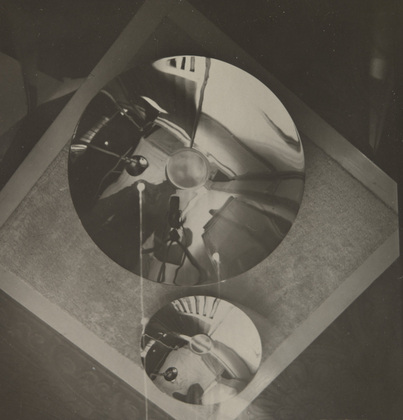
The image “Untitled” accompanying today’s post by Gyula Pap (1928).
12/02/2013 (12 Moons Solo Project Day 336)

12 Moons Solo Saxophone Project Day 336

Date: 12/02/2013

Instrument: Tenor saxophone

Location: Home studio in Clinton, WA (Whidbey Island)

Notes:

For the past several days I’ve felt an immense joyousness in me, and I believe that much of this is due to an experience I had two nights ago.  I woke up every few hours feeling remarkably well rested.  At 2am, 4am, 6am I would wake up and feel ready to begin the day.  Sometime in the 2 o'clock hour I sat up, got out of bed, walked into my practice room and wrote down the following phrase:

“Love is the practice of patience, and the product of empathy." 

The next morning I remembered feeling compelled by something in that moment, and I remember being in a half awake, half sleeping state while writing it.  This phrase has stayed with me constantly the past two days.  I am a happy, fulfilled person, but I am not intrinsically a joyous person.  I have to fight to have a light heart, and the fact that this naturally emerged from me is a fascinating thing, and today I wanted to explore this in my improvisation.

In this piece I tried to capture the transient nature of joyousness in me.  I created a loose, dreamlike atmosphere with melodies darting in and out of a harmonic palette.  By adjusting my embouchure mid-phrase I was able to shift the harmony while still executing the same fingering cycle.  These fingerings resonated parallel Major and Dominant chords.  Dominant is a transient, transitional chord, where the Major is solidly joyful.  The challenge for me was to sculpt a piece that used both "life states” simultaneously, and to allow the individualism of both states influence the improvisation in equal measure.  

The fingering motions would be impossible to fully notate below, but suffice it to say that that there were 3 primary fingering ares I used during this piece.  They employed key flicking, as well as embouchure motions to fully realize the sounds.  They could vaguely be written as follows:

-B Major/B Dominant Chord (Descending shapes).  This shape opens the piece:

Flick high F# key, and move immediately into: (Left Hand) Palm Eb, Palm D, 1-2, Octave, Low Bb // (Right Hand) 1-2-3, Low C.  Then move into: (Left Hand) 1-2, Octave, Low Bb // (Right Hand) 1-2-3, Low C.

-B Major/B Dominant Chord (Ascending shapes).  This shape was played faster, and enters at :22

Same as above, but begin by flicking High F key instead of the high F#.

-B Dominant sue chord.  This shape enters at 1:43.  It is distinct in that it has a much simpler sound profile.

(Left Hand) 1-2, Low Bb // (Right Hand) 1-2-3, Low C.  Then move into: (Left Hand) Palm D, 1-2, Octave, Low Bb // (Right Hand) 1-2-3, Low C.

-Neil

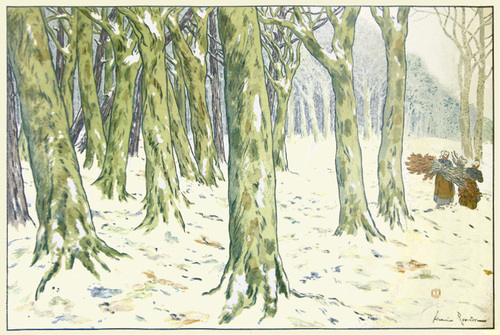
The image “The Woods, In Winter”–plate 9 from the suite, “Aspects of Nature” accompanying today’s post by Henri Riviere (1898).

12/01/2013 (12 Moons Solo Project Day 335)

12 Moons Solo Saxophone Project Day 335

Date: 12/01/2013

Instrument: Tenor saxophone

Location: Home studio in Clinton, WA (Whidbey Island)

Notes:

This afternoon I practiced out of the book “Repository of Scales and Melodic Patterns” by the great saxophonist Yusef Lateef.  As is often the case, I chose one specific page and made it the focus of my practice session.  This particular exercise used the B diminished scale in various melodic and rhythmic permutations, including notes groupings of 4, 5, 6, 7, 8 and 10 tuplets.  The challenge for me was to execute these passages with solid articulation, phrasing, and time.  I specifically struggled moving in even time between sixteenth note groupings of 5 and 7.  In trying to shift between these odd phrases, I decided to re-visit a compositional model I have explored I believe a total of 3 times now during the 12 Moons project.  I tackled a partially improvised, partially composed model based off of 10 melodic sets that were combined at-will.

Previous versions of this model included the following: composed material played strictly fast, little dynamic shifting, flexibility to choose melodies at will, wide intervals at all times, and disjunct rhythms.  I stayed true to some of these ideas but stretched the boundaries of others.  During this piece the melodic material was very intervalic overall, but I did include more diatonic langue here.  I also used more dynamic shaping from loud to soft, specifically within the same melodic gestures.  Unlink my previous models, I made the 10 figures flexible in their tempo throughout the piece.  Finally, I also used silence.  The use of silence became a particularly important, spur of the moment improvisational shape.  Near the mid point of the piece I would sporadically interject a half second or so pause between some figures.  I then decided to dive head first into longer bouts of silence, and maintained the flexibility to include this at will until the piece’s conclusion.

-Neil

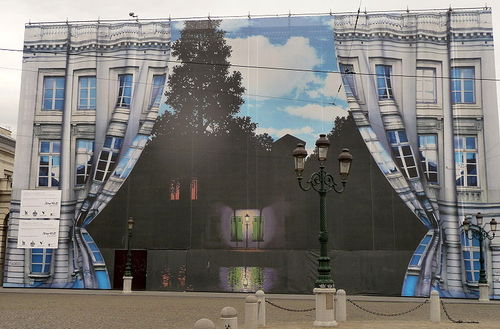
The image accompanying today’s post by Warburg, depicting the Magritte Museum at the Royal Museum of Fine Arts in Belgium, Brussels. 

11/30/2013 (12 Moons Solo Project Day 334)

12 Moons Solo Saxophone Project Day 334

Date: 11/30/2013

Instrument: Tenor saxophone

Location: Home studio in Clinton, WA (Whidbey Island)

Notes:

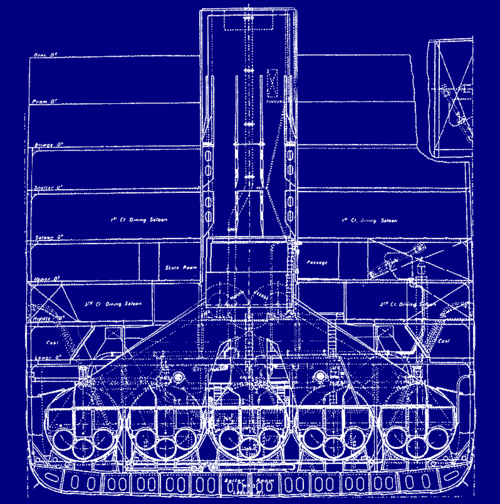
While at a used bookshop this morning a book cover caught my eye that immediately brought me back to my childhood.  It was a children’s book called “The Big Book of Cross-Sections,” and it had an image of the Titanic sliced up into five pieces, exposing all the compartments inside.  I don’t have any recollection of having actually owed this book, but I remembered looking through it at a book store when I was a kid.  I remembered being fascinated by the idea that tiny worlds could exist inside a much larger “body."  This fascination never really went away, and music has always helped me give voice to this mystical concept.  Today’s improvisation was directly inspired by this nostalgic memory.

When I finally began my practice session later in the day, I sat down with the aim of finding a quiet sound world that I hadn’t noticed before.  After an hour or so I stumbled into an area that I remember discovering several years ago.  When moving chromatically from the mid register G (with octave key) upwards to the high register F (still with the octave key), if I blow with a good amount of back-pressure and nearly no pressure against the reed, a second series of chromatic pitches emerges below.  These pitches begin exactly a Major 6th below, and start slowly creeping downwards in their ratio of distance from the upper pitch, until the final interval, the fingered High F, has a tone a Major 7th below (F#).  These lower tones are extremely muted and very difficult both to hear and to maintain.  

After re-familiarizing myself with this second layer of chromatic pitches, I dug even further, and found buried within two of the fingerings a third layer.  From the fingered middle octave G to A (again with the octave key), the lower tones C to D spring out.  However, there is an octave key exchange from the main octave key to the lower octave key when moving between these two standard fingerings.  I explored moving from the A to the G fingering very, very slowly, and was able to identify 4 distinctly different tones below.  In order of execution, they were: C, C#, Bb, A.  The C# occurs only at a slight moment where both octave keys are barely raised above their key cups.  After working with these 4 pitches for some time, I recorded an improvisation that explored them melodically.  Like the Titanic book from my childhood, I wanted this tiny world to be fully developed, despite originating from a body of traditional fingerings that begged to speak at all times.  At the mid point of the improvisation, I began incorporating these "body” pitches–the A and G above the 4 melodic tones below, creating harmony above the melody.  

This was by far my quietest recording yet during the 12 Moons project, and possibly the quietest recording I have done at all.  Sticking with the spirit of the project, I did not manipulate the sound in any way besides increasing the volume for listening purposes.  I tried to breath as quietly as possible during this piece and to move my fingers very fluidly to as not to distract from the music.  A sense of just how quiet the actually music really is can be heard in its ratio of volume as compared to the volume of my breathing, and the occasional spongy sound of the key closing against the body of the horn.

-Neil 

The image accompanying today’s post is a cross-section blueprint of the hull of the Titanic.

11/29/2013 (12 Moons Solo Project Day 333)

12 Moons Solo Saxophone Project Day 333

Date: 11/29/2013

Instrument: Tenor saxophone

Location: Home studio in Clinton, WA (Whidbey Island)

Notes:

Before heading out for a long rehearsal, I sat down to practice for a bit this morning and was inspired to work on singing into the horn.  In what eventually became today’s 12 Moons improvisation, I wanted to explore singing static pitches inside a static multiphonic chord, while opening and closing the octave key.  With the particular multiphonic I chose the lower octave key was used as a necessary element of the fingering.  I found while singing almost any pitch in any register, some slight pulsation in the otherwise static chords came to be.  This single fingering was as follows:

(Left Hand) Fork F, 2-3, Octave, Low Bb // (Right Hand) 1-2-3, Low C.  This is a very common multiphonic fingering with the following pitches (in the tenor key of Bb): Eb, Ab, Gb

I did not have a pre-determined shape for the improvisation in mind or any pitch material to be sung.  My singing tended to ascend in pitch, though there were a few moments where I moved up and down in a more irregular shape–breaking this overall trend.  

-Neil

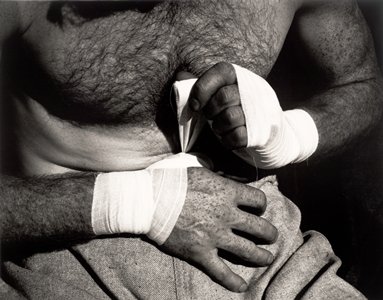
The image accompanying today’s post by Willard Van Dyke (1933).