11/28/2013 (12 Moons Solo Project Day 332)

12 Moons Solo Saxophone Project Day 332

Date: 11/28/2013

Instrument: Tenor saxophone

Location: Home studio in Clinton, WA (Whidbey Island)

Notes:

On Thursday mornings I’m generally scrambling to get work done early before beginning my long teaching day.  But today is Thanksgiving, and I woke early to do my own work in my own time.  On this day of family, friends and relaxation, it felt wonderful to rise first thing in the morning and play music, a wonderful ability I am so grateful to have.  My improvisation today reflected this calm, quiet gratitude on this day of Thanksgiving.

While practicing, I decided to work with extremely simple, two-note chord voicings.  I gravitated towards two chords, the first of which was a Major 6th interval, and the second a split octave.  Though they were incredibly simple in their structure, I decided to embrace their quiet beauty and sculpt an improvisation around them.  These are notated below are Chords 1 and 2.  I wanted these two chords to make up the bulk of the material in the improvisation, so I made constant reference to them, at first playing each in pure and un-ornamented style, while later on adding more rhythmic variety between them as well as occasional leading tones.  

To further magnify the stark simplicity of these two chords, I used two additional chord shapes, labeled below are Chords 3 and 4 which worked to offset the established harmonic landscape.  Chord 3 was played near the middle of the piece, at 1:38.    Throughout the improvisation, Chords 2 and 3 were directly related harmonically to Chord 1, which I viewed as the key center in G major.  However, due to slight differences in intonation, Chord 3 opened an opportunity to shift the key center at the piece’s conclusion.  I reserved Chord 4 as the final statement of the improvisation–the only time this chord was played.  It was in the key of Bb major, but sonorously I felt it was a beautiful compliment to Chord 3 and the entire piece overall.

The fingerings as well as pitch content for Chords 1-4 are notated below in concert key.

Chord 1.  Pitches (in ascending order).  D, B

(Left Hand) 1, Octave, Low Bb, Palm Eb key only // (Right Hand) 1-2-3, Low C

Chord 2.  Pitches (in ascending order) F, F (each a quarter step flat).

(Left Hand) 1, Octave, Low Bb, Palm Eb key only // (Right Hand) 1-2-3, Low C, High F#

Chord 3.  Pitches (in ascending order) Db, Bb (with a slight passing tone of B natural in the upper register).

(Left Hand) 2, Octave, Low B  // (Right Hand) 1-2, Low C

Chord 4.  Pitches: D, Bb.  I also used my embouchure to flex between a Bb and C in the upper octave.

(Left Hand) 1-2, Octave, Low Bb, Palm D // (Right Hand) 1, Low C

-Neil

The image accompanying today’s post by Marcel van Eeden.
11/27/2013 (12 Moons Solo Project Day 331)

12 Moons Solo Saxophone Project Day 331

Date: 11/27/2013

Instrument: Tenor saxophone

Location: Home studio in Clinton, WA (Whidbey Island)

Notes:

A few days ago I discovered that there is a leak in my Low C# key.  The key sits flush against the key cup normally, but if I fully open the key and gently put it back down, it sits about a millimeter above the tone hole, causing a small amount of air to escape.  However if I let go of the C# key with a bit more force it will fully close, completely eliminating the leak.  There are two small pins that help this key close, and on an old horn like mine every so often the rods that the pins are connected to become sluggish and need to be cleaned and re-oiled.  I decided to use this leaking pad in today’s improvisation, and while practicing I worked to develop a piece that incorporated the fully open C#, as well as the partially leaking C#.  

During this improvisation I used a total of 3 fingerings, each with its own sound profile.  I used fluctuations in my air flow and embouchure to phase tones in and out, and to create momentary sound worlds that would emerge and disappear.  To help illuminate slight differences in the tuning captured in each fingering, I slowly trilled my octave key open and closed through the entire piece.  Fingering 1 was a stable, common multiphonic chord that creates a Concert G major triad.  After working with this multiphonic/fingering, I carefully put down the C# key, creating the slight leak described above.  I then moved on to Fingering 2, which is possible only with the leaking C# key interacting with my air flow.  This fingering created a Perfect 4th interval with the pitches B and E in the upper register.  It can heard for the first time at 1:10.  Finally, I began playing Fingering 3, which had a rich sound profile that easily enabled me to explore the pitches contained in this overtone series.  I explored the following pitches (in ascending order) B, F#, B, D, and F#.  The B acted as a drone in the middle octave as I explored for of a melodic profile in the upper register.  This series of pitches enters at 2:07.

The fingerings for these chords were as follows:

Fingering 1.  Pitches D, B, G

(Left Hand) 1-2-3, Low C# // (Right Hand) 1-2-3, Low C.  Trill the octave key continuously.

Fingering 2.  Pitches B, E

(Left Hand) 1-2-3, Low C# // (Right Hand) 1-3, Low C.   The low C# key is slightly open, having done so by moving from Fingering 1 into Fingering 2.  Trill the octave key continuously.

Fingering 3.  Pitches B, F#, B, D and F#.  

(Left Hand) 1-2-3, Low C# // (Right Hand) 1-2-3, Low C.  Same as Fingering 1, but again the low C# key is slightly open.  Trill the octave key continuously.

-Neil

The image “Little Brancaster” accompanying today’s post by Norman Ackroyd.

11/26/2013 (12 Moons Solo Project Day 330)

12 Moons Solo Saxophone Project Day 330

Date: 11/27/2013

Instrument: Tenor saxophone

Location: The back, center of the main performance hall at Chief Sealth High School.  Seattle, WA

Notes:

Between my teaching commitments today I recorded in the main performance hall at Chief Sealth high school.  With the holiday’s coming up, my access to this room during the 12 Moons project will become limited, and I felt very thankful and energized to be playing in this excellent space once again.  I walked into the room with an improvisational model in mind, but immediately after beginning the recording process a piece emerged that was rooted in my teaching work from a few hours earlier.

To begin my weekly sectional time with a group of Denny Middle School jazz students, I played the recording “Blues For You” from John Coltrane’s album “Coltrane Plays the Blues."  There is a deep but easy-blowing mood on this album, and I used the recoding as a springboard for today’s sectional theme.  After finishing this class and walking into the performance hall, a very simple, blues inspired piece emerged.  In this improvisation, I used 3 pitches that formed an A minor triad.  At will I would insert a recurring multiphonic chord with the following fingering:

(Left Hand) 1-2-3, Low Bb // (Right Hand) 1-2-3

The scope and direction of this improvisation was unplanned, and it was not until nearly the end of the piece that I realized I was developing a long, slow burn from humble beginnings into a larger, darker sound space.  I generally maintain a good sense of elapsed time while improvising, but during this improvisation I felt liberated from time, my ego and my natural inhibitions.  I felt deeply a part of the space and the present.

-Neil

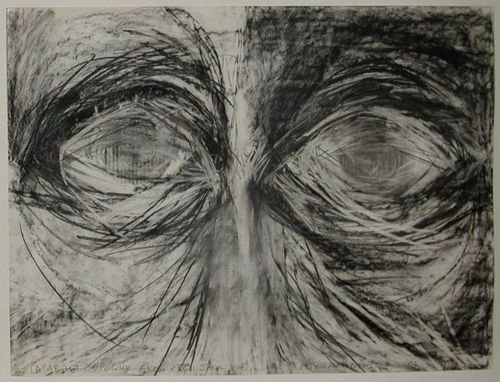
The image "Cataract-Opaque Area Clouding Eye” accompanying today’s post by Magdalena Abakanowicz (2002).

11/25/2013 (Solo Project Day 329)

12 Moons Solo Saxophone Project Day 329

Date: 11/25/2013

Instrument: Tenor saxophone

Location: Home studion in Clinton, WA (Whidbey Island)

Notes:

This morning was my first multi-hour stretch of uninterrupted practice time in at least a few weeks.  Luckily my mind and body were prepared to work, and I had a very focused and productive session.  Towards the end of this practice time, I began improvising a series of small motives, repeating each in isolation, or threading them together into longer strains of activity.  I naturally gravitated towards 3 melodic figures, and then found multiphonic fingerings that complimented both the individual melodic shapes, and the melodic shapes surrounding them.  These three melodies and three multiphonics became the source material for today’s improvisation.

I wanted these multiphonics to relate harmonically as well as timbrally to the melodies.  Overall, I aimed for a continuous flow of sound with gentler textures in all the played material.  Each melody had its accompanying multiphonic.  These are notated below as Melody 1, and Multiphonic 1, respectively.  Each are notated in the tenor key of Bb.

Melody 1.  Pitches A, E, G, E

Multiphonic 1.  Pitches (in ascending order) F#, F#

(Left Hand) 1-2, Octave, Low B // (Right Hand) 2, High F#

Melody 2.  Pitches Eb, E, B, D

Multiphonic 2.  Pitches (in ascending order) A, Bb, F

(Left Hand) 1-2, Octave, Low B // (Right Hand) 1-2

Melody 3.  Pitches C, D, E, A, D, G, A

Multiphonic 3.  Pitches: C#, E, D

(Left Hand) 1-2-3, Palm Eb only // (Right Hand) 1-2, Low C

The piece opens with a repeating cycle of Melodies 1, 2 and 3 one after the other.  To compositionally balance this, the piece closes with the repeated playing of Multiphonics 1, 2 and 3, again one after the other.  During the bulk of the piece I would continuously move from Melody 1, to 2, and 3, while occasionally interrupting the melodic threads by playing a multiphonic immediately after its Melodic pair.  For example, I would play Melody 1, 2, 3, 1 followed by Multiphonic 1, and then continue on to Melody 2, 3, 1 etc.

-Neil

The image “Constructivismes 2009” accompanying today’s post by R.H. Quaytman (2009).

11/24/2013 (12 Moons Solo Project Day 328)

12 Moons Solo Saxophone Project Day 328

Date:11/24/2013

Instrument: Tenor saxophone

Location: Home studio in Clinton, WA (Whidbey Island)

Notes:

My wife and I headed up to Mount Index today to close our cabin for the Winter.  We spent the day installing simple, swinging window covers to help keep out the snow, a hard lesson we learned after last Winter’s heavy snowfall.  After finishing for the day, I headed to the top of the property to record today’s 12 Moons improvisation.  It was late afternoon with full sun shining down. The snow line was very low, exposing all the bare patches of earth on the majestic Cascade Range off in the foreground.  With the foliage now gone from the trees that surrounded the cabin and our property beyond, the Skykomish River was once again in view at the bottom of the ravine below us.  

During this piece I opened myself up to the beautiful day around me.  We’ve been lucky to have a long stretch of cold, sunny days this past week, and I was happy to up at the cabin working today.  During this piece I wanted to capture the calmness of this wonderful place, but also my purpose for being there today.  In a few weeks the ground will be covered in snow and within a 4-6 weeks it will be early impassible by car.  It’s always a bit sad for me knowing it will be half a year until I’m back at the cabin again, but the wait also makes the first trip back that much for enjoyable for me once the snowmelt finally comes.  To capture this transitional mood and the spirit of this day, I centered this improvisation around a figure which used a consonant major third interval with the pitches G# and E, played with rapid articulation.  But surrounding this interval was darker half step interval with the pitches G# and A.  I then incorporated a winder, more ominous Major 7th chord with the pitches A (mid register) and G# (upper register).  I used quick accelerando’s to articulate many of these pitches, chords and clusters, and used the fast tempo increases to suddenly break into and out of the textures I was exploring. 

-Neil

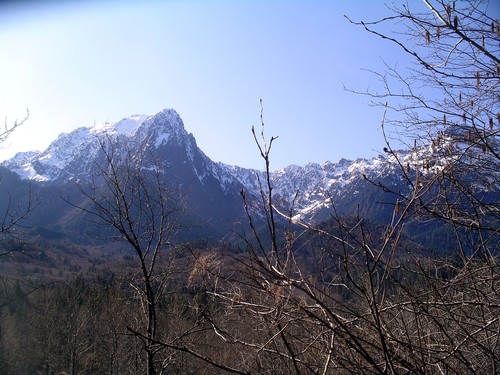
The image accompanying today’s post is of Mount Index.