11/23/2013 (12 Moons Solo Project Day 327)

12 Moons Solo Saxophone Project Day 327

Date: 11/23/2013

Instrument: Tenor saxophone

Location: Home studio in Clinton, WA (Whidbey Island)

Notes:

A small cocoon is fastened to the outside of my practice room window.   About three months ago a small bug made its way up the window and began constructing the cocoon.  Only a few feet away a massive spider had woven it’s own resting spot.  Over the course of a day or two the cocoon was fully formed.  I had wondered if the spider would make it’s way over to target the easy pray, but it never appeared to do so.  After about 3 weeks, I noticed two wings beginning to push out from the white cocoon, but this is where the process stopped.  Whatever was inside did not make it, and was now frozen in position.  I’ve left it alone on the window to see what the process of diminution would look like.  Its now been about 3 months since the cocoon was formed, Winter has set in, and the little grave looks remarkably unchanged.  I developed today’s improvisation after having looked at it on the window for a minute or so this morning and having forgotten about the cocoon for at least a week. 

During this improvisation I pivoted around two fingerings to create, at the outset, a dark and static mood.  The two fingerings were as follows:

Fingering 1.  Pitches G (lower register) and Bb (upper register)

(Left Hand) 1-2-3, Low B // (Right Hand) 1-2-3, Low Eb.  Trill open and closed the G key in the left hand.

Fingering 2.  Pitches G (lower register) and A (upper register)

(Left Hand) 1-2-3, Low Bb // (Right Hand) 1-2-3.  Trill open and closed the G key in the left hand.

From these two fingerings I then began exploring the concept of maintaining the more static mood, while quickening the pace of melodic action, representing the forming of the cocoon.  After about 1 minute I began cycling open and closed the G key in the left hand as well as the side Bb key while quickening the overall tempo.  Inside this outer “cocoon” I wanted the internal structure, or mood to remain the same.  Eventually I began incorporating more indeterminate pitches by articulating against the reed, until a point at which the internal structure fractures and all that remains is a series of threaded, punctuated sounds–the outer shell.  After a brief unwinding of these articulations I unstained two pitches, each derived from the original fingerings, followed by a grand pause.  There is then a return to the original body of sound, this time with fractured pitch punctuations surrounding it.  

-Neil

The image accompanying today’s post from the blog “Inside Art New Orleans” from co-curators Caroline Rankin and Megan Whitmarsch.
11/22/2013 (12 Moons Solo Project Day 326)

12 Moons Solo Saxophone Project Day 326

Date: 11/22/2013

Instrument: Tenor saxophone

Location: Home studio in Clinton, WA (Whidey Island)

Notes:

This improvisation came to me immediately as I began practicing this morning.  In it I used a simple folk melody played through a series of split tone and multiphonic fingerings.  Buried internally within the chords, the melody used the pitches Gb, Ab, Bb, D during the ascent, and the Bb, Ab, Gb on the descent.  As the melody ascended, I used fingerings which added a new key as each pitch climbed higher, and then subsequently began releasing one key per pitch during the descent.  The improvisation overall was felt in a 6/8 meter, with occasional diversions way from triple into duple phrasing.  I played the bulk of the material at medium tempo but gave myself the liberty to transition into slower or faster tempos at all times. 

During the piece I used a familiar technique of phasing in and out of octaves, exploring the beautiful colors hidden within the chord structures.  When diverting away from the cyclical 6/8 feel, I would often create punctuations in either the upper register or lower register, while then interjecting the 6/8 melody once again.  At other points I faded out the melodic cycle, while cross-fading in the Concert D (the highest tone in the melody) which them came to dominate the sound spectrum as a sustained pitch.  Even during these brief moments of sustain, I wanted the improvisation to possess a feeling of forward motion at all times.

The fingerings and primary melodic cycle were as follows (in order of execution)

(Ascending)

1.  (Left Hand) 1-2, Low Bb // (Right Hand) 1-2-3, Low C

2.  (Left Hand) 1-2, Octave, Low Bb // (Right Hand) 1-2-3, Low C

3.  (Left Hand) 1-2, Octave, Palm Eb key only, Low Bb // (Right Hand) 1-2-3, Low C

4.  (Left Hand) 1-2, Octave, Palm Eb key only, Low Bb // (Right Hand) 1-2-3, Low C, High F

(Descending)

5.  Same as fingering 3.

6.  Same as fingering 2.

-Neil

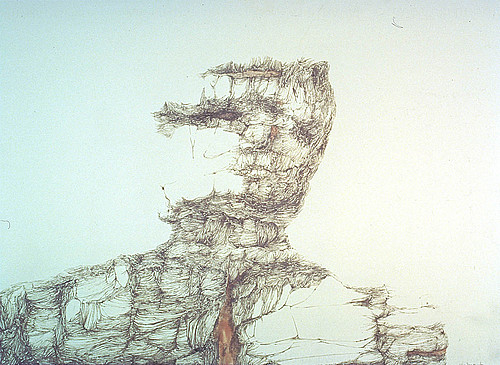
The image accompanying today’s post by Elias Friedensohn.

11/21/2013 (12 Moons Solo Project Day 325)

image

12 Moons Solo Saxophone Project Day 325

Date:11/21/2013

Instrument: Tenor saxophone

Location: Home studio in Clinton, WA (Whidbey Island)

Notes:

This morning I was thinking about an interesting topic I heard on the radio a while back.  The speaker was discussing the idea of debate as a critical process in conversation, but that it can also carry an intrinsic flaw.  For his example, he showed how two people can argue opposite perspectives on the same topic, but the topic in fact does have a definite answer.  Ultimately one of the two are indeed correct, but the very nature of two people debating one another can lead a listener to believe that the two sides of the argument are roughly equal, when in reality this may be far from the case.  One argument might be wildly off base, but through cleaver techniques it can be presented in a way that seems equally matched to the truth.  Politicians use this tactic quite often to refute an argument they know to be a truth by counterbalancing facts with slight of hand and obfuscation, warping a listener’s mind into believing that their perspective is of equal value.  

In my improvisation, I explored the concept of opposing perspectives and the gradual decay of clarity into a place where both perspectives seem of equal balance.  During this piece I began with undulating tones in the lower register, which I defined as Argument A.   I then interjected upper register flourishes with rapid single pitches and multiphonics.  This represented Argument B–the opposing argument.  As the piece developed, I began gradually moving the lower register pitches (Argument A.) higher and higher, as well as increasing the volume.  I kept the upper register flourishes (Argument B.) at roughly the same volume, but began decreasing the amount of time passing between execution of the figures.  At about the mid point in the improvisation, Argument A. finally settles into a recurring melody in the middle register, played at the same volume as Argument B.  From this point forward the two begin to overlap, until finally they begin to overlap into one broad, undefined perspective where the two arguments loose any sense of definition.  

-Neil

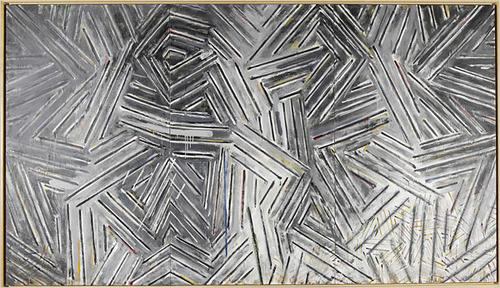
The image “Between the Clock and the Bed” accompanying today’s post by Jasper Johns (1982-83).

11/20/2013 (12 Moon Solo Project Day 324)

12 Moons Solo Saxophone Project Day 324

Date: 11/20/2013

Instrument: Tenor saxophone

Location: Home studio in Clinton, WA (Whidbey Island)

Notes:

Yesterday Bad Luck ended out Fall tour by driving from Kettleville, CA (about 3 hours North of LA) back up to Seattle.  After staying the night in the city, I made it back home to the island this morning.  Doing chores around the house and practicing, I found myself filled with a duel feeling, both of the joy of being home and a desire to be back on the road meeting new people and exploring new places.  I decided to embrace dualism in my improvisation today. 

During this improvisation I used a primary melodic figure in medium tempo.  The fingerings contained inside this melody then became the source material for faster, more indeterminate figures that I explored freely.  The melody opens the improvisation and is played 4 times, the 4th being a springboard for the improvised material.  The second and eight pitches in the melodies were the roots of larger chords, the former being a minor chord and the latter a major.  I used the dichotomy of minor to parallel major as a means to bring about my dual state of mind.  These two chords also became a point of reference during the piece to bind the improvised material to the full melody.  The fingerings used for the primary melody were as follows (written below in the order they were played):

Pitch G: (Left Hand) 1-2, Low B //  (Right Hand) 2-3

Pitch Bb: (Left Hand) 1-2, Palm Eb key only, Low B //  (Right Hand) 2-3 *This was a tight, clustered minor chord*

Pitch C: (Left Hand) 1-2, Low B //  (Right Hand) 2-3, Side C

Pitch D: (Left Hand) 1-2, Fork F, Low B //  (Right Hand) 2-3, Side C

Pitch C: Same as C fingering above

Pitch Bb: Same as Bb fingering/clustered minor chord above

Pitch G: Same as G fingering above

Pitch B: (Left Hand) 1-2, Low B, Palm Eb only, Low B // (Right Hand) 1-2-3

-Neil

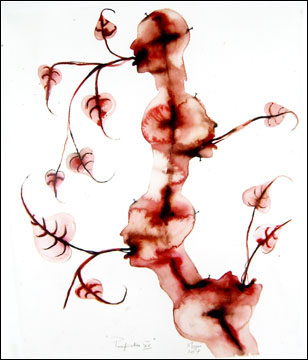
The image accompanying today’s post by Barthelemy Toguo. 

11/19/2013 (12 Moons Solo Project Day 323)

12 Moons Solo Saxophone Project Day 323

Date: 11/19/2013

Instrument: Tenor saxophone

Location: A local garbage dump.  Mount Shasta, CA

Notes:

Today Bad Luck is on our way back home driving North from Los Angeles to Seattle.  After a good 9 hours of driving under our belt, we stopped briefly for me to record in the town of Mount Shasta, CA, located at the base of the beautiful mountain itself.  We headed up a dirt road that went directly towards the smaller Black Butte mountain.  This road eventually led us to the city dump, and finally a second service road ended at a refuse pile for building materials such as old pallets and lumber.  Bordering the pile were neat rows of old oil drums.  The cold wind was blowing hard off of the mountain and it began to rain.  I decided to set up my mic inside one of the oil drums to experience the drums’ perspective on my sound.

I blasted into the oil drum at a high level of volume.  The mic was placed directly onto the bottom, and I tilted the bell of my horn into the hole at the top of drum to play inside.  Throughout the piece, and particularly so at the end, there’s a great deal of distortion from overwhelming the microphone.  This has yet to happen during this project and was not intentional.  This was the result of a miscalculation on my part as to how loud my sound would reverberate inside the drum.  However, the distortion itself is really interesting.  The brightest clipping takes place on the denser multiphonic clusters versus the straight tone.  During these high volume pieces, the highest recorded levels tend to be at the moment of tongue articulation after having have breathed, rather than during a cluster of some kind.  The fact that the clusters themselves overwhelmed the mic is really interesting to me, and something I’d like to explore more in the future.

During this piece I used a single fingering action and articulated my sound with both my tongue and key flicking on the low C.  The fingering was as follows:

(Left Hand) 1-2-3, Low Bb // (Right Hand) 1-2-3.  Flick closed, then opened on the Low C key.  This helped the multiphonics to emerge in denser shapes.

-Neil

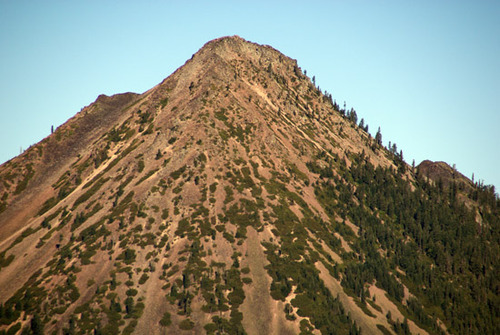
The image accompanying today’s post is Black Butte mountain, Oregon.