10/20/2013 (12 Moons Solo Project Day 293)

12 Moons Solo Saxophone Project Day 293

Date: 10/20/2013

Instrument: Tenor saxophone

Location: Home studio in Clinton, WA (Whidbey Island)

Notes:

This morning I woke up fairly early, gathered some wood from the shed and walked into my practice room to record.  Because of the early hour, as with my recording last Sunday, there was the strict limitation of low volume.  I decided to work with a phasing piece, using a single fingered actio but divide the improvisation into scope between two sound areas.  I used a multiphonic chord with the following fingering to do this:

(Left Hand) 1-3, Octave, Low B // (Right Hand) 1-2-3, Low C.   Throughout this improvisation I also trilled the Octave key continuously.

The first sound area involved presenting and exploring a range of pitches from the lower partials of the multiphonic up to about an altissimo C.  Some of these sounds were cross-faded, such as the transition between the first pitch to the second.  Other approaches included “dotting” the sound, such as the altissimo C which is presented at 1:38.  The second sound area included pushing the sound colors out instead of phasing between them.  With this approach I would blow into the horn with many different air flow patterns and embouchure shapes, trying to varying them with each execution.  This second sound area was far more indeterminate than the first.

-Neil

The image “Untitled” accompanying today’s post by Burk Uzzle (1975).
10/19/2013 (12 Moons Solo Project Day 292)

12 Moons Solo Saxophone Project Day 292

Date: 10/19/2013

Instrument: Tenor saxophone

Location: Home studio in Clinton, WA (Whidbey Island)

Notes:

This afternoon while practicing I reached for a balance of pre-determined and indeterminate sound from my horn.  I wanted to explore phasing from one sound spectrum to another, all the while looking for q union between what I needed to hear versus what the horn would offer to me.  During this practice work, as well as my recording today, I maintained a primary fingering throughout with alterations to this fingering.  Many of the sounds explored in this piece were practiced for about a half hour or so before recording, and only after feeling like I had a good grasp of what the horn was offering up to me did I begin this recording process.  I opened the improvisation with the same area of sound I had left off on only moments before in practice.  Mentally it therefore felt as though I was continuing a natural, calm process of searching and working rather than beginning anew.  I began recording in mid-thought.

To approach this improvisation, I listened to the tight clusters, little percussive cycles and melodic figures, and was constantly on the lookout for a hook of some kind.  Once I identified a hook that spoke to me I let this sound lead me to new areas on the instrument.  These included little tone smears, rhythmic cycles, clusters, and more punctuated single pitches, etc.  The primary fingering used during this improvisation was as follows:

(Left Hand) 1-2-3, Octave, Low B // (Right Hand) 1-3, Side Bb.  I freely opened and closed the Side Bb, Low F# key, C, G and E keys in various combinations, playing some of them singularly and others overlaping.

-Neil

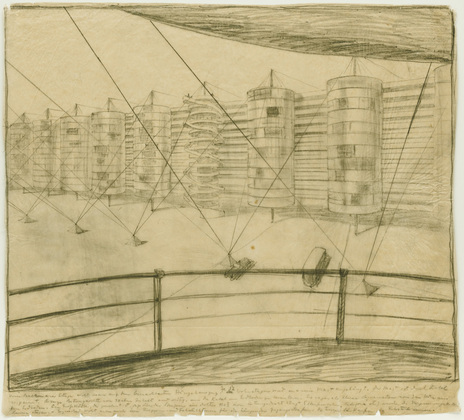
The image “Suspension Houses Project, Perspective sketch” accompanying today’s post by Bodo Rasch (1927-28).

10/18/2013 (12 Moons Solo Project Day 291)

12 Moons Solo Saxophone Project Day 291

Date: 10/18/2013

Instrument: Tenor saxophone

Location: Home studio in Clinton, WA (Whidbey Island)

Notes:

This morning I spent some time reflecting on how much my past study of classical Hindustani music has shaped my musical sensibilities.  But in general I realize how my musical study–those touchstone periods of great importance from my past, return time and time again to influence my current music.  In today’s improvisation, I decided to reference musical concepts from my own past.  This was namely done in three areas:

1.  The use of a fixed scale, the idea being taken both from my study of Indian music, but also my early grade school study of the blues scale.

2.  Drawing on split tone fingerings I have developed in the past, and applied harmonically over this fixed scale.

3.  The use of “interruption,” a common theme in my music throughout the last several years.

This improvisation uses a hexatonic scale (with the root repeated in the next register for a total of 7 pitches). In descending order and in the key of Bb, the pitches were as follows:

 E, Eb, B, Bb, Ab, F, E.

After the initial statement of the scale with a very plain-spoken descent in the notes, I interrupted this sound world by descending the scale harmonically.  The pitches were grouped as E/Eb, B/Bb, Bb/Ab, F, E.  The F and the E each had overtones of the octave above them, with the E also including a very present B in the upper register.  The fingerings for these note groupings were as follows:

E/Eb: (Left Hand) Fork F, 2-3, Low Bb // (Right Hand) 1-2-3, Side Bb

B/Bb: (Left Hand) 1-3, Low B // (Right Hand) 1-2-3, Low C, Side Bb

Bb/Ab: (Right Hand) 1-2, Low Bb // (Right Hand) 1-2-3, Low C, Side Bb

F: (Left Hand) 1-2-3, Low Bb // (Right Hand) 1-3

E: (Left Hand) 1-2-3, Low B // (Right Hand) 1-2, Low Eb

After the statement of these chords in the descending scale, I abruptly transitioned into a static harmonic, and percussive motion with the two chord clusters B/Ab, and Bb/Ab.  I recall using this sixteenth note phrasing with these two specific chords in the past during my 12 Moons project.  I decided to use them none the less as a nod to the theme of “fingerings developed in the past."  I also decided mid improvisation to begin singing the upper notes of each chord into the horn a two different points.  These chords were fingered as follows:

B/Ab:  (Left Hand) 1-3, Low B // (Right Hand) 1-2-3, Low C

Bb/Ab: (Right Hand) 1-2, Low Bb // (Right Hand) 1-2-3, Low C, Side Bb (same as above).

-Neil

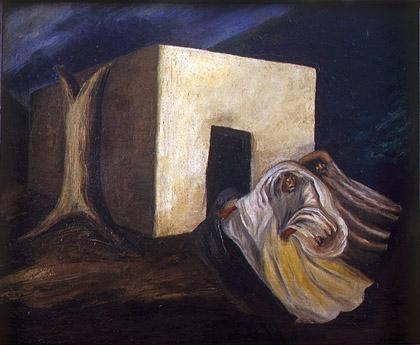
The image "The White House” accompanying today’s post by Jose Clemente Orozco (1925).

10/17/2013 (12 Moons Solo Project Day 290)

12 Moons Solo Saxophone Project Day 290

Date: 10/17/2013

Instrument: Tenor saxophone

Location: The choir room at South Whidbey High School.  Langley, WA (Whidbey Island)

Notes:

This morning I worked on a single fingering action, pushing and pulling chord clusters into different regions of the horn.  These clusters might resonate in the lower half of the instrument as high tones, or resonate in the upper region as lower tones.  This is a process through which I always learn something new about my instrument.  When a key is pressed down and air is blown into the horn, the air flow naturally produces an amount of back pressure against the key pad.  The air essentially is trying to force its way out of the horn but is blocked by the pad.  In the past year or so I’ve noticed myself gradually paying more an more attention to how my mind reacts to the tiny physical subtleties of these slight vibrations in my fingers.  There are moments when a sound cluster rolls down the tube of the horn and I can feel it in my hands the entire way.  I’m still trying to make my own determinations as to how I react to this in the moment when the physical feel is not necessarily in the forefront of my mind.  At this point, I have begun to notice that sound shapes with a strong physical vibration presence in my hands tend to stick clearer in my mind when I go to execute them again.

The single fingering used in this improvisation was as follows:

(Left Hand) 1-2-3, Octave, Low B, Palm Eb only // (Right Hand) 2-3.  Trill open and closed the Palm Eb key only at various heights.  To pull out lower pitches, I also occasionally took away the octave key.

I opened and closed the Palm Eb key at different heights, allowing the air to interact with the rest of the horn and flow through it in many different ways.  As a chord shape would ascend in pitch, often there was a counter-sound with a downward movement.  In equal measure to the actual sound coming out of the horn, I focused my energy on the feeling of the keys against my fingers as the air tried to rise, fall, do both, or hold steady. 

I played at a lower dynamic level during this improvisation, but in the later half as I began playing more aggressively and louder, I began walking away from the microphone.  My aim here was to give a sense of the large size of this room.  Since the tiny subtleties of sound in the horn were being lost in the shear volume, I wanted the room itself to express this new energy.  I also wanted overall level of volume to be balanced throughout all the sections of the improvisation.

-Neil

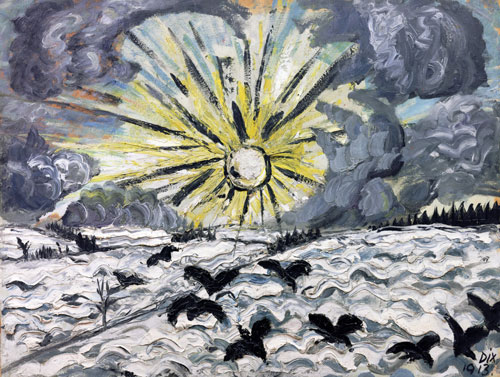
The image “Sunrise” accompanying today’s post by Otto Dix (1913).

10/16/2013 (12 Moons Solo Project Day 289)

image

12 Moons Solo Saxophone Project Day 289

Date: 10/16/2013

Instrument: Tenor saxophone

Location: Home studio in Clinton, WA (Whidbey Island)

Notes:

This is my second day of being sick during the project, but I’m feeling considerably better than yesterday.  My lungs are hurting a bit more today than the past couple of days, and because of this while practicing I worked with gestures that had less physical back-pressure and quieter dynamic levels.  This helped me to find a comfortable physical state in which to approach the horn.  Since yesterday’s piece explored a darker, more brooding mood that fit my life state that day, today I wanted to execute a piece that responded to the welcoming feeling of being on the mend.

In today’s improvisation I explored freely improvised melodic lines with multiphonic, chordal interjections.  I kept ornamentation to a minimum during this piece, the only exception being the occasional grace note passage.  I wanted the chordal passages in these piece to take on many roles.  At times the harmonic structure of a mutliphonic would be complimentary to a passage before or immediately after.  I generally approached this by anticipating what multiphonic I would like to play next, and to then tailor my melodies to end on a pitch that was either in the multiphonic chord, or an upper or lower neighbor.  At other times I included these chordal interjections more indeterminately, their harmonic language bearing little to no relationship with the melodies surrounding them.

-Neil

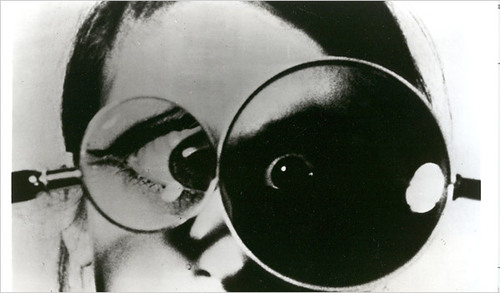
The image “16 Millimeter Earings” accompanying today’s post by Meredith Monk (1980).