10/15/2013 (12 Moons Solo Project Day 288)

12 Moons Solo Saxophone Project Day 288

Date: 10/15/2013

Instrument: Tenor saxophone

Location: The orchestra room at Chief Sealth International High School.  Seattle, WA

Notes:

In today’s improvisation I reached for a sound area to suit my mental and physical state throughout the day.  What started as a slight cold a few days ago has now evolved to include more physical discomfort, with a very sore throat, plugged up ears and nose, and the standard aches and pains that come with a bad cold.  Despite this I feel grateful this is only the first time during the 12 Moons project that I’ve been sick in any way.  

Because it’s often available in the afternoon, I greeidly waited to record in the main performance hall.  Unfortunately classes were taking place in the rooms adjacent to the hall that made focusing and capturing a good piece difficult for me.  I decided to record in the more controlled, sterile environment of the orchestra room.  During this improvisation I used continuous vibrato with a series of mulitphonics.  I chose multiphonics with complimentary chordal motions to create a darker mood.  These chords also allowed pitches to speak with isolation, and throughout the improvisation I pulled a variety of these tones out.  I heard the Concert E as the primary drone pitch in the piece however, and it became a touchstone to develop, devolve from and return too.  I used 4 fingerings during this piece, each played with continuous vibrato at a fairly steady pace of oscillation.

Multiphonic 1 (open the improvisation)

(Left Hand) 1-2-3, Octave // (Right Hand) 2-3

Multiphonic 2 (first appears at :29)

(Left Hand) 1-2-3, Octave // (Right Hand) 2-3, Side F#

Multiphonic 3 (first appears at 1:10)

Multiphonic 4 (first appears at 2:22)

(Left Hand) 1-2-3, // (Right Hand) 2-3.  This fingering was the same as Multiphonic 1, but without the octave key.

*At the end of the improvisation, kids at the high school can be heard in the hallway outside the room as they walked by.*

-Neil

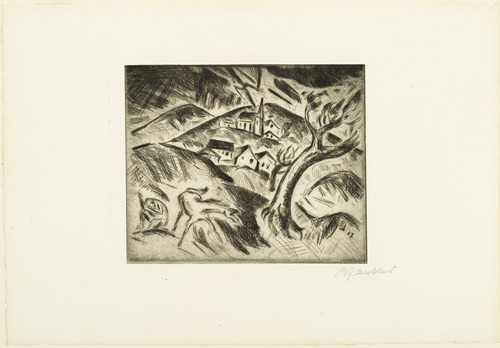
The image “The Storm” accompanying today’s post by Richard Janthur (1913).
10/14/2013 (12 Moons Solo Project Day 287)

12 Moons Solo Saxophone Project Day 287

Date: 10/14/2013

Instrument: Tenor saxophone

Location: The rec room of my childhood home.  Edmonds, WA

Notes:

I recorded this week in the same spot and at virtually the same time as my 12 Moons piece from 2 weeks ago.  On both days I practiced and worked in the rec room of my childhood home, and conditionally recorded while the kids at school across the street played during recess.  Two weeks ago my temperament was calm and nostalgic.  I was well rested, felt strong and tackled the day with eagerness.  Today I quiet different.  I woke up with a very soar throat, and slept at most only two hours before having to wake up for the day.  I decided to push through this and practice for a few hours to use sound as my magic medicine.  I arrived at today’s improvisation towards the end of my practice session.

During this piece I used a false fingering and took advantage of a slight gap in the felt between my Low Bb key in the left hand, and the mechanism that interacts with it.  I manually pressed the Low Bb key with my right (with my middle finger) along with the remaining keys traditionally used to play the Low Bb fingering.  Because of the slight gap in the bit of felt, the Low B key rises above the key cup by just a hairs width is the Low Bb is manually pushed down.  This creates and interruption in the air flow, pulling out beautiful chords and overtones.  During this piece I would also gently press and release the B key, momentarily stopping this leak.  This helped to pull out even more colors and also added punctuations with a concert pitch A.

This chord spoke very differently at full volume versus low volume.  What were brittle sound structures became incredibly stable multiphonic chords and full-toned pitches when played louder and with a looser embouchure.  I explored this difference at about the mid point of the improvisation in the aggressive swells in volume.

-Neil

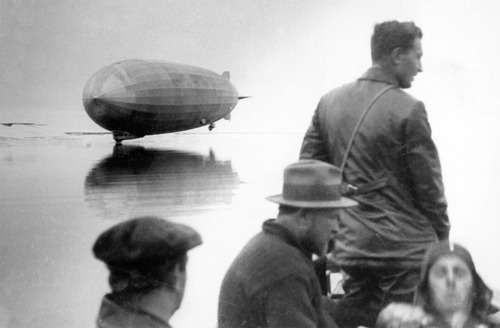
The image accompanying today’s post is a Zeppelin hovering about the Pacific Ocean.

10/13/2013 (12 Moons Solo Project Day 286)

12 Moons Solo Saxophone Project Day 286

Date: 10/13/2013

Instrument: Tenor saxophone

Location: Home studio in Clinton, WA (Whidbey Island)

Notes:

I was up this morning before sunrise to give myself a bit of time to practice and record in what is otherwise a very busy day.  This time of day can be restrictive.  I don’t have the flexibility of being able to play above a very soft dynamic level, and these morning are often on a strict time scale.  But with these restrictions also comes the opportunity to narrow down what my possible range of sound will be.  I decided today to work with a texture I’ve heard my friend Jacobo Zimmerman explore quite a bit.  In this improvisation I trapped a bit of saliva in the mouthpiece and explored using my air flow in union with the saliva to pull various sounds out of the horn.  

This is the first time I’ve sat down with the specific aim of improvising with this technique for more than just a few minutes.  With more specialized techniques such as this, I often wait until I feel the time is right to approach it honesty and full energy.   As this was my initial run with this concept, I decide to limit my range of action within the more overtone rich bell-tones.  I used primarily the lower octave fingerings, namely the range between the Low Bb and D.  I was amazed at the spectrum of both percussive and pitched sounds that resonated in the horn.  I used single and double tonging to create interruptions in the strains of sound, and worked to create a balance of more noise-oriented undulations with recurring wing-beat continuations.

-Neil

The image “show through II” accompanying today’s post by Tabaimo (2009).

10/12/2013 (12 Moons Solo Project Day 285)

12 Moons Solo Saxophone Project Day 285

Date: 10/12/2013

Instrument: Tenor saxophone

Location: Home studio in Clinton, WA (Whidbey Island)

Notes:

This afternoon I decided to quickly compose a series of 10 motives without any prescribed melodic, rhythmic or harmonic relationship to one another.  I intentionally used wide leaps in range to further distort any regularity of shape.  As is almost always the case in my writing, the motives bore a strong resemblance to one another after all.  After composing this series of motives, I took each motive and re-wrote the pitches from back to front (retrograde) and maintained the same rhythm.  With the motives now totaling 20, I re-wrote them on a fresh page in indeterminate order in what seemed to me to be an even spread in their orientation.  I then improvised the piece freely, combining motives together into strains of action in various lengths.

While recording this afternoon I found it to be extremely challenging to randomize my playing of these figures.  As is always the case when I perform such a piece, my natural inclination is to scan from left to right, or move directly above or below.  In the split second it takes to avoid this motion, my next most common move will be to go to the extreme opposite side of the page.  For example, if I read a motive in the upper right hand corner, once I’ve avoided looking directly below I very naturally want to simply jump to the bottom of the page.  Combatting both these tendencies is very tricky, particularly at the tempo I recorded at.  After several attempts, I chose my strongest take.  I waited until the end of the day to re-listen to the track and begin my written description, when I mistakenly deleted it.  In the immediate frustration of that moment I put my horn together, turned on the mic and did it again.  The energy in this take was much more focused, possibly because of my pent of energy and natural frustration at having deleted the take only moments before.  However I found my eyes darting around the page indeterminately in a much more randomized fashion, and  my mind was more strongly attached to sculpting the piece than it had been in the lost take.

-Neil

The image “Former War Factory” accompanying today’s post by Osaka Shomei.

10/11/2013 (12 Moons Solo Project Day 284)

12 Moons Solo Saxophone Project Day 284

Date: 10/11/2013

Instrument: Tenor saxophone

Location: Home studio in Clinton, WA (Whidbey Island)

Notes:

This morning I was emailing back and forth with Erin Waterman, the mother of my saxophone student Carli.  Erin is a passionate advocate for CureSearch, which “Funds and Supports targeted and innovative children’s cancer research with measurable results” (curesearch.com).  Just before Carli’s 4th birthday, she was diagnosed with Lymphoblastic Lymphoma.  Now in the 7th grade, she is a healthy, passionate kid and a very gifted young saxophonist in my studio.  In the coming months, Carli’s mother Erin plans to walk 26 miles in one day in support of CureSearch.  Today’s improvisation was inspired by Erin Waterman and her daughter Carli.

In this improvisation I worked with tonality, balancing fingerings and singing into the horn.  I wanted to create a beautiful, hopeful atmposphere in this piece and I felt that the inclusion of my natural voice would be key in this goal.   I’ve spent quite a bit of time singing into the instrument to pull out both consonant and dissonant textures, but I’ve spent comparatively little time working working on more traditional compositional approaches, such as consonant harmonic movement, voice leading, contrary motion, and non-parallel movement.  In this piece I wanted to directly tackle these areas, but above all I wanted to create an honest, open flow of sound that expressed my deep appreciation for what Erin has dedicated herself towards.  She is an inspiration to us all and I am deeply grateful to know her and her wonderful daughter.

This improvisation was approached freely, but a simple transcription of the first few seconds of the piece was as follows (written below in the tenor key of Bb):

Sung :         F#—————F natural—–F#——A quarter step flat———————F#—-

Fingered:   1……….2……………..1………………………………2…………………1…..

Above: The line (—-) should be interpreted as a sung pitch which is held out.  The dot (.) should be interpreted as a trill to be executed along with the fingered pitch associated with Fingerings Number 1 or 2.

Fingering 1:

(Left Hand) 1-2-3, Low B  // (Right Hand) 1-2-3, Low C.  Trill the D key in the Right Hand constantly.

Fingering 2:

(Left Hand) 1-2-3, Low Bb  // (Right Hand) 1-2-3, Low C.  Trill the D key in the Right Hand constantly.

*Erin will be walking 26 miles of the Pacific Crest Trail for the Ultimate Hike,  benefiting CureSearch for Children’s Cancer.  You can donate directly to Erin’s walking campaign Here:

http://www.ultimatehike.org/faf/donorReg/donorPledge.asp?ievent=1059263&supid=297786486*

-Neil

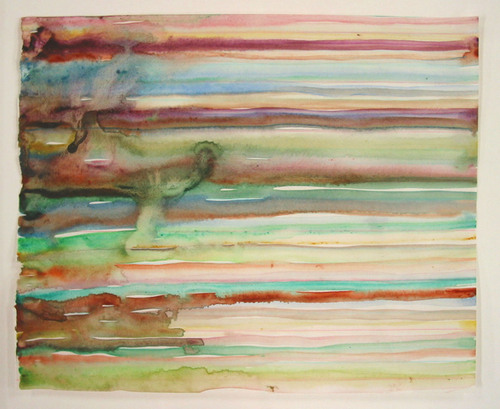
The image “Untitled” accompanying today’s post by Hayley Tompkins (2001).