10/10/2013 (12 Moons Solo Project Day 283)

12 Moons Solo Saxophone Project Day 283

Date: 10/10/2013

Instrument: Tenor saxophone

Location: Home studio in Clinton, WA (Whidbey Island)

Notes:

Today’s improvisation used a repetitive cycle with 3 fingering actions.  The overall sound concept was derived from exploring the extreme elements inherent in only of those 3 actions.  These fingerings were as follows:

Fingering 1 (Left Hand) Fork F, 2, Low C# (Right Hand) 1-2-3, Side Bb, Low C

Fingering 2 (Left Hand) Fork F, 2, Low C# (Right Hand) 1-2-3, Low C

Fingering 3 (Left Hand) Fork F, Low C# (Right Hand) 1-2-3, Low C 

Fingering 1 (Left Hand) Fork F, 2, Low C# (Right Hand) 1-2-3, Side Bb, Low C

The sound shape that opens the piece uses the above three fingerings in the following order:

Fingering 1 (Left Hand) Fork F, 2, Low C# (Right Hand) 1-2-3, Side Bb, Low C

Fingering 2 (Left Hand) Fork F, 2, Low C# (Right Hand) 1-2-3, Low C

Fingering 3 (Left Hand) Fork F, Low C# (Right Hand) 1-2-3, Low C 

Fingering 1 (Left Hand) Fork F, 2, Low C# (Right Hand) 1-2-3, Side Bb, Low C

Despite the heavy, quick movement of fingerings in this improvisation, the overall sound concept was taken from Fingering 2: Fingering 2 (Left Hand) Fork F, 2, Low C# (Right Hand) 1-2-3, Low C.  This multiphonic has three distinct sound ares which became my point of departure for the entirety of the improvisation.  I thought of the three sound areas as Low, Medium and High.  The Low area included a split-tone chord between a Concert Db and D.  The Medium area breaks into the upper-mid register with more brittle, colorful tones that included the lower Db and D.  Finally, the High area created a variety of split-tones and overtones.  

During this improvisation I kept these sound areas in my head at all times, but by cycling Fingerings 1-3, new chords and shapes were possible as well.  My aim was to balance the 3 “pure” multiphonic sound areas from Fingering 2 along with the more interactive sound environment created by cycling all 3 of the fingerings.  As the improvisation progressed, during more rapid passages I also began incorporating the Side C, and trill the G key in the left hand.

-Neil

The image “Huile sur toile” accompanying today’s post by Vladimir Velickovic (1974).
10/09/2013 (12 Moons Solo Project Day 282)

12 Moons Solo Saxophone Project Day 282

Date: 10/09/2013

Instrument: Tenor saxophone

Locaciton: Home studio in Clinton, WA (Whidbey Island)

Notes:

After finishing my practice session I set to work with the immediate goal of trying to find a new sound texture on the horn.  After searching for some time I developed a fingering for a wide range multiphonic chord with a series of 3 clustered pitches in the upper register.  Each pitch could be isolated or played in harmony.  But after playing the shape melodically and in sound cycle format, I  realized that I had learned this shape some time ago and forgotten it.  That was a testament to the fact that these discoveries, if not implanted in my brain or at minimum properly notated down, can tend to disappear.  For those who are curious, the fingering was as follows:

In ascending order and in the tenor key of Bb, the pitches were:

-Bottom most pitches: D quarter step sharp, G quarter step flat.  

-Upper register 3-tone cluster: Eb, F quarter step flat, Gb

(Left Hand) Fork F key, 2-3, Octave // (Right Hand) 2-3, Low C, Low Eb

I stopped for a moment in frustration, and when I picked the horn back up, strangely another long-forgotten shape came immediately into my fingers.  The sound of this second shape resonated with me much deeper, and I decided to perform a blind improvisation and re-discover some of its possibilities.  The overall sound shape explored in this improvisation was built off of the Low Bb fingering while barely opening and closing the Low Eb key.  I blew into the horn with an air flow that helped to pull out a myriad of overtones.  The warbling vibrato sounds were made by trilling open and closed the Octave key.  Other techniques included intermittently tilling the Palm D and Eb keys, and the gentle and extremely quiet lower register upward bends were made from the initial burst of air escaping out of the low Eb key.  These bends occurred at various points during the improvisation for a second at most.  An example of an upward bend can be heard at 1:17

-Neil

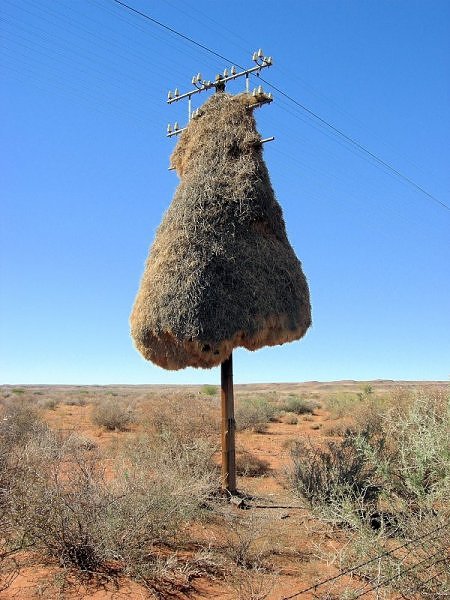
The image accompanying today’s post is a bird nest created by Weaver Birds.

10/08/2013 (12 Moons Solo Project Day 281)

12 Moons Solo Saxophone Project Day 281

Date: 10/08/2013

Instrument: Tenor saxophone

Location: The orchestra room at Chief Sealth High School.  Seattle, WA

Notes:

In today’s improvisation I worked with a close-knit split-tone sound that I used as a drone.  I let it flex up and down and worked to create interruptions of “action” on top of it.  I wanted these points of interruption to feel like like a clear departure from the established oscillation of the split-tone, but I also wanted these melodies to feel as though they were naturally born out of the drone itself.  This particular split-tone has a hollowness to it that I found to be beautiful, and I tried to sculpt the interruptions in kind.    I perceived these interruption “actions” as sound flourishes.  To create the illusion of reverb, I primarily used the Side C, Side F, Side F# while opening and closing fingerings in the left hand.  This helped to bind the sounds together into longer, more sustained phrases.  I’ve recorded in the orchestra room at Chief Sealth 3 other times during this project, and I’ve discussed in the past how remarkably dead this room is.  Throughout this improvisation I tried to work against the room’s natural tendencies.

During this improvisation I visualized an arch of sound with the mid point occurring at the busiest point of the interrupting melodic action.   After the mid point of the improvisation I changed the split tone and began bending between the lower register B and an upper register C.  I then gradually shortened the length of the melodic interruptions, and worked to bring down the volume and pacing of action to the approximate levels used in the opening of the improvisation.  

The split tone oscillated between a Concert B and C, and used a fixed fingering:  

(Left Hand) 1-2-3, Low B // (Right Hand) 2-3, Low C

*Near the mid point of the improvisation a series of booming sounds take place that occurred in the rafters above where I was recording.  These sounds were not intentionally a part of the recording.*

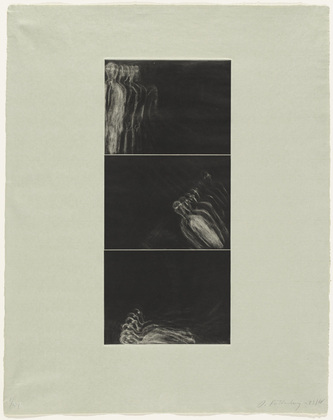
The image “Three Parts” accompanying today’s post by Susan Rothenberg (1987-88).

10/07/2013 (12 Moons Solo Project Day 280)

12 Moons Solo Saxophone Project Day 280

Date: 10/07/2013

Instrument: Tenor saxophone

Location: The rec room of my childhood home

Notes:

Between rehearsals and teaching this morning I stopped off at my families house.  With just a half hour or so before I need to leave I suddenly found myself in a calm and quiet space by myself.  I had just finished up a rehearsal for Bad Luck, my collaborative duo project with drummer Chris Icasiano.  Though we try and keep a light spirit, our rehearsals are marathon sessions filled with music that challenges us mentally and physically.  I carried this energy into my 12 Moons improvisation today, bringing this residual heightened state of energy into what would normally have been a calmer mood at my families empty house.

This improvisation was based off of an improvisatory section in a new Bad Luck composition.   I worked with the theme of clustered activity, both in the played material and space itself.  I wanted the microcosmic space between pitches to resonate as much as the short pitch punctuations themselves.  This improvisation begins with a heightened state of energy and activity that continues to builds on itself.  I used single and double tonguing, and despite the gritty textures I worked to stay particularly aware of the range and timbres I used while playing.  The bulk of the pitched material uses the palm keys which I would overblow to create bright crackles of sound. 

-Neil

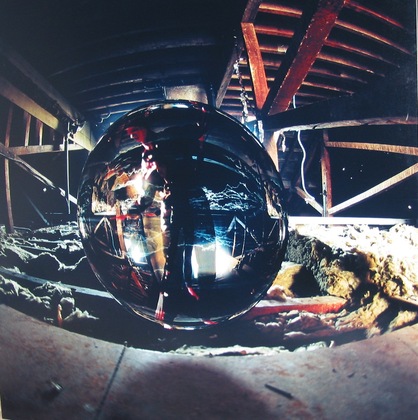
The image “Crawl Space” accompanying today’s post by Jane Wilson and Louise Wilson (1995).

10/06/2013 (12 Moons Solo Project Day 279)

12 Moons Solo Saxophone Project Day 279

Date: 10/06/2013

Instrument: Tenor saxophone

Location: Home studio in Clinton, WA (Whidbey Island)

Notes:

I’ve spent time with more aggressive sound executions the past several weeks, and while practicing a bit this morning I focused on tiny, subtle sound worlds.  I became interested in a combination of small sound constructions where I combined elements of varying levels of stability.  For example, the two pitches that begin the improvisation were extremely solid despite being played very quietly, but by adjusting my embouchure at :49-1:04 a brittle major chord emerges that at all times hinges on collapse.  It was extremely difficult to make it speak, let alone sustain it.  The bit of warbling in this chord was not intentional but was instead a bi-product of trying to hold it out as long as possible.

During this piece, movement between the F–quarter step flat, and Eb–quarter step flat became the central melodic figures.  I worked to balance this direct note-to-note melodic motion with chords that emerge from each of these pitches.  This included, for example the middle octave F opening up to become the fundamental of a Bb minor chord/multiphonic in 2nd inversion.  This can be heard at :38-:43.   The upper octave Eb then moves down slightly from time to time to take on a major chord shape.  The fingerings used during this improvisation were as follows:

F–quarter step flat (middle register)

(Left Hand) 1-2-3 // (Right Hand) 1-3

Eb–quarter step flat (upper register)

(Left Hand) 1-2-3, Palm Eb key only // (Right Hand) 1-3

Bb minor chord

(Left Hand) 1-2-3, Low B // (Right Hand) 1-3

Major chord (slightly loosen embouchure pressure)

(Left Hand) 1-2-3, Palm Eb key only, Low B // (Right Hand) 1-3

-Neil

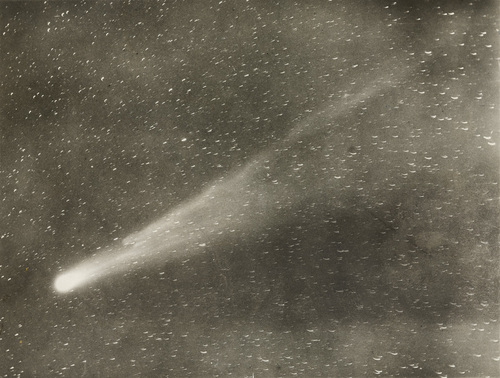
The image “Haley’s comet as It Looked in 1910” accompanying today’s post by United Press International (1910).