10/05/2013 (12 Moons Solo Project Day 278)

12 Moons Solo Saxophone Project Day 278

Date: 10/05/2013

Instrument: Soprano saxophone

Location: Outside my cabin at Mt. Index.  Mt. Index, WA

Notes:

My wife and I spent the day up at our cabin.  It’s located at the foot of Mt. Index in the Central Cascade Range about 7 miles past the town of Gold Bar.    The weather was too good to be inside the cabin, so we spent the day keeping ourselves warm around the fire ring to spite the chilly alpine wind blowing down off the mountains.   With no set agenda or obligations I spent many hours of my day practicing and improvising.   However, even though I came to the horn easily I found it hard to tackle my 12 Moons recorded improvisation. 

The mood of the day was light but the my surroundings were so extraordinarily grandiose, I wanted to honor the space with an appropriate improvisation.  After over an hour of false leads I naturally came to this piece.   Staring straight out at the craggily-toped peaks of the Cascades I tried to improvise a piece that mirrored their severity and amazing statliness.  During this improvisation I used quick, wide angled single pitches with rapid single tonging and slap tonging.  As one large mountain peak has many smaller ridges and bumps I worked to give this improvisation that character.  The piece maintains steady pacing overall until the conclusion, where the density of sound begins to dwindle away into unaccompanied single pitches with wider gaps between their execution.

-Neil

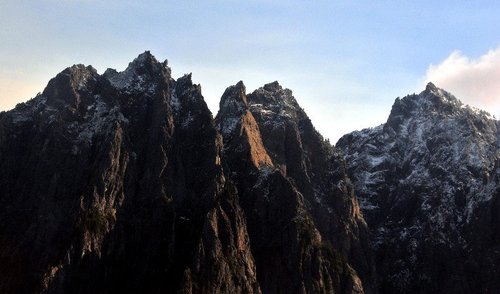
The image accompanying today’s post is Mt. Index and surrounding peaks in the Central Cascades.

10/04/2013 (12 Moons Solo Project Day 277)

12 Moons Solo Saxophone Project Day 277

Date: 10/04/2013

Instrument: Tenor saxophone

Location: Home studio in Clinton, WA (Whidbey Island)

Notes:

A few days ago my life force felt incredibly depleted.  There was a hollowness in me that wasn’t exhaustion or depression but something deeper and older.  I described it to my wife that I felt like a human puzzle with a missing piece. There was some indescribable thing that I was yearning for, and I came to realize that I needed the healing medicine of John Coltrane’s music.  I listened to the album “Infinity,” which features music released posthumously with beautiful string arrangements by his late wife Alice Coltrane.  I let the music wash over me and I felt this missing piece of life force fill back up.  The profound human searching in Coltrane’s helped guide me towards what I was looking for.  

In gratitude to Coltrane’s music and it’s importance in my life I recorded this improvisation today.  In the last period of his music Coltrane often talked about a trying to achieve a universal sound–a boundless sound that could unite all music together.  During this period nearly every composition of his uses the major or minor pentatonic scale in some form.  From the folk sounds of Appalachia to traditional music of Ghana, this magical scale is found in all musical cultures.  It’s my feeling that Coltrane used this scale so frequently because he believed in it’s universal power.  Today I explored the C Major Pentatonic scale through singing and hollering into the horn while playing a harmonic accompaniment. 

The first two pitches in the improvisation: G-E became the fulcrum of this improvisation.  Setting off from there I then improvised the remained of the improvisation, filling it in with the full C Major pentatonic scale.  To create the bulk of the harmonic material I used a single fingering, which was as follows:

For the pitches (in ascending order from lowest to highest played/sung): E, G, A, E, G, A

(Left Hand) 1-2, Low Bb // (Right Hand) 2-3.  Continuously cycle in a staggered motion the G key (left hand) and the Side F (right hand).

The remaining Concert C and Concert A used the following fingerings

Concert C:

(Left Hand) 1-2, Low Bb // (Right Hand) 1-2-3.  Continuously cycle in a staggered motion the G key (left hand) and the Side F (right hand).

The A minor chord created on the low octave A used the following fingering:

(Left Hand) 1-2-3, Low B // (Right Hand) 1-2-3, Low C.   Continuously cycle in a staggered motion the G key (left hand) and the Side F (right hand).

-Neil

The image “A Palm Sunday Painting” accompanying today’s post by Kai Althoff.

10/03/2013 (12 Moons Solo Project Day 276)

12 Moons Solo Saxophone Project Day 276

Date: 10/03/2013

Instrument: Tenor saxophone

Location: Practice Room B at South Whidbey High School.  Langley, WA (Whidbey Island)

Notes:

In today’s improvisation I wanted to explore the idea of stationary sound with accompanying motion.  To do this I structured the improvisation around two specific chord clusters and found fingerings that would allow the main chords themselves to ring out despite a variety of action around them.  There are some melodic and rhythmic cells where the chord is only used sparingly, but during these points the pitches used would move quickly back into the chord, or were used to contribute to the larger theme. There are components of the chord voicing that come in and out, or even morph into more dynamic roles within the “motion."  But there are some common factors that remained as stationary as possible, such as the muted Concert E in the lowest part of the voicing that almost functions as a drone throughout the entire improvisation.

Other techniques akin to the idea of stationary versus motion sound included holding the chord and suddenly bursting into fast melodic and rhythmic cells.  An example of this could be heard at 1:30.  The two chords contrasted in their sound profiles but shared the common lower octave, muted Concert E.  The first chord is dense, with a tight half step cluster in the upper octave.  This is the chord that opens the improvisation.  The second used only the Concert E, with each pitch split in octaves between the mid and upper register.  An example of this second chord can be heard at 2:38.  Each chord was referenced and developed several times and often dovetailed from one to the other.  The fingerings were as follows:

Chord Shape 1 (dense)

(Left Hand) 1-2, Octave, Palm D // (Right Hand) 1, Side Bb, Side F

Chord Shape 2 (octaves)

(Left Hand) 1-2, Octave, Palm Eb only // (Right Hand) 1, Side Bb, Side F

-Neil

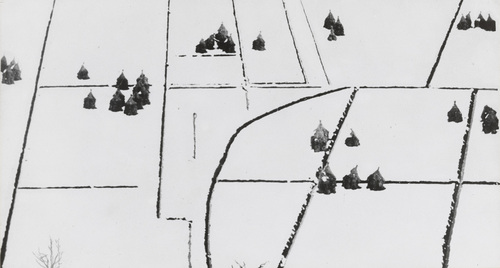
The image "Snow Pattern” accompanying today’s post by Kenji Tadamoto (c. 1959).

10/02/2013 (12 Moons Solo Project Day 275)

12 Moons Solo Saxophone Project Day 275

Date: 10/02/2013

Instrument: Tenor saxophone

Location: Home studio in Clinton, WA (Whidbey Island)

Notes:

Yesterday my friend and musical colleague Jacob Zimmerman and I gave a demonstration on the music of Roscoe Mitchell at Cornish College of the Arts.  Among many topics discussed was the strong prescense of Roscoe’s own saxophone technique in his composition.  Today I decided to work with this theme, and composed a short series of pitches intended to be improvised on and selected directly from the page.  Each of these pitches were played in the left hand only.  In the right hand I maintained a continuous “walking” trill with my index and middle fingers on the F clutch key.  

Because I was limited to working with fingerings in the left hand only, I used alternate fingerings in addition to traditional fingerings to allow for more chromatic pitches.  The trilling in the right hand added a fast wobbling that simulated a vibrato.  Because of the F clutch key being trilled in the right hand there were specific pitches that would become trilled if I were to play them.  I avoided these until about :45 into the improvisation, and then began intermittently incorporating them into the single pitch melodies.  The trilled pitches were as follows:

G>F#, G#>F#, B>A#, G>F# (middle octave), G#>F# (middle octave), B>A# (middle octave), G>F# (altissimo octave).

Overall I used wider, more dissonant intervals but there is some smaller, step-wise motion in the improvisation as well as some altissimo register notes, but these were used more infrequently.  I used aggressive articulation and a quiet to medium-loud level of volume throughout.  The pitch series improvised off of was as follows:

A, Eb, C, C#, F, D*, Eb, C, E*, Bb, D, C#, Eb, A, D*, C, A, Bb, C#

The * denotes alternate fingering. 

D* Palm D key only

Eb* Palm D and Eb keys only

E* Palm F key only

-Neil

The image “The subway” accompanying today’s post by Jose Clemente Orozco (1928).

10/01/2013 (12 Moons Solo Project Day 274)

image

12 Moons Solo Saxophone Project Day 274

Date: 10/01/2013

Instrument: Tenor saxophone

Location: Main performance hall at Chief Sealth High School

Notes:

For the third consecutive Tuesday in a now I was back in the main performance hall at Chief Sealth High School in West Seattle.  My current reed allowed for a very precise attack, particularly with a hard, swiping action, and I decided to center today’s improvisation around this technique and use the reverent hall to accentuate it.  I would flood the horn with air, and at virtually the same moment gently squeeze in my embouchure and smudge out the air flow with a quick application of my tongue.  This is similar to placing your hand over a vacuum cleaner hose and then pull it immediately away.  The pressure pulls my tongue in and then I almost have to force it away.   This is done very rapidly, and works the best when playing a single fingering, and at the moment the tongue touches the reed I move to an alternate fingering or unrelated pitch.  The end result is a push and pull effect that almost sounds like a series of pitches played in reverse.

During this improvisation I found that the room was the most responsive when moving between a traditional fingering into a two-toned cluster fingering.  However I would only let one of the tones in the cluster speak at a time.  Because the clusters can either hold two pitches at once or allow for isolation on either note, the motion of swiping the reed seems to pull the sound down or up towards the final pitch in an extremely fast bend.  This is a technique I’ve worked with extensively over the past two years.  Ab Concert was an absolute center of action during this piece.  I mainly pivoted around this pitch and focused heavily on it while playing.  The finger action used to accentuate this Ab was as follows:

Initial attack: (Left Hand) 1-2, Octave, Low Bb.  Articulate this pitch with the tongue in a legato style.

Final attack: (Left Hand) 1-2, Octave, Low Bb // (Right Hand) 1-2, Low Eb key.   Finger this at the moment the tongue is Applied.  Then immediately pull away the tongue.

-Neil

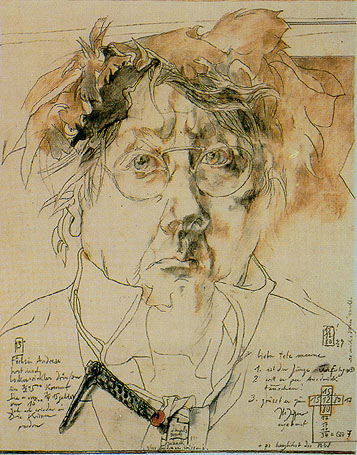
The image “Self Portrait” accompanying today’s post by Horst Janssen.