09/30/2013 (12 Moons Solo Project Day 273)

12 Moons Solo Saxophone Project Day 273

Date: 09/30/2013

Instrument: Tenor saxophone

Location: A room in my childhood home.

Notes:

The morning I was at my childhood house in Edmonds, practicing between my commitments for the day.  We grew up across the street from an elementary school, the same school I went to as a kid.   As with all children, one of my strongest memories was the liberating feeling in my body and soul at recess time.  The playground was on the other side of the street from our house, and every day as a child I would explore my adolescent world and grow on this playground, feeling the fresh air and weather on me.  But unlike other kids I always felt the comfort of being able to see my house while playing.  This made my home all the more special–even the seasons felt like a part of my house.  Playing in the maple leaves, running in the rain or kicking a ball around the pavement with my house in the foreground made it feel like my home was the world.  

By chance today I happened to begin recording right when the kids were let out for recess.  No matter how many years pass or how the world changes the joyful sounds of kids at play, their chatter, hollering and screaming from across the street stays the same.  I recorded two pieces today, and in trying to capture this amazing nostalgic feeling my first improvisation was good, but the spirit of it wasn’t in there.  I decided to record again, this time taking in what was around me–an open window in my mom’s house facing the street and the playground–endless little kids running around in the Fall air that’s now growing colder–the wind blowing.  I recorded this piece towards the end of recess and the bell telling the kids to line up for class can be hear ringing in the recording.  The kids kept on playing, like we all used to do.  And eventually their chatter gets quieter as they formed their little lines next to the building.

In this piece I wanted to compliment the environment outside the window.  Cars were driving by and the wind was blowing a bit.  I used very simple melodic figures in G major: 3-2-1— //  3-5—–3-2-1—–, with wide, breathy vibrato.

-Neil

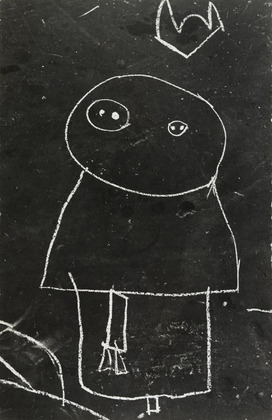
The image “(Untitled) People In Trees” accompanying today’s post by David Korty (2003).
09/29/2013 (12 Moons Solo Project Day 272)

image

12 Moons Solo Saxophone Project Day 272

Date: 09/29/2013

Instrument: Tenor saxophone

Location: Home studio in Clinton, WA (Whidbey Island)

Notes:

This morning I spent some time working with two sound clusters, each with tones approximately a half step apart.  They contained (in the tenor key of Bb) the pitches C/C (quarter step sharp) and A/Bb.  After alternating between these two chords for some time, I decided to incorporate them into larger combinations of chords, single pitched microtones and tempered pitches.  These combinations created amazing sound colors with very evocative moods.  I eventually decided to turn these sounds into more melodic cycles that tried to balance melody, harmony and rhythm into interesting combinations.  I felt that this improvisation almost had a dance-like quality to it, with lightly churning rhythms that sometimes held steady or would morph into new patterns and cycles.  

I tried to pace this improvisation in such a way that these melodic, harmonic and rhythmic cycles had forward momentum at all times.  I wanted to weave the sounds together into a labyrinth that seemed to have no beginning or end, just motion.  This accounted for the abrupt ending at the piece’s conclusion.  The interruption of established motives also became a critical element of this piece.  Before recording I practiced interrupting steady pulses with new pulse material, and then approached this with melody and harmony.  Again, during this improvisation I tried to use this concept multi-dimensionally, using the broader themes of continuance and interruption to apply to melody, harmony and rhythm simultaneously.

The bulk of this piece was improvised with a few of the figures, namely the opening figure, having been practiced ahead of time.  I used this opening figure as a platform from which to build, adding new pitches, rhythms and ornamentation such as grace notes and trills.  The 3 pitch areas used to build this opening were as follows:

Pitch: Eb (quarter step flat)

(Left Hand) Palm Eb key only, Octave

Pitches: C/C (quarter step sharp) split-tone

(Left Hand) 2, Octave, Low B // (Right Hand) 1-2

Pitches: A/Bb

(Left Hand) 2, Octave, Low B // (Right Hand) 1-2

-Neil

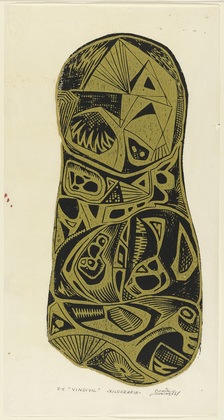
The image “Vindivil” accompanying today’s post by Julio Camino Sanchez (1967).

09/28/2013 (12 Moons Solo Project Day 271)

12 Moons Solo Saxophone Project Day 271

Date: 09/28/2013

Instrument: Tenor saxophone

Location: Home studio in Clinton, WA (Whidbey Island)

Notes:

Yesterday I worked with taking internal pitches inside a multiphonic chord and using those notes as the melodic material for improvising.  Today I buried melodic material inside of two chord shapes.  This melodic material was improvised, and I used the two chord shapes as springboards for exploring variation in sound while singing a melodic tone within them.  Chord Shape 1 and Chord Shape 2 are very similar, but Chord Shape 1 uses tones in the mid range and is more sparsely filled in.  Chord Shape 2 is much more full, denser in sound quality and uses tones in the lower register.  During much of the improvisation I would sing a pitch with Chord shape 1 and then continue to hold that same pitch while then moving on to the fingering in Chord shape 2.  An example of this can be heard at (:12) where I sang a Concert B with Chord Shape 1, and at (:15)  moved to Chord Shape 2.  The difference is subtle, and I thought of this motion as an orchestrational move, with the initial sound being being gently filled in and rounded out by the second. 

During this improvisation it was exciting for me to hear that sometimes a major chord would ring out in Chord Shape 1, but would become some other slightly different quality chord altogether when entering into Chord Shape 2.  This was despite the fact that both chords had very similar internal pitches.  As the piece progressed, I began singing different pitches from Chord Shape 1 to Chord Shape 2 to further explore internal clusters of sound and combinations of harmonic colors. 

There was also a bit of mystical sound in this improvisation.  When singing a Concert F# with chord Shape 1, I clearly heard my own voice singing a B above it.  This was not a different tone, but to my ears clearly a 2nd tone coming out of the horn with my own vocal qualities.  I’ve experienced similar occurrences like this before while singing into the horn but never a second tone so plainly stated with the same sound as my voice.  This can be heard, at least to my ears, at :21-:24 and again from :29-34. While playing the sound was as clear as day to my ears.

The fingerings used for each chord shape were as follows:

Chord Shape 1:

(Left Hand) 1-2-3, Low Bb // (Right Hand) 1-3, Low C#, Side F

Chord Shape 2:

(Left Hand) 1-2-3, Low Bb // (Right Hand) 1-3, Low C#

-Neil

The photograph “New York” accompanying today’s post by Helen Levitt (c. 1939).

09/27/2013 (12 Moons Solo Project Day 270)

12 Moons Solo Saxophone Project Day 270

Date: 09/27/2013

Instrument: Tenor saxophone

Location: Home studio in Clinton, WA (Whidbey Island)

Notes:

In today’s improvisation I used the internal pitch structure of a multiphonic chord as the bulk of the improvising material.  I had a discussion with my old saxophone teacher Michael Brockman yesterday about the application of multiphonic and split tone chords in composition, and this topic became my source material today.  I structured the improvisation around a chord with the following pitches: C (middle octave), B quarter step flat (upper octave) and F# (altissimo octave).  The chord shape used the following fingering:

(Left Hand) 1-3, Octave, Low B // (Right Hand) 1-2-3, Low C

With each execution of the multiphonic chord, I tried to give the listener some variation in volume. At times I would do a diminuendo shape spread over say 3-4 times playing the chord, do a contrasting crescendo shape,  or more indeterminately play the chord loud or soft.  The 3 pitches C, B, F# that made up the chord were used as the improvising material during the puckish interludes between the swiping chord sounds.   I moved the 3 pitches to various octaves at will and used traditional fingerings.

The swiping chords used at the beginning of the improvisation were rooted in a fingering similar to the main chord above.  However, the pitch content was more unrelated, focusing on an A to Bb motion.  I chose this texture because of it’s muted quality and lower register than the remaining material.  This was in contrast to the more solid mutiphonic chord and the plain-spoken single pitches.  I felt this contributed to an overall balance of textures during the improvisation.

I alternated between two chord shapes to create this sound.  

(Left Hand) 1-3, Low B // (Right Hand) 1-2-3, Low C (same as the primary multiphonic fingering, but without the octave key).

(Left Hand) 1-2, Low B // (Right Hand) 1-2-3, Low C

-Neil

The image “Le Beau Monde” accompanying today’s post by Rene Margritte (1962).

09/26/2013 (12 Moons Solo Project Day 269)

12 Moons Solo Saxophone Project Day 269

Date: 09/26/2013

Instrument: Tenor saxophone

Location: Practice room B at South Whidbey High School.  Langley, WA (Whidbey Island)

Notes:

I tried for about an hour this morning to develop a piece and record it, unsuccessfully.  It’s difficult sometimes to walk away from a piece which you have faith in but untimely does not work.  Looking for further inspiration, on the way out the door to teach I grabbed a newly picked-up book called “To A Violent Grave: An Oral Biography of Jackson Pollock."  Just the subject matter, the font on the pages and a few lines of text gave me the inspiration for today’s improvisation.  After coming up with the initial sound design and sculpting it a bit, I recorded this piece in a single take.

This improvisation is an exploration in contrasting moods in what I hear as a blues piece.  I built sound cycles off of complex chord clusters and tried to balance an analytical approach to my sound with a gut-instinct approach to blues playing.  The improvisation was centered around a Concert Ab with the following pitches: Ab, B, Db.  The gesture overall was in this pitch order: Ab, B, Db, B, Ab—-.  There is a muted sound cycle that opens the improvisation and is returned to a total of 3 times.  The upper register tones in this cycle became progressively more and more the sound focus as the piece evolved. Though it had little tonal reference to the blues melody and chords that are used in the remainder of this piece, I felt this opening sound was the perfect platform.  There is a sad, brooding feeling to it that just fit the mood so well.  The pitches and fingerings were as follows:

The melody: Continuously open and close the Side Bb (right hand) and C key (left hand) in a staggered cycle.

Ab (mid register overtone)

(Right Hand) 1-2-3, Low Bb // (Right Hand) 1-2-3

(Right Hand) 1-2-3, Low Bb, Eb palm key open ½ // (Right Hand) 1-2-3

Db

(Right Hand) Fork F, 2-3, Low Bb, Eb palm key open ½ // (Right Hand) 1-2-3

The muted sound cycle: Continuously open and close the Side Bb and C key (left hand) in a staggered cycle.

(Left Hand) 1-2-3, Low C# // (Right Hand) 1-2-3

The Melodic/Harmonic gesture occasionally played with the figure: Ab, B, Ab was fingered as follows:

Ab

(Left Hand) 1-2-3, Low Bb // (Right Hand) 1-2-3.  Cycle the Side Bb (right hand) and C key (left hand).

B

(Left Hand) 2-3, Low C# // (Right Hand) 1-2-3.  Cycle the Side C (right hand) and B key (left hand).

Ab

(Same as Ab above)

-Neil

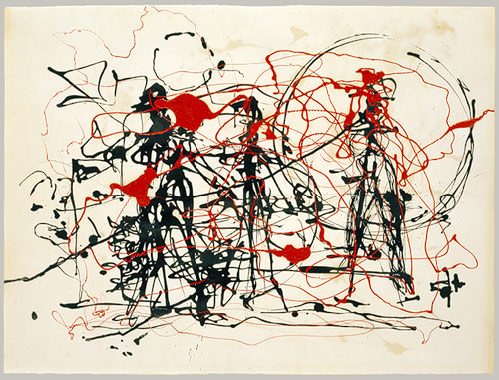
The image "Untitled” accompanying today’s post by Jackson Pollock (circa 1948-49).