09/25/2013 (12 Moons Solo Project Day 268)

12 Moons Solo Saxophone Project Day 268

Date: 09/25/2013

Instrument: Tenor saxophone

Location: Home studio in Clinton, WA (Whidbey Island)

Notes:

In my practice sessions the past week I’ve done a lot of singing into the horn, exploring textures that span the gamut from quiet subtlety to near noise.  The improvisation today is part of my current cycle of exploration in the subtler side of this area, which included singing into the horn the pitches that naturally occur in a split tone fingering.  While normally playing a split-tone there is a major adjustment in embouchure and air flow that needs to take place to accurately balance both pitches.  During this improvisation I created that same shape, but would sing the split tone pitches an octave below.  This allows the top tones to continue to speak a bit, but in more of a muted fashion.  The physical feeling in my throat while doing this is incredibly unique.  It’s very challenging, and it literally felt as though I was singing every microcosm of sound that came out.  The air flow fights back from the horn tremendously, and the sound almost rolls around my throat and chest.  I suspect this is because the split-tone has two pitches played simultaneously, and in my singing I’m only sounding one pitch at a time.  This results in a fight between the single tones and chord tones.

While playing this piece I used the motion of my voice to move up and down between pitches, as in a very slow trill.  Because of the above described physical back-pressure, it’s very challenging to sing these purely in tune.  I decided to make my singing a bit more flexible in pitch, sometimes trying to sit dead-on and other times bending the note up and down to explore textures in the overall chordal sound.  In the last third or so of the improvisation I began a much faster trill with my voice, which was done with a new mouth shape where I moved my tongue up and down in my throat, which when sung out loud makes a phonetic sound like the letters"o-e-o" but at a very rapid speed.  The fingerings and pitches (in the tenor key of Bb) were as follows:

E-C# (each a quarter step flat)

(Right Hand) 1-2-3, Palm Eb // (Right Hand) 1-2, Low C. 

C# (quarter step flat)-D#

(Right Hand) 1-2-3, Palm Eb, Low Bb // (Right Hand) 1-2, Low C. 

D-E-F# tri-chord (each a quarter step flat)

(Right Hand) Fork F, 2-3, Low Bb // (Right Hand) 1, Low C.

-Neil

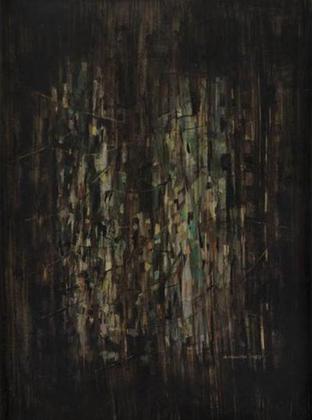
The image “Untitled” accompanying today’s post by Seymour Rosofsky (1960-61).
09/24/2013 (12 Moons Solo Project Day 267)

12 Moons Solo Saxophone Project Day 267

Date: 09/24/2013

Instrument: Tenor saxophone

Location: The main performance hall at Chief Sealth High/Denny Middle School.

Notes:

This morning my chest and lungs were feeling a bit tight, maybe from a cold on the horizon.  I decided to explore sound action executed within a single breath to celebrate the feeling instead of fight it.   Each gesture in this piece lasted as long as my body could comfortably allow.  I used a single fingering throughout, one which required a great amount of air and had a high degree of back-pressure while playing.  This fingering had a wide sound-spectrum, with colors in tight and wider pitch clusters, gritty multiphonics and brittle altissimo tones.  I made it my aim to simply blow into the horn with a variety of embouchure pressures and directions in air flow.  From the point at which the sound came out of the horn, I would try to carefully work with what was presented to me and to shape it in subtle ways.

The fingering used was as follows/:

(Left Hand) 1-2, Octave, Palm Eb, Low Bb // (Right Hand) 1, Low C

-Neil

The image “City Night” accompanying today’s post by Norman Lewis (1949).

09/23/2013 (12 Moons Solo Project Day 266)

12 Moons Solo Saxophone Project Day 266

Date: 09/23/2013

Instrument: Tenor saxophone

Location: The rec room of my childhood home in Edmonds, WA 

Notes:

In preparation for a show tonight, I worked on the great saxophonist Rosoce Mitchell’s landmark composition Nonaah during my practice session today.  The wide, disjunct melodic landscape is organized in a brilliant series of chromatic gestures separated by, in my cases, over 2 octaves of displacement.  The piece is both an achievement in composition and a fantastic platform from which to build as an improvisor.  It’s his use of octave displacement in particular that fascinates me, and in today’s improvisation I was interested in exploring the idea of opposing musical forces.  This was represented in my improvisation by using groupings of two pitches, each an octave apart, but with one side starkly more aggressive and loud in volume, and the other more subdued in timbre and significantly quieter.

There was no particular structure to the pitch choice, accept to say that I tended to avoid moving chromatically.  Though it was inadvertent, there were some pitches used very sparingly, such as: Concert, Ab, D, B, Bb, and F#.  Others used very frequently included: G, Db, A.  I had no overarching formal structure to the improvisation other than the simple concept of octave displacement paired with timbre/volume displacement.  As the piece progressed I ebbed and flowed between periods of relative calm and periods of faster, higher density action.

-Neil

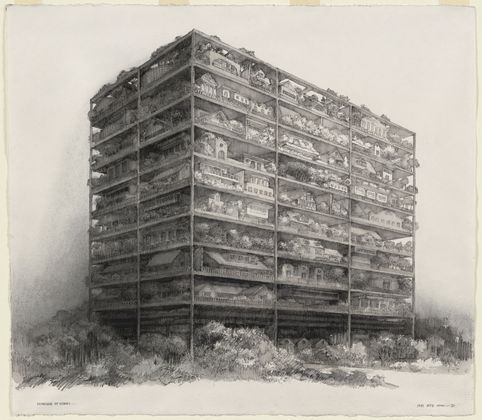
The image “SITE (Sculpture in the Enviornment)” accompanying today’s post by James Wines (1981).

09/22/2013 (12 Moons Solo Project Day 265)

12 Moons Solo Saxophone Project Day 265

Date: 09/22/2013

Instrument: Tenor saxophone

Location: Home studio in Clinton, WA (Whidbey Island)

Notes:

This improvisation used a multilayered “diving” technique I’ve been working on a bit lately.  During this piece I continuously articulate pitches indeterminately in the lower to mid registers, while “diving” pitches down with my voice simultaneously.  During this piece I tried to phase between periodic sections of more and less control over which pitches would be played and sung.  The improvisation opens with a more balanced level of volume end density between what is played and what is sung, but as I explored further this balance ebbed and flowed.  As the piece progressed I began balancing indeterminate singing with occasional unison singing alongside the fingered pitches.  At about the 2/3 mark there is a slower section in the improvisation where the initial attack on the pitch I sang was in unison with the pitches being played on the horn.  But from this point forward I began getting more aggressive with the gruffness of sound being explored and referenced the unison sound pretty infrequently.

During the bulk of the piece every pitch that was sang was also followed by an articulation.  Depending on how quickly I moved in my fingered pitches, sometimes the pitches would move at a ratio of 1 to1, but at other points I would play several fingerings while doing one attack of the voice dive.  This ratio could then increase to 1-2, 1-3, etc.  Throughout there was no set articulation pattern whatsoever, but there are periods of increased repetition, and even some small tonal development in the form of arpeggiation.  As the piece evolved I also began using some double tonging to increase the ratio of “played” versus “sung” pitches.

-Neil

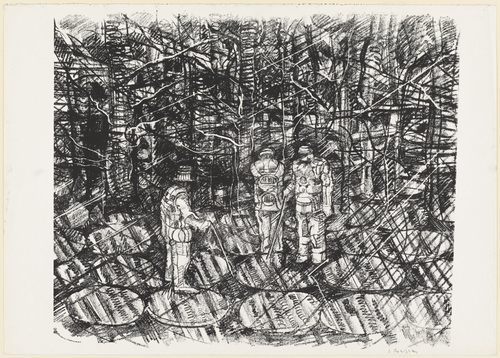
The image “Untitled” accompanying today’s post by Lennart Olson (1940-53).

09/21/2013 (12 Moons Solo Project Day 264)

12 Moons Solo Saxophone Project Day 264

Date: 09/21/2013

Instrument: Tenor saxophone

Location: Home studio in Clinton, WA Whidbey Island)

Notes:

I spent the day composing and fleshing out parts for an upcoming performance.  On days like this I spend far less time on my horn, but I find that I walk away feeling not only artistically fulfilled, but also fulfilled in my practicing.  I decided to wait until the compositional phase of my work today was finished, and recorded right as I ended.  The improvisatoin has little to do with the composition work that came before it, but I found that the spirit of this work highly influenced this piece.  I felt calm, relaxed, and the figures I worked with felt very comfortable and familiar.

The theme of this piece in my mind was the creation of a sound landscape.  This improvisation used a simple, patient melodic shape above a higher density torrent of chords and clusters beneath it.  I used two fingerings, both of which shared two common tones, the Ab and F.  The two fingerings used the Low Bb and Low B traditional saxophone fingerings, but were played with sound cycles by opening and closing the B key (left hand) and the side F key (right hand).  The fingerings used were as follows:

Low Bb fingering with the octave key depressed.  Cycle open and closed the B key and side F key.

(Left Hand) 1-2-3, Octave, Low Bb  // (Right Hand) 1-2-3, Low C.

Melodic shape: Ab-F // Ab-D

Low B fingering with the octave key depressed.  Cycle open and closed the B key and side F key.

(Left Hand) 1-2-3, Octave, Low B // (Right Hand) 1-2-3, Low C

Melodic shape: Ab-F // Ab Eb

The Ab and F were common tones between both chords.  I approached this piece at a mid-quiet level of volume.  The above pitches are part of the overtone series, and the flexibility while moving between them is similar in mouth shape and air speed to simply playing the traditional fingerings without the sound cycles incorporated.  As the improvisation evolved, I occasionally opened the octave key in both fingerings to allow the lower tones in the overtone series to speak.

-Neil

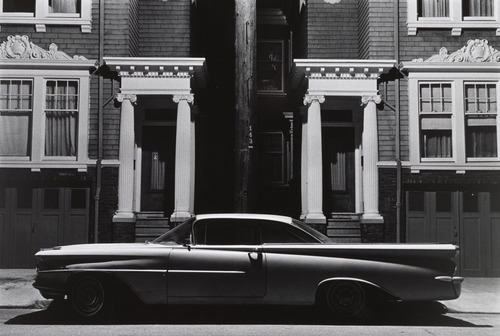
The image “Untitled” accompanying today’s post by William Gedney (1966).