09/20/2013 (12 Moons Solo Project Day 263)

12 Moons Solo Saxophone Project Day 263

Date: 09/20/2013

Instrument: Tenor saxophone

Location: Home studio in Clinton, WA (Whidbey Island)

Notes:

While on a break between students yesterday I flipped through a terrible coffee table book on the history of music.  There was a brief mentioning of the importance of Steve Reich’s music in the development of minimalism, particularly his use of the phasing technique; offsetting rhythmic cycles to create new sets of rhythms, harmony and melodicism–all in a near constant state of evolution.   Phasing is a compositional tool very important to me in my solo playing, and in today’s improvisation I worked on a new phasing technique using vibrato.  I selected a split tone fingering which has different pitch content depending on the octave the fingering is played in.  If I treat the fingering as though it were an overtone and adjust my embouchure and air flow, I can move between these groupings of pitch content with small moments of overlap.  It’s in these moments of overlap where I focus my energy in much of my solo playing.  I generally use a combination of mouth shape with alternate fingerings to create sound and rhythm cycles, again, often with some degree of phasing.  In today’s improvisation I used a continuous flow of vibrato to maintain a fairly static rhythmic pulse while phasing between octaves.  This vibrato not only maintained rhythm but as also use to blend one section of the horn into another.

This improvisation was extremely challenging, and specifically the split tone chord which begins the piece.  I needed a wide and very focused air flow to speak both pitches at once, and while doing vibrato it’s very challenging to find the core shape needed to allow the pitches to speak.  Another challenge was finding an overall mouth shape that could work in all registers.  I did adjust a bit to pull out the different sound regions in this piece, but I needed a core base of muscle control to build from.  

During this improvisation I primarily used a single fingering.  At about the mid point I began adding the octave key, which shifted some of the pitch content up a half step. I would then move between the original and this secondary fingering, all the while maintaining the wide vibrato.  Overall I heard the sound divided in Fingering 1between 3 sections, which are written below.  I did move a bit higher up the horn, but this area of the horn was only fleeting. The pitches and fingerings (in the tenor key of Bb) were as follows:

Fingering I  (primary fingering)

(Left Hand) 1-3, Low B // (Right Hand) F-E-D keys, Low C.  This fingering allowed for the following sound areas.  

-Ab/B  split tone (mid register)

-B.  (mid register.

-A (upper register) Ab/B (mid register).  Same as the first split tone grouping.

Fingering 2 (secondary fingering used sparingly)

(Left Hand) 1-3, Octave, Low B // (Right Hand) F-E-D keys, Low C.  Same fingering as above but with the octave key added.

-C (mid register).  This pitch moved ½ step up from the B (sound 1) in fingering 1.

-A (upper register) C (mid register).  This split tone maintained the same upper note voicing as the A (sound 3) from fingering 1.  However, the Ab in the bottom drops out and the B moves up a half step to become a C.

-Neil

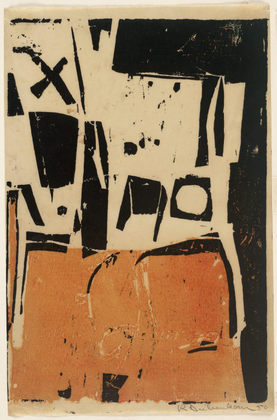
The image “Untitled” accompanying today’s post by Richard Diebenkorn (1950).
09/19/2013 (12 Moons Solo Project Day 262)

12 Moons Solo Saxophone Project Day 262

Date: 09/19/2013

Instrument: Tenor saxophone

Location: Home studio in Clinton, WA (Whidbey Island)

Notes:

I wanted to create a sound landscape in today’s improvisation that brought to life the amazing feeling of being up well before sunrise, where you feel like a participant in an alternate world no one else knows about.  I love being awake while much of the world is asleep.  I feel like the day is full of possibility and can be shaped as I want it to be.  Generally these days I’m up at about 5:45am, but this morning I slept in until 6:30am.  I looked outside and saw that it was already light out.  A car were driving by, and lights were already on in other houses.  This entire morning I’ve felt like the world is 1 hour ahead of me, and I wanted to capture in sound that extraordinary feeling that I was unable to experience today.  A new day in early morning.

During this improvisation I simulated the use of reverb by using both muted fingerings and split tone fingerings.  The only editing I do to these tracks each day is clipping off the dead air at the beginning and ends of the improvisation, and occasionally boosting the volume a bit.   Other than that there is zero editing.  I actually re-edited this piece after finishing it because I was convinced that I had accidentally added reverb at the beginning of the track.  The bleeding of the the pitches in this piece, particularly in the first 30 seconds sound so beautiful to me, and I was amazed at the horns response to my shaping of the sound.

I wanted to capture the calm, clear-headedness of early morning.  The melody used here is somewhat melancholiac, and I worked to create harmonic support for it that contributed to a floating, malleable sound world.  The pitch content in the melody used three pitches/chords and was as follows (in the tenor key of Bb):

A (quarter step flat)

A/B split tone (each a quarter step flat)

Eb/F (the Eb in the upper register was a quarter step flat)

E (upper register), A/B split tone (each a quarter step flat)

This last chord was added to the end of the phrase as the piece evolved.  This was the sustained chord that breaks away from the primary melody.

The fingerings for these pitches/chords were as follows:

A (quarter step flat)

(Left Hand) 1-2, Octave, Low Bb // (Right Hand) 1-3

A/B split tone (each a quarter step flat)

(Left Hand) 1-2, Octave, Low Bb // (Right Hand) 1-2-3

Eb/F (the Eb in the upper register was a quarter step flat).

(Left Hand) 1-2, Eb and D palm keys, Octave, Low Bb // (Right Hand) 1-2-3

E (upper register), A/B split tone (each a quarter step flat)

(Left Hand) 1-2, Octave, Low Bb // (Right Hand) 1-2-3.  Same as the second A/B split tone chord fingering, but apply more pressure with the embouchure and focus on a gentler, higher air flow in the mouth.

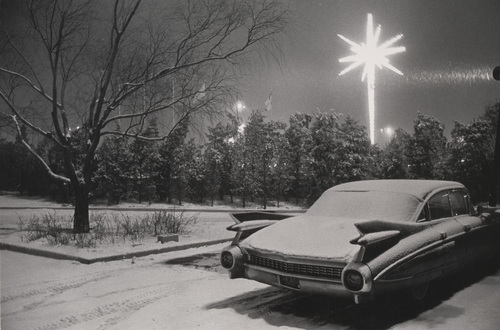
The image “Christmas at Kennedy Airport” accompanying today’s post by Joel Meyerowitz (1968).

09/18/2013 (12 Moons Solo Project Day 261

12 Moons Solo Saxophone Project Day 261

Date: 09/18/2013

Instrument: Tenor saxophone

Location: Home studio in Clinton, WA (Whidbey Island)

Notes:

This is an energy piece that emerged at the end of a practice session.  During this session I focused on much more subtle, controlled elements of combining chords and split tones at quiet to medium loud dynamic levels.  It felt like a natural impulse to bring this concept into my recording today, but I decided to try an energy piece with fresh ears instead.  During this improvisation I used a split tone (two-note chord) fingering, but instead let only the bottom fundamental pitch speak.  I sang a single pitch, plucked from a major triad above this fundamental, singing either the root, 3rd or 5th each time.  This allowed a much more dynamic chord to emerge than would have with only the split-tone fingering.  The fundamental pitch itself is a quarter step sharp Concert A.  Between the held out major shapes I played aggressive sound-textures with an unrelated harmonic base along with humming, screaming and growling.  With this fingering I flicked open the Low C key to help the sound travel more aggressively up the horn.  The fingerings were as follows:

Split-tone fingering (with pitches sang in unison on the root, or harmonically on the 3rd or 5th):

(Left Hand) 1-3, Octave, Low B 

Sound-texture:

(Left Hand) 1-2-3, Low B // (Right Hand) 1-2-3, Flick the low C key closed and then open.

-Neil

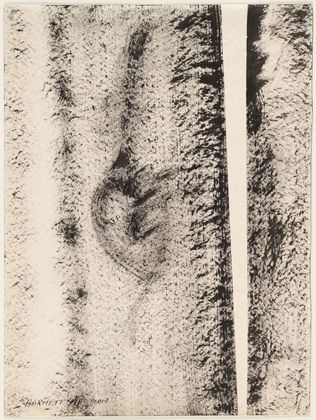
The image “Untitled” accompanying today’s post by Barnett Newman (1946).

09/17/2013 (12 Moons Solo Project Day 260)

12 Moons Solo Saxophone Project Day 260

Date: 09/17/2013

Instrument: Tenor saxophone

Location: Performance hall at Chief Sealth International High School.  Seattle, WA

Notes:

After a few months away from this room, I recorded this morning in the performance hall at Chief Sealth High School.  I love this space, but I’m admittedly a bit intimidated recording here.  The acoustics are vibrant and warm and the space is welcoming enough, but it seems every time I walk into this room my sound is overtaken by the shear size and presence of it.  I don’t often perform in a traditional performance hall, and rarely one of this size.  This is a very flexible space, and it allows for an amazing dynamic range and very site-specific sonic responses as I play.  I think my leeriness may come from my own ego trying to fulfill the allure of this room.  It offers so many specific options I rarely take full advantage of, or execute in such a way as to maximize their effect.  Today I walked in feeling much more confident and welcomed the chance to explore what the room had to offer me.

Because of the clear projection of my sound in this room, I decided to record a piece that used a phasing melodic sound with the illusion of an echo.  This was best executed near the beginning of the improvisation at (:18).  To do this, I projected my volume at an equal level but would very quickly pull back my volume as evenly as possible at the very last moment.  I thought of my sound as traveling along a fixed line with a quick descent at a 45 degree angle into silence.  I used a recurring folk-like melody, and explore de-tuned tones at the ends of my phrasing.  Along with the dips in volume, the de-tuned pitches helped to contribute to the illusion of an echo.  I developed this improvisation over about 15 minutes of trial recording, letting the room be my guide as how to best achieve these effects.

-Neil

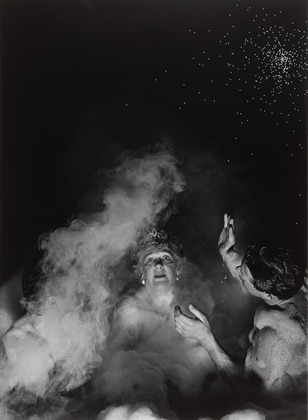
The image “Stellar by Starlight #2” accompanying today’s post by Anne Noggle (1985).

09/16/2013 (12 Moons Solo Project Day 259)

12 Moons Solo Saxophone Project Day 259

Date: 09/16/2013

Instrument: Tenor saxophone

Location: Home studio in Clinton, WA (Whidbey Island)

Notes:

In a rehearsal yesterday with Chris Icasiano for our duo Bad Luck, we worked on melodic material we’ve constructed that can only be played by the two of us.  This is an artistic process we’ve cultivated over several years together now.  Our compositional process is reliant on each other for execution, with passages that are specifically written for textural or conceptual figures unique to our playing, usually via composing based on each others interests in solo work.   This concept bled into my 12 Moons improvisation today.  

For the past several days I’ve also been very discouraged by my sound.  I had a lip blister which made it difficult to play and even more difficult to form my regular embouchure.  The embouchure changes I needed to make in order to play did open up some new sound fields for me, but today my mouth is thankfully feeling just about back to normal.  The reed I stumbled on this morning was really optimal for this kind of improvisation.  There are colors and textures in this piece that aligned perfectly with the physical conditions in my body and horn today.  In this way, from yesterday’s rehearsal and more confidence in my sound, my mind was free to explore more complicated figures that are unique to my own sound interests.

In this piece I used a recurring 5/8 phrase with the beaming of 2-3.  Using odd metered phrasing is a very common approach for me in solo playing.  I used 2 Figures during this improvisation, and each figure had two fingering systems.  I divided Figure 1 up in my mind as having three tiers.  Tier 1 is the lower register melody (this opens the improvisation).  Tier 2 is a mid register counter melody added to the bottom (this begins to enter at :27).  Tier 3 is in the upper register, which is added to the bottom and middle melodies.  This begins to enter at 2:22.  Each of these Tiers was played by adjusting my air flow and embouchure pressure while maintaining the fingering and rhythmic cycle.

At 3:10 I make an abrupt harmonic change and Figure 2 enters.  There is also a slight, momentary pause before it begins.  I maintained the 5/8 time signature and 2-3 phrasing.  This figure has a slightly different sound profile than Figure 1, with tighter chord voicing’s and a darker aesthetic quality to it.  I then began alternating between the Figure 1 (3 Tiers) and the Figure 2 landscapes from this point forward.  The piece ends with a focus on a more static upper register tone in the Figure 2 fingering system.

Figure 1

System 1: 2-3 Phrasing (written in order they were played)

(Left Hand) 1-2-3, Octave, Palm Eb, Low Bb  // (Right Hand) 1-2, Low C

(Left Hand) 1-2-3, Octave, Low Bb  // (Right Hand) 1-, Low C

(Left Hand) 1-2-3, Octave, Palm Eb, Low Bb  // (Right Hand) 1-2, Low C

(Left Hand) 1-2-3, Octave, Palm Eb, Low Bb  // (Right Hand) 1-, Low C

(Left Hand) 1-2-3, Octave, Low Bb  // (Right Hand) 1-, Low C

System 2:  2-3 Phrasing (written in order they were played)

(Left Hand) 1-2-3, Octave, Palm Eb, Low Bb  // (Right Hand) 1-2, Low C

(Left Hand) 1-2-3, Octave, Low Bb  // (Right Hand) 2-, Low C

(Left Hand) 1-2-3, Octave, Palm Eb, Low Bb  // (Right Hand) 1-2, Low C

(Left Hand) 1-2-3, Octave, Palm Eb, Low Bb  // (Right Hand) 2-, Low C

(Left Hand) 1-2-3, Octave, Low Bb  // (Right Hand) 2-, Low C

Figure 2 fingerings (same as above, but supplement the F Palm key instead of the Eb palm key, and completely take away the octave key).  To do this, reach over to the key with the left thumb which was formally pushing down the octave key.  For specific reference, this fingering system is notated below as well.

System 1: 2-3 Phrasing (written in order they were played)

(Left Hand) 1-2-3, Palm F, Low Bb  // (Right Hand) 1-2, Low C

(Left Hand) 1-2-3, Low Bb  // (Right Hand) 1-, Low C

(Left Hand) 1-2-3, Palm F, Low Bb  // (Right Hand) 1-2, Low C

(Left Hand) 1-2-3, Palm F, Low Bb  // (Right Hand) 1-, Low C

(Left Hand) 1-2-3, Low Bb  // (Right Hand) 1-, Low C

System 2:  2-3 Phrasing (written in order they were played)

(Left Hand) 1-2-3, Palm F, Low Bb  // (Right Hand) 1-2, Low C

(Left Hand) 1-2-3, Low Bb  // (Right Hand) 2-, Low C

(Left Hand) 1-2-3, Palm F, Low Bb  // (Right Hand) 1-2, Low C

(Left Hand) 1-2-3, Palm F, Low Bb  // (Right Hand) 2-, Low C

(Left Hand) 1-2-3, Low Bb  // (Right Hand) 2-, Low C

-Neil

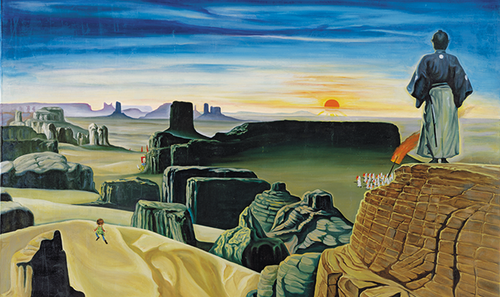
The image “Samurai, the Watcher” accompanying today’s post by Tateishi Koichi (1965).