09/15/2013 (12 Moons Solo Project Day 258)

12 Moons Solo Saxophone Project Day 258

Date: 09/15/2013

Instrument: Tenor saxophone

Location: Home studio in Clinton, WA (Whidbey Island)

Notes:

Today I worked with a bluesy gesture in the key of E minor.  I used a series of multiphonics which hd distinct profiles in two separate octaves, creating melodic ideas that I explored in each range but tried to weave together into a broader melodic and harmonic whole.  I combined the multiphonics to create melodic fragments which I repeated continuously.  There were some figures, particularly those in the lower register, which I played far more infrequently than those explored in the upper register.  During this improvisation I maintained a steady tempo, but because of the nature of my improvised fingering systems, some of the pitches were more muted or were slightly de tuned from one note to another.  Because of the additional notes, this resulted in polyrhythms that bled into the melody, giving the melodies either a steady pulse, or at other times these polyrhythms added momentary hiccups into the expected phrasing.

The melodic fragments in the two octaves tended to center around the following melodic gestures (written in the tenor key of Bb):

Upper register: F#, C#, E, F, E, C#—- //  // C#, E, F, E C#—-

The fingerings used to make these various pitch centers, again with additional sound profiles built into them as multiphonics were as follows:

(Left Hand) B-A-G keys, Octave, Low B // (Right Hand) E-D keys

(Left Hand) Fork F, G key, Octave, Low B // (Right Hand) E-D keys

(Left Hand) Fork F, G key, Octave, Low B // (Right Hand) E-D, F# key

Lower register: F#, C#, F#—- // F#, A, F#—-, C#, F#—-

The fingerings used to make these various pitch centers, again with additional sound profiles built into them as multiphonics were as follows

(Left Hand) B-A-G keys, Octave, Low B // (Right Hand) E-D keys

(Left Hand) A-G keys, Octave, Low B // (Right Hand) E-D keys

-Neil

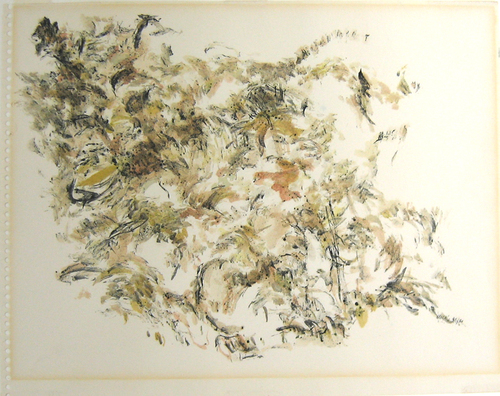
The image “Forest Floor” accompanying today’s post by Tony Urquart (1961).
09/14/2013 (12 Moons Solo Project Day 257)

12 Moons Solo Saxophone Project Day 257

Date: 09/14/2013

Instrument: Tenor saxophone

Location: Home studio in Clinton, WA (Whidbey Island)

Notes:

Today’s improvisation was born out of a long, laborious process.  This afternoon I had an allergy attack, which is very unusual for me.  This unfortunately coincided with the practice session time I had set aside, and during the two hours I was working the allergy attack spanned the gamut from physical discomfort, to a near inability to play, the hazy mental perception that comes with any kind of cold, and eventually the attack’s passing.  At one point, after every note I played my body responded with a sneeze.  I continued to play because I’ve found in the past that by playing the horn, I can cast out certain ailments like black magic.  By the end of my practice session, my allergy attack was down to a state of mild discomfort.  My improvisation today was a piece that explored the extremes that we all know will exist in these circumstances, the storm and a return to the calm.

During this piece I used a total of three fingerings.  The first two make up the aggressive swatches of sound where I sing into the horn and the third is the calm major chord.  In the aggressive textures I sang between a Concert Ab to B, which mirrored the split tone chords being played that had the same pitches inside them. The split tone can be played simultaneously or one pitch at a time.  During this piece I used both approaches. 

Aggressive split tone chords:

(Left Hand) Bis Bb, Low Bb // (Right Hand) F-E-D keys, Low C, Side Bb

(Left Hand) B-A keys, Low Bb // (Right Hand) F-E-D keys, Low C, Side Bb

Major Chord:

(Left Hand) B-A-G keys, Octave, Low B // (Right Hand) F-E-D keys, Side Bb, Low C.

-Neil

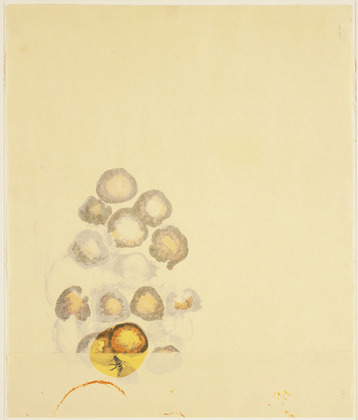
The image “IX from the series Folded Light (Luz Plageda)” accompanying today’s post by Jose Maria Sicilia (1994).

09/13/2013 (12 Moons Solo Project Day 256)

image

12 Moons Solo Saxophone Project Day 256

Date: 09/13/2013

Instrument: Tenor saxophone

Location: Home studio in Clinton, WA (Whidbey Island)

Notes:

Today I worked with repetitive, sustained pitches and chords using different tonging techniques.  In this improvisation I wanted to explore the idea that quickness of tempo can be linked to timbre.  To explore this idea, I would sustain a note and find false fingerings to play against it that would make  very marginal, subtle changes in the tuning.  Because each false fingering is a little different, some pitches speak more than others, whether because they have greater or less volume relative to one another, or maybe because of the timbral relationship from one pitch to another.  This can create sound cycles that, because some notes are more punctuated, begin to create complex rhythms and incredible sound worlds.

In the opening of this piece I use rapid, single tonging at a consistent tempo.  I play a Concert C, then close the F, E, and D keys before opening them all back up to speak the Concert C again.  This is a sound cycle with 4 components, which is easy to link up with when articulating sixteenth notes.  At :49 seconds I began using double tonging. Even though this articulation is clearly more rapid, in a way it feels almost slower to me than the single tonging.  The double tonging has a harsher attack, but in the single tonging, I strike the reed much more gently in order to play quickly.   The false fingerings bring out a very subtle, sustained C in the upper register which is very audible in the single tonging but almost inaudible in the double.  This upper octave tone combines with the sustained G in the lower register, and to my ears this pairing of sustained pitches accentuates the stark difference of the articulation attack, and makes is sound even quicker.

In this improvisation, along with the varied articulation, I was also interested in using contrasting sound elements.  At 2:33 I abruptly jump into the upper register to play two very consonant chords.  Before doing this I changed the fingering cycle pattern in the right hand in order to allow those chords to create a sound cycle as well.  The pitches and fingerings (in the tenor key of Bb) used were as follows:

Lower register sound cycles:

Pitch D: B-A keys, Palm Eb only.   Close the F, E, then D keys in the right hand, and then open fully.

Pitch Eb: Bend up to this pitch by playing the A fingering and opening the Fork F key.  Close the F, E, then D keys in the right hand, and then opening fully.

Upper register chords/sound cycles:

Chord 1:

(Left Hand) B-A keys, Octave, Palm Eb key // (Right Hand) 

Chord 2: 

(Left Hand) B-A keys, Octave, Palm D and Eb keys // (Right Hand) 

Notes: Close the E, D, then C keys in the right hand in a triplet pattern for each chord.

-Neil

The image “Untitled” accompanying today’s post by Charline von Heyl (2007).

09/12/2013 (12 Moons Solo Project Day 255)

12 Moons Solo Saxophone Project Day 255

Date: 09/12/2013

Instrument: Tenor saxophone

Location: Lecture Room 107 at South Whidbey High School.

Notes:

Between students this afternoon I spent time working in the choir room at South Whidbey High School.  The acoustics in this space are incredibly reverberant, and one corner of the room has a tight, pinging delay that I believe comes from the air ducts overhead in combination with the rooms large size.  While I explored this space, the school band director Chris Harshman happened to come through the room and suggested I try playing in the lecture hall.   It’s an oval-shaped room with concrete floors, a tall ceiling and tiered lecture hall styled seating. Chris had already pinpointed an incredible sweet spot in that room.  It was in the center, 2/3 up the room and specifically between two rows of chairs.  In this sweet spot there is an amazing convergence of acoustic pinging.  The delay is longer and more percussive than the choir room, and the sound qualities of this space appeared to me to be a convergence of the architectural shape of the room, the materials used, and some kind of duct work in the walls and or ceiling.  

During this improvisation I used a number of specific percussive techniques.  The louder clacks are the use of a lighter to medium pressure slap tonging.  I tried to restrict this to the fingering D. The louder, more aggressive pitch slap was done on the Low Bb or Low B.  Slap tonging is an aggressive stopping of the air against the reed with a quick pull-back.  In this use of slap tonging I blew air into the horn versus pulling air back out of it.  The bulk of the remaining sound material is a technique that creates a kissing sound on the horn.  The physical creation of this sound is very different than slap tonging.  The kissing sound is quicker and is a pulling away of the reed and mouthpiece while sucking in air.  While doing this my tongue releases the reed and is immediately put back on.  Even on a single fingering many different pitches can be pulled out, depending on embouchure pressure and air flow.  The last technique used during this piece was flutter tonging while raising my tonging in the back of my throat, creating a wind tunnel-like sound.  This again was done on the low Bb.

-Neil

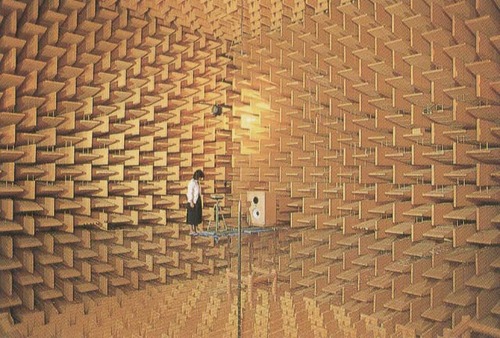
The image accompanying today’s post is of an Anechoic Chamber, a room designed to minimize or eliminate sound.

09/11/2013 (12 Moons Solo Project Day 254)

12 Moons Solo Saxophone Project Day 254

Date: 09/11/2013

Instrument: Tenor saxophone

Location: The rec room of my childhood home in Edmonds, WA 

Notes:

I developed this improvisation early this morning, and did so after quickly searching for two chords with a complimentary sound profile.  I wanted to find two chords that struck me and to commit to working with them.  I’ve become very interested lately in using more traditional voice-leading in my solo music, and this improvisation alternates between two chords that explore this idea.  Though the pitches between the two chords descend, there are non-traditional components to the harmonic motion that give the implication of more complex voice leading.  For example, the top-most pitch descends by a whole step, but the bottom most pitch descends by only a quarter step.  In the harmonic make-up of the first chord, there are two clearly audible pitches, versus the second which has three.  This third pitch is a minor third below the melodic voice, and when this is introduced into the sound field it almost gives me the impression that the voice has moved up, when it reality it simple just enters abruptly.  The more muffled, subdued timbal sound of the pitch likely influences this impression.

The fingerings and pitches used in the two chords were follows (in the tenor key of Bb) :

Chord 1.  Pitches: Middle octave F (quarter step high), Upper register F

(Left Hand) B-A keys, Octave, Palm F only // (Right Hand) F key, Low C

Chord 2.  Pitches: Middle octave (quarter step high), Upper register C and Eb

(Left Hand) B-A keys, Octave, Palm Eb only // (Right Hand) F key, Low C

-Neil

The image “Enrique Metinides” accompanying today’s post is of the photographer himself, photograph by Eunice Adorno (2010).