09/10/2013 (12 Moons Solo Project Day 253)

12 Moons Solo Saxophone Project Day 253

Date: 09/10/2013

Instrument: Tenor saxophone

Location: Home studio in Clinton, WA (Whidbey Island)

Notes:

I spent the morning working on a solo guitar piece for my friend and musical comrade Simon Henneman, which he’ll perform at our collaborative Racer Session concert in October.  In Simon’s playing I hear a tremendous force of expressiveness that seems fully personal, complete, and inherently different from other musicians.  This influenced my approach to composing a piece of music for him, and while doing my 12 Moons documentation today I continued on with the idea of individual stylization.  

In today’s improvisation I used 5 multiphonic chords and identified a melodic shape by arranging the chords in a particular order.  I then worked to bring out specific tones within the chords to be able to improvise a melody that my ear could latch onto.  I purposefully used chords which had different timbral qualities from one another, as well as chords with differing degrees of harmonic definition.  By this I mean that one chord may clearly ring out a major shape or some assemblage of tempered pitches, and others are clusters of sound with less definable harmonic qualities. 

I used 5 multiphonic fingerings which are written below in order of their first playing.  Although a chord may have been repeated this is the order that each new chord was introduced, so therefore they were not necessarily always played in this order.  The fingerings were as follows:

Chord1 

(Left Hand) A-G keys // (Right Hand) F-E-D keys, Low Eb

Chord 2

(Left Hand) B-A keys // (Right Hand) F-E-D keys, Low Eb

Chord 3

(Left Hand) B-G keys // (Right Hand) F-E keys, Low Eb

Chord 4

(Left Hand) B-A-G keys // (Right Hand) E-D keys, Low C

Chord 5

(Left Hand) B-A-G keys, Octave // (Right Hand) E-D keys

-Neil

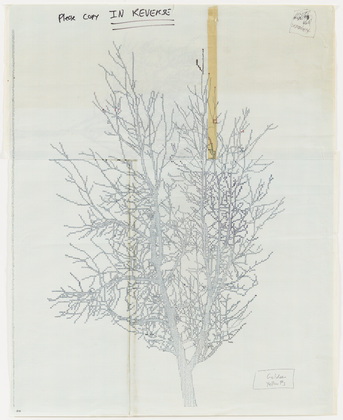
The image “Distracting Distance, Chapter 16, 2010” accompanying today’s post by R.H. Quaytman (2010).
09/09/2013 (12 Moons Solo Project Day 252)

12 Moons Solo Saxophone Project Day 252

Date: 09/09/2013

Instrument: Tenor saxophone

Location: Home studio in Clinton, WA (Whidbey Island)

Notes:

I was back on my tenor today after 3 days on the soprano exclusively.  Since the tenor is my main horn, it’s extremely rare that I take more than a day off of it.  Even if I spend the day on alto or soprano I generally work on tenor for some period of time.  It was good to get some fresh perspective on my sound and to pick up the horn feeling a bit renewed.  Except for a few days last year, I have not taken a day off playing in about 8 years.  Daily practice and study is a reality of my life, but this project has added a bit of pressure when I come to the instrument on certain days.  To come to the horn with virgin ears was a welcome feeling.  

During this improvisation I wanted to explore the concept of a “prescribed burn."  With the current talk of the massive wildfire outside Yellowstone National Park, the subject of fire on a massive scale, whether prescribed, arsonist, or natural has been orbiting my brain.  The use of the term "prescribed” in the sense of a fire obviously implies a high degree of control over the use of a massive force of energy.  In my improvisation this was embodied by using a series of multiphonics while singing with a raspy, throaty call of sound into the horn.  I wanted to pull out a wide swatch of dissonant color, including at points very beautiful, consonant chords.  I played relatively quiet during this improvisation and worked to apply gentle but targeted pressure against the reed, pulling some sounds out indeterminately and other intentionally. I essentially began with an understanding of how loud I would like to get and what areas of sound I was interested in covering.  For example, there is no period in this piece of elongated shrieking, or any abandonment from the core of each chord.  I set specific boundaries for myself but let my embouchure wander within those boundaries.

There were three fingering areas I used, all very close to one another:

Area 1

(Left Hand) B-A-G keys, Octave, Palm Eb key // (Right Hand) F-E keys, Low C

Area 2

(Left Hand) B-A-G keys, Octave, Palm Eb key, Low B // (Right Hand) F-E keys, Low C

Area 3

(Left Hand) B-A-G keys, Octave, Palm Eb key, Low Bb // (Right Hand) F-E keys, Low C

-Neil

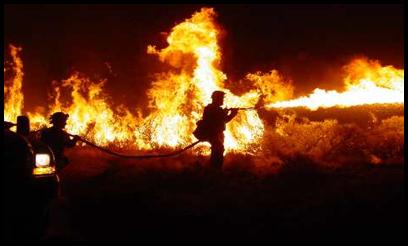
The image “firefighters using a terra torch during a prescribed burn operation” accompanying today’s post by the USFWS.

09/08/2013 (12 Moons Solo Project Day 251)

12 Moons Solo Saxophone Project Day 251

Date: 09/08/2013

Instrument: Tenor saxophone

Location: Home studio in Clinton, WA (Whidbey Island)

Notes:

On the drive home from Oregon, my wife and I listened to an amazing celtic flute solo on the radio.  The musician created the illusion of a virtuosic duet being played, but it was in reality a carefully executed composition for flute played live.  It was one of the best examples in my memory of using specific techniques–quick tempo, heavy ornamentation, octave displacement, and dynamic shaping to create a vivid illusion for the listener.  This area has been a major for focus for me as well the last few years, but also the true use of polyphonic sound to thread chords together.  In my improvisation today, I decided to improvise a flash composition that used the opposite approach–obvious melody and chordal accompaniment.  

The melody in this improvisation does however use polyphonic sound, and the fingerings allowed for a pliability of the pitches.   The chords played in the harmonic accompaniment were derived from the fingerings used in the melody, so in this way the melody and chords are interrelated by pitch content and the physical bond of the fingerings.   The melody centered around a Concert B (quarter step high), C# and D, each in the upper register.  These were played with the following fingerings:

Concert B (quarter step high)

(Left Hand) B-A-G keys, Octave // (Right Hand) E-D keys

Concert C# and D

Same as above, but slowly open the Fork F key in the left hand while adding pressure in the embouchure and bending the air flow up.  

The harmonic accompaniment, as stated above, was derived from this same fingering.  The first example of this can be heard at :27 in the recording. There were two chords used, written below in ascending order of pitch:

Pitches: G, E, C

(Left Hand) B-A-G keys, Octave // (Right Hand) E-D keys.  (Same fingering from the above melody).

Pitches: F#, E, B

(Left Hand) B-A-G keys, Octave, Low B // (Right Hand) E-D keys.

-Neil

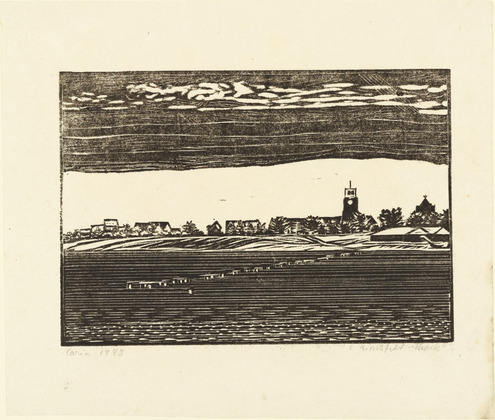
The image “Corio” accompanying today’s post by Ludwig Hirschfeld-Mack (1943).

09/07/2013 (12 Moons Solo Project Day 250)

12 Moons Solo Saxophone Project Day 250

Date: 09/07/2013

Instrument: soprano saxophone

Location: Beside a creek in Daggettville, Oregon

Notes:

While still camping on the Oregon coast today, my wife and I drove down Highway 101 for about 70 miles (140 miles round trip), making our way from Cannon Beach to about Newport.  We experienced an extraordinary array of scenery, from grand vistas looking out at the Pacific Ocean, to beach-side towns with families and tourists, open farmland and heavily treed foothills.  Near the town of Hebo, OR we took a highway going East off of Highway 101, passing a very small farming community called Daggettville, and again followed another road into the foothills.  We eventually stopped alongside a medium-sized creek, located well outside the town on an old road.  

I set up my mic on a natural earthen overhang above the creek, and improvised a simple bluesy melody that I thought fit the mood.  The location was serene, with old chestnut trees, birch and cedar along the bank tucked into a lightly forested landscape.  The air was warm a clean, with an occasional breeze reinforcing it, or instead bringing with it the smell of cattle from nearby farms.  The spirit of this place led me towards this bluesy piece.  In it, I explored the common Dorian Minor scale in the concert key of A.  I used traditional fingerings in the first half but all the while sung the same pitches into the horn.  In the later half of the piece I again maintained the singing and the same scale, but used the low B fingering while opening and closing the side Bb and side C, creating a fingering cycle that fractured the purity of the straight tones explored in the first half of the improvisation.

-Neil

The image “Working Drawings for Numbers and Trees #7” accompanying today’s post by Charles Gaines (1989-90).

09/06/2013 (12 Moons Solo Project Day 249)

12 Moons Solo Saxophone Project Day 249

Date: 09/06/2013

Instrument: Soprano saxophone

Location: A road pullout South of Cannon Beach, Oregon

Notes:

This weekend my wife and I decided to go camping in Oregon, and tonight found ourselves on the coast near Cannon Beach.  This is a very popular tourist destination for entering the seemingly unending twists and turns of Highway 101 South.  Even though the terrain surrounding the coast is rugged and forested, the shear beauty of it has led to widespread development. In the area we found to camp it was difficult to find even a pullout that didn’t have a house at the end of it.  I stumbled on a small dirt road that lead into what will eventually be a large housing development on a steep hillside overlooking the water.  It’s raining steadily today, and what was a thick forest has now been removed, leaving a long and barren scar of sopping mud with fire hydrants and future driveways carved out.  

In today’s improvisation I used the faster walking trill against the Fork F key, creating an aggressive, pliable sound area that allowed me to bend notes up and down a wide range.  This improvisation is much looser in execution, and I wanted to explore wider pitch bends and large dynamic shifts.  The first half of the piece explores this spectral concept, but the later half is performed at a very low dynamic level, again using the same fingered technique.  The fingering used was as follows:

(Left Hand) B-A keys, Low Bb // (Right Hand) Walking trill on the Fork F key (using the index and middle finger).  The octave key and low Bb were also occasionally lifted or depressed during this improvisation.

-Neil

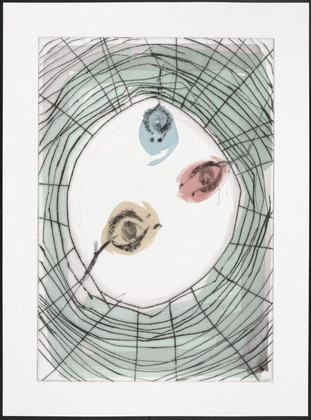
The image “Untitled from untitled” accompanying today’s post by Gert Tobias (2008).