09/12/2013 (12 Moons Solo Project Day 255)

12 Moons Solo Saxophone Project Day 255

Date: 09/12/2013

Instrument: Tenor saxophone

Location: Lecture Room 107 at South Whidbey High School.

Notes:

Between students this afternoon I spent time working in the choir room at South Whidbey High School.  The acoustics in this space are incredibly reverberant, and one corner of the room has a tight, pinging delay that I believe comes from the air ducts overhead in combination with the rooms large size.  While I explored this space, the school band director Chris Harshman happened to come through the room and suggested I try playing in the lecture hall.   It’s an oval-shaped room with concrete floors, a tall ceiling and tiered lecture hall styled seating. Chris had already pinpointed an incredible sweet spot in that room.  It was in the center, 2/3 up the room and specifically between two rows of chairs.  In this sweet spot there is an amazing convergence of acoustic pinging.  The delay is longer and more percussive than the choir room, and the sound qualities of this space appeared to me to be a convergence of the architectural shape of the room, the materials used, and some kind of duct work in the walls and or ceiling.  

During this improvisation I used a number of specific percussive techniques.  The louder clacks are the use of a lighter to medium pressure slap tonging.  I tried to restrict this to the fingering D. The louder, more aggressive pitch slap was done on the Low Bb or Low B.  Slap tonging is an aggressive stopping of the air against the reed with a quick pull-back.  In this use of slap tonging I blew air into the horn versus pulling air back out of it.  The bulk of the remaining sound material is a technique that creates a kissing sound on the horn.  The physical creation of this sound is very different than slap tonging.  The kissing sound is quicker and is a pulling away of the reed and mouthpiece while sucking in air.  While doing this my tongue releases the reed and is immediately put back on.  Even on a single fingering many different pitches can be pulled out, depending on embouchure pressure and air flow.  The last technique used during this piece was flutter tonging while raising my tonging in the back of my throat, creating a wind tunnel-like sound.  This again was done on the low Bb.

-Neil

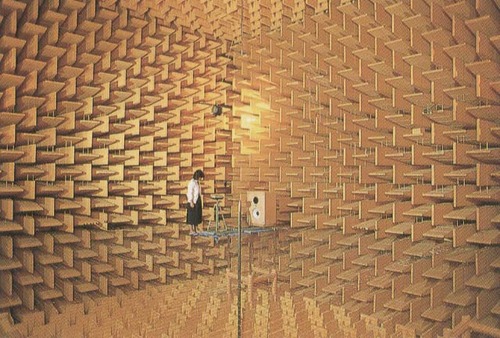
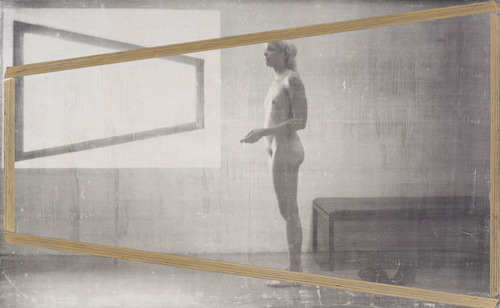
The image accompanying today’s post is of an Anechoic Chamber, a room designed to minimize or eliminate sound.
09/11/2013 (12 Moons Solo Project Day 254)

12 Moons Solo Saxophone Project Day 254

Date: 09/11/2013

Instrument: Tenor saxophone

Location: The rec room of my childhood home in Edmonds, WA 

Notes:

I developed this improvisation early this morning, and did so after quickly searching for two chords with a complimentary sound profile.  I wanted to find two chords that struck me and to commit to working with them.  I’ve become very interested lately in using more traditional voice-leading in my solo music, and this improvisation alternates between two chords that explore this idea.  Though the pitches between the two chords descend, there are non-traditional components to the harmonic motion that give the implication of more complex voice leading.  For example, the top-most pitch descends by a whole step, but the bottom most pitch descends by only a quarter step.  In the harmonic make-up of the first chord, there are two clearly audible pitches, versus the second which has three.  This third pitch is a minor third below the melodic voice, and when this is introduced into the sound field it almost gives me the impression that the voice has moved up, when it reality it simple just enters abruptly.  The more muffled, subdued timbal sound of the pitch likely influences this impression.

The fingerings and pitches used in the two chords were follows (in the tenor key of Bb) :

Chord 1.  Pitches: Middle octave F (quarter step high), Upper register F

(Left Hand) B-A keys, Octave, Palm F only // (Right Hand) F key, Low C

Chord 2.  Pitches: Middle octave (quarter step high), Upper register C and Eb

(Left Hand) B-A keys, Octave, Palm Eb only // (Right Hand) F key, Low C

-Neil

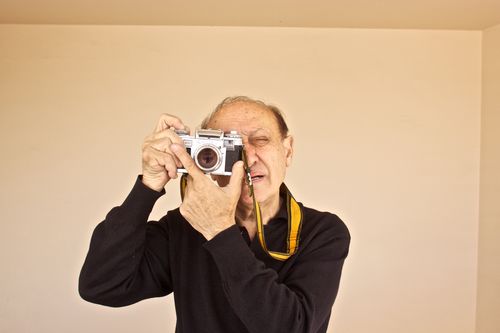
The image “Enrique Metinides” accompanying today’s post is of the photographer himself, photograph by Eunice Adorno (2010).

09/10/2013 (12 Moons Solo Project Day 253)

12 Moons Solo Saxophone Project Day 253

Date: 09/10/2013

Instrument: Tenor saxophone

Location: Home studio in Clinton, WA (Whidbey Island)

Notes:

I spent the morning working on a solo guitar piece for my friend and musical comrade Simon Henneman, which he’ll perform at our collaborative Racer Session concert in October.  In Simon’s playing I hear a tremendous force of expressiveness that seems fully personal, complete, and inherently different from other musicians.  This influenced my approach to composing a piece of music for him, and while doing my 12 Moons documentation today I continued on with the idea of individual stylization.  

In today’s improvisation I used 5 multiphonic chords and identified a melodic shape by arranging the chords in a particular order.  I then worked to bring out specific tones within the chords to be able to improvise a melody that my ear could latch onto.  I purposefully used chords which had different timbral qualities from one another, as well as chords with differing degrees of harmonic definition.  By this I mean that one chord may clearly ring out a major shape or some assemblage of tempered pitches, and others are clusters of sound with less definable harmonic qualities. 

I used 5 multiphonic fingerings which are written below in order of their first playing.  Although a chord may have been repeated this is the order that each new chord was introduced, so therefore they were not necessarily always played in this order.  The fingerings were as follows:

Chord1 

(Left Hand) A-G keys // (Right Hand) F-E-D keys, Low Eb

Chord 2

(Left Hand) B-A keys // (Right Hand) F-E-D keys, Low Eb

Chord 3

(Left Hand) B-G keys // (Right Hand) F-E keys, Low Eb

Chord 4

(Left Hand) B-A-G keys // (Right Hand) E-D keys, Low C

Chord 5

(Left Hand) B-A-G keys, Octave // (Right Hand) E-D keys

-Neil

The image “Distracting Distance, Chapter 16, 2010” accompanying today’s post by R.H. Quaytman (2010).

09/09/2013 (12 Moons Solo Project Day 252)

12 Moons Solo Saxophone Project Day 252

Date: 09/09/2013

Instrument: Tenor saxophone

Location: Home studio in Clinton, WA (Whidbey Island)

Notes:

I was back on my tenor today after 3 days on the soprano exclusively.  Since the tenor is my main horn, it’s extremely rare that I take more than a day off of it.  Even if I spend the day on alto or soprano I generally work on tenor for some period of time.  It was good to get some fresh perspective on my sound and to pick up the horn feeling a bit renewed.  Except for a few days last year, I have not taken a day off playing in about 8 years.  Daily practice and study is a reality of my life, but this project has added a bit of pressure when I come to the instrument on certain days.  To come to the horn with virgin ears was a welcome feeling.  

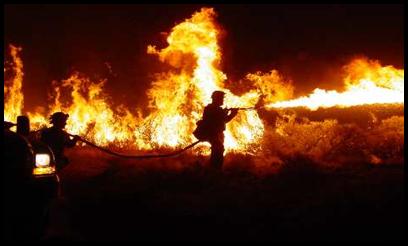
During this improvisation I wanted to explore the concept of a “prescribed burn."  With the current talk of the massive wildfire outside Yellowstone National Park, the subject of fire on a massive scale, whether prescribed, arsonist, or natural has been orbiting my brain.  The use of the term "prescribed” in the sense of a fire obviously implies a high degree of control over the use of a massive force of energy.  In my improvisation this was embodied by using a series of multiphonics while singing with a raspy, throaty call of sound into the horn.  I wanted to pull out a wide swatch of dissonant color, including at points very beautiful, consonant chords.  I played relatively quiet during this improvisation and worked to apply gentle but targeted pressure against the reed, pulling some sounds out indeterminately and other intentionally. I essentially began with an understanding of how loud I would like to get and what areas of sound I was interested in covering.  For example, there is no period in this piece of elongated shrieking, or any abandonment from the core of each chord.  I set specific boundaries for myself but let my embouchure wander within those boundaries.

There were three fingering areas I used, all very close to one another:

Area 1

(Left Hand) B-A-G keys, Octave, Palm Eb key // (Right Hand) F-E keys, Low C

Area 2

(Left Hand) B-A-G keys, Octave, Palm Eb key, Low B // (Right Hand) F-E keys, Low C

Area 3

(Left Hand) B-A-G keys, Octave, Palm Eb key, Low Bb // (Right Hand) F-E keys, Low C

-Neil

The image “firefighters using a terra torch during a prescribed burn operation” accompanying today’s post by the USFWS.

09/08/2013 (12 Moons Solo Project Day 251)

12 Moons Solo Saxophone Project Day 251

Date: 09/08/2013

Instrument: Tenor saxophone

Location: Home studio in Clinton, WA (Whidbey Island)

Notes:

On the drive home from Oregon, my wife and I listened to an amazing celtic flute solo on the radio.  The musician created the illusion of a virtuosic duet being played, but it was in reality a carefully executed composition for flute played live.  It was one of the best examples in my memory of using specific techniques–quick tempo, heavy ornamentation, octave displacement, and dynamic shaping to create a vivid illusion for the listener.  This area has been a major for focus for me as well the last few years, but also the true use of polyphonic sound to thread chords together.  In my improvisation today, I decided to improvise a flash composition that used the opposite approach–obvious melody and chordal accompaniment.  

The melody in this improvisation does however use polyphonic sound, and the fingerings allowed for a pliability of the pitches.   The chords played in the harmonic accompaniment were derived from the fingerings used in the melody, so in this way the melody and chords are interrelated by pitch content and the physical bond of the fingerings.   The melody centered around a Concert B (quarter step high), C# and D, each in the upper register.  These were played with the following fingerings:

Concert B (quarter step high)

(Left Hand) B-A-G keys, Octave // (Right Hand) E-D keys

Concert C# and D

Same as above, but slowly open the Fork F key in the left hand while adding pressure in the embouchure and bending the air flow up.  

The harmonic accompaniment, as stated above, was derived from this same fingering.  The first example of this can be heard at :27 in the recording. There were two chords used, written below in ascending order of pitch:

Pitches: G, E, C

(Left Hand) B-A-G keys, Octave // (Right Hand) E-D keys.  (Same fingering from the above melody).

Pitches: F#, E, B

(Left Hand) B-A-G keys, Octave, Low B // (Right Hand) E-D keys.

-Neil

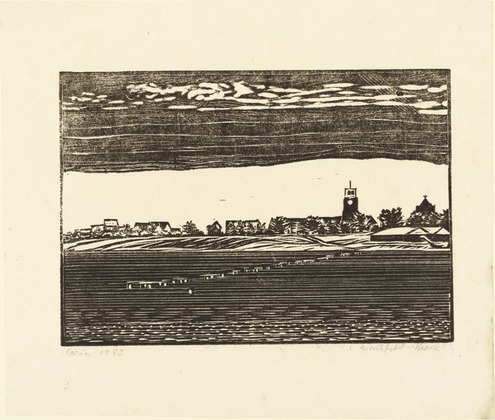
The image “Corio” accompanying today’s post by Ludwig Hirschfeld-Mack (1943).