09/04/2013 (12 Moons Solo Project Day 247)

12 Moons Solo Saxophone Project Day 247

Date: 09/04/2013

Instrument: Tenor saxophone

Location: Practice room B at South Whidbey High School.  Langley, WA (Whidbey Island)

Notes:

During a long break between students this afternoon, I explored the reverberant sound of practice room B at South Whidbey High School.  The shear mass of sound from the saxophone seems to overwhelm this room even at a quiet dynamic level, and while prancing I worked to find single note melodies that balanced the heavy reverb with interconnected melodic lines.  My aim was to give the illusion of polyphonic sound without actually doing it. Tighter clusters and multiphonics do sound excellent in this space, but I wanted to take almost a pianistic approach by having the flexibility to explore sound color as though I were taking away the sustain pedal.  

This improvisation uses a recurring finger shape that had some flexibility to slightly change the cycle to introduce new subtleties.  Some elements of the cycle put a natural emphasis on one note versus another.  Because the cycle itself is very muted in timbre, any slight interruption by adding a non-muted tone naturally emphasizes this new pitch.  Because of this, I kept virtually the same airspeed the entire piece and used very little tongue at all, yet there are definite rhythms and tiny melodies that emerge in the listeners ear and I shifted from one fingering focus to another.

Overall, I rooted myself in the following fingering:

(Left Hand) B-A-G Keys // (Right Hand) F-D keys

From this fingering I created a sound cycle by opening and closing the B key in the left hand, Side C, and Side Bb.  The slight changes to the cycle took place primarily in the left hand, where I would lift either the G key or the C key.

-Neil

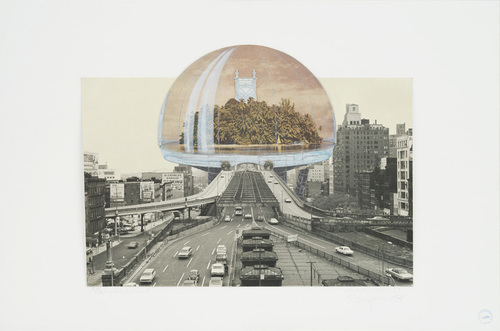
The image “Palmtree Island (Oasis) Project, New York, New York, Perspective” accompanying today’s post by Haus-Rucker-Co, Gunter Zamp Kelp, Laurids Ortner, Manfred Ortner and Kaus Pinter (1971).
09/03/2013 (12 Moons Solo Project Day 246)

12 Moons Solo Saxophone Project Day 246

Date: 09/03/2013

Instrument: Tenor saxophone

Location: My cabin at the base of Mt. Index.  Mount Index, WA

Notes:

I spent the day at my cabin; reading, practicing, and sitting inside tending to the fire were the main events of my day.  I had my dog to keep me company, and the weather was mild and the cabin warm and dry. This is a small 110 square foot, one-room cabin located at the base of Mount Index in the Central Cascades.  This was the first time I’ve been to the cabin this summer, and the space itself was so particularly calm today I felt compelled to bring to life the sound of the room as I experienced it.  The full day I didn’t run across another person.  The dominant sounds of this day were the rustling maple leaves outside the cabin and the crackling fire burning in the stove.

This recording marks my second time documenting in this space during the 12 Moons solo project.  When I practice at the cabin it’s generally in front of the fire.  There is a strong, primordial draw to watching a fire.  When I practice or perform I often shake myself out of a several minutes long deep stair into soul of a particular object.  We all do this from time to time, whether in a deep state of focus or simply meditating on a thought, but I believe we all feel a deep connection to the fireplace.  The glare has a heavy pull to it in such a small room, and my improvising today strived for a balance between my horn and the fire I was tending.  

This improvisation was developed over the course of about an hour, with careful thought as to which sounds should be introduced and how much space to leave.  The improvisation is based off of two themes, each with two sounds apiece.  Overall I felt this improvisation had a strong compositional core, with themes, space, a coda, and a feel of a slow, malleable ¾ time signature.

Theme a.

Sound 1. Sustained D Pitch 

-(Left Hand) B-A-G keys, Octave, Low B

Sound 2.  Sustained B (quarter step sharp) and C in the upper register

-(Left Hand) B-A-G keys, Low B // (Right Hand) F-E-D keys, Side C

Theme b.

Sound 1.  (This chord was also used in my improvisation from 09/01/2013 as well as my composition Willing Joy).  I used my embouchure to pull pitches in and out to maintain the ¾ feel, but the full chord used the following pitches: E, C D.

-(Left Hand) B-A keys, Octave, Low Bb, Palm D // (Right Hand) F key

Sound 2.  A (quarter step sharp) B (quarter step sharp).

-(Left Hand) B-A-G keys, Low Bb // (Right Hand) F-E keys, Side Bb

-Neil  

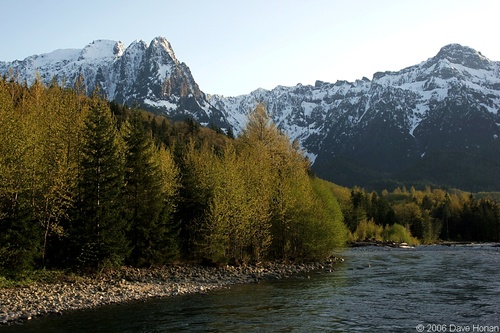
The image accompanying today’s post is the Skykomish River with Mount Index in the background.

09/02/2013 (12 Moons Solo Project Day 245)

12 Moons Solo Saxophone Project Day 245

Date: 09/02/2013

Instrument: Tenor saxophone

Location: Home studio in Clinton, WA (Whidbey Island)

*Once again my daily count has been off for some amount of time.  Today is actually day 245 of this year, but yesterday’s post was also written as 245.  All daily improvisations are still accounted for and the mistake has been caught!*

Notes:

In today’s improvisation, I used the cross-fading of pitches between octaves.  This piece uses a single fingering with a recurring “walking” trill in the right hand.  The fingering used was as follows:

(Left Hand) B-A-G keys, Octave, Palm Eb // (Right Hand) Continuously trill the F clutch key only (the actual F key should not be depressed).

I specifically used three major regions of the horn–mid, upper and alitssimo.  Within these ranges I also occasionally introduced a multiphonic and other more infrequent accentuated pitches, such as a brighter Upper Range concert Db than the Db pitch used throughout the remainder of the piece.   In each range, there was a center of pitch:

Mid Range: Concert C (quarter step flat)

Upper Range: Concert Db

Altissimo Range: Concert Bb

I tried to move from one range to the other as naturally as possible, using my breathing and the horn’s response to the air as my guide.  This improvisation required a great deal of pressure in my embouchure, and therefore the air speed was more directly pointed.  This made me listen very closely to hear if the octave exchanges seemed to want to move quickly or slowly.  The overall concept of cross-fading had a diversity of approach.  Some regions were moved to quickly, others slowly, and I used changes in dynamic level to help accentuate these shifts.

The “walking” trill is a trill technique I’ve explored many times over during this project, where I alternate striking the key with my index and middle fingering, trilling the note at a pace much more quickly than what is possible with a traditional trill.  I worked on this improvisation for some time before recording it, and unfortunately the even tempo of the trill whittled away with each minute that passed due to fatigue in my fingers and for-arm.  Because of this I mixed the walking trill with the standard trill technique, and used the two as more a platform to explore more abstract clacking beneath the played pitches.  The trill did serve a very specific purpose however, as its use created a slight variation of pitch over all the different ranges.  

-Neil

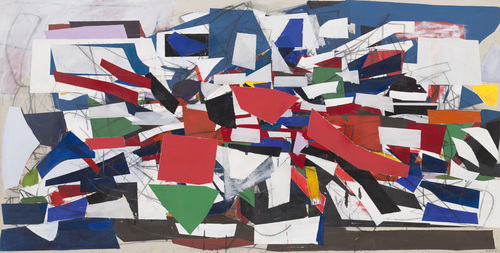
The image “Struggle” accompanying today’s post by Robert Goodnough (1967).

09/01/2013 (12 Moons Solo Project Day 244)

image

12 Moons Solo Saxophone Project Day 244

Date: 09/01/2013

Instrument: Tenor saxophone

Location: Home studio in Clinton, WA (Whidbey Island)

Notes:

So many of my improvisations lately have used a specific region of the instrument and very selective fingering cycles.  The execution in these pieces has used levels of volume that are mostly quiet to medium loud.  Today I decided to work with a very subtle core finger motion at an extremely low dynamic level.  My approach to this improvisation was two fold.  First, I wanted to make the use of a continuous trill as an underlying characteristic of all the sounds in the piece.  This was done with the use of trilling the octave key.  Secondly, I wanted a recurring melody with a harmonic accompaniment buried within it.  Overall I wanted to explore a calm, reflective mood in this piece.  I had the image of taking one long, unhurried breath and exhale.

I developed this piece while practicing, and my process was very similar to so many of my improvisations.  I began with an initial figure that sparked my interest.  In this case it became the opening figure for the piece and a major framework for the entire improvisation.  I alternated for some time between two fingerings.   The fingerings and pitches were as follows:

Fingering 1

Pitches: Alternating between A and Bb (quarter step sharp).

(Left Hand) B-A-G keys, Octave, Low B // (Right Hand) F-E-D keys.  Trill the octave key constantly.

Fingering 2

Pitches: C (with the octave trill creating a slight change in pitch as it was opened and released)

(Left Hand) B-A-G keys, Octave, Low B // (Right Hand) F-E-D keys, Low C  Trill the octave key constantly.

Eventually the alternating of these two fingerings becomes the beginning of the melody.  I added a slight amount of pressure to add a Bb in the upper register to the existing A/Bb pitches to Fingering 1.  With this same amount of embouchure pressure an A in the upper register is also added to the C in Fingering 2.  This created both the melody and some contrapuntal motion in the chord progression beneath it.

There are two additional chords used in the upper register and in the melody.  I heard these as Major and Minor shapes respectively.  I alternated at will between these two chords, and the melody then takes on a shape which explores a mood of parallel major and minor tonalities. The two chords were played with the following fingerings:

Major melodic/harmonic shape:

(Left Hand) B-A-G keys, Octave, Low B // (Right Hand) F key.  Trill the octave key constantly.

Minor melodic/harmonic shape:

(Left Hand) B-A-G keys, Octave, Low B // (Right Hand) F-E keys.  Trill the octave key constantly.

-Neil

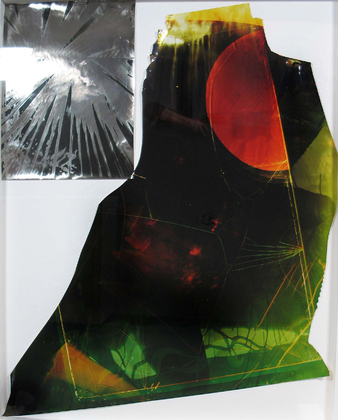
The image “30” accompanying today’s post by Mariah Robertson (2009).

08/31/2013 (12 Moons Solo Project Day 243)

image

12 Moons Solo Saxophone Project Day 243

Date: 08/31/2013

Instrument: Tenor saxophone

Location: Home studio in Clinton, WA (Whidbey Island)

Notes:

Unlike yesterday, today I devoted a lengthy period of time directly to both my practice and my recording.  This improvisation is based off a series of 4 chord clusters with a recurring melodic figure used as a pivot point between the chords.  I wanted 4 strong chordal components to draw from at will during the improvisation, each of which occupies a different kind of sonic space.  Chord 1, for instance is a very stable two-note cluster, versus Chord 4 which is made up of three pitches with  brighter and breathier tone qualities.  Some chords saw more use than others.  The chord fingerings and pitches were as follows (as notated in the tenor key of Bb).  They are also written in their order of use during the piece:

Chord 1:  C#/B

(Left Hand) A-G keys, Low C# // (Right Hand) F-E-D keys, Low C

Chord 2: Bb/Ab

(Left Hand) B-A keys, Low Bb // (Right Hand) F-E-D keys, Low C

Chord 3: E, C, D, G

(Left Hand) B-A keys, Octave, Palm D, Low Bb // (Right Hand) F key

Chord 4: Bb, A (quarter step flat), F

(Left Hand) B-A keys, Octave, Low C# // (Right Hand) F-E keys, Low C

Chord 4 does not appear until the mid to later half of the improvisation, where there is an exploration of the four chords only with no melody.  This is also the only point in the piece where there is absolute silence used as a compositional device.

The recurring melodic figure that linked the chordal activity primarily moved to Chord 1, with the eventual motion to Chord 2 being perceived by me as the tonic.  This melodic figure was used specifically because of it’s tuning in relation to the chord clusters, but also because is just had a very calm, pleasing aesthetic quality to me.  The fingerings and pitches, again notated in the tenor key were as follows:

A (quarter step sharp)

(Left Hand) B-A-G keys, Octave, Low C# // (Right Hand) F-E-D keys, Low C, Side Bb

D (quarter step flat)

(Left Hand) B-A-G keys, Octave, Low C# // (Right Hand) F-E-D keys, Low C

E

(Left Hand) B-A-G keys, Octave, Low C# // (Right Hand) F-E keys, Low C

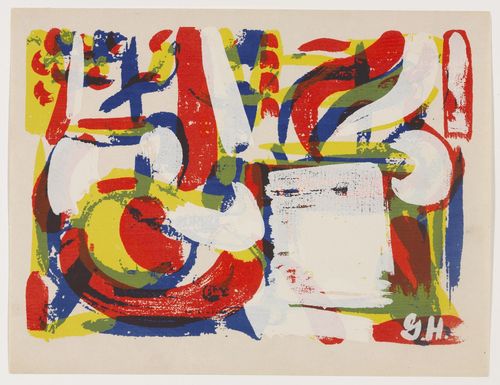
The image “Proof for plate (folio 17) from FOLDER, Volume I, number I” accompanying today’s post by Grave Hartigan (1953).