08/30/2013 (12 Moons Solo Project Day 242)

image

12 Moons Solo Saxophone Project Day 242

Date: 08/30/2013

Instrument: Tenor saxophone

Location: Home studio in Clinton, WA (Whidbey Island)

Notes:

I decided to take this day and work as hard as possible towards a single task.  This was a marathon day, something I do from time to time to re-center myself.   My attention lately in both my music and day to day life has been scattered.  My practice routine has been a critical part of maintaining and strengthening my mental clarity.  This routine also contributes towards the longevity of my focus during live performance, recording and the rest of my life.  However, in the past few months I’ve noticed that my level of singular attention while practicing or just doing a task, even making coffee or getting ready in the morning, has begun to fracture.  I walk out of the room without having finished putting my razor back, or I leave one vegetable half chopped while I begin working on another. 

My goal today was to design and finish building a good quality coop to house a few quail out in our backyard.  From sun up, I decided not to eat, drink, or rest until it was finished to the best of my personal standard and ability.  I started around 9:30am and was fully finished at 6:30pm.  I didn’t look at my watch until I was finished.  What I discovered, as I have many times over in my personal marathon sessions, was that focus is not always dependent on energy but it is more dependent on a singular desire towards an end.  Throughout the day I did go through periods of exhaustion and frustration, but I tried to view these as part of the larger arch of the day–begin and end–start with a design and finish with a product.  

After finishing this marathon session, I had only a small amount of time to play and record before other personal obligations later in the night.  I walked immediately into my practice space and began recording for about a half hour.  It felt incredible to play–I was exhausted but full of life force.  The horn was calling me to explore, and I felt absolutely no barrier between myself and the instrument.  This marathon session was not intended to be a cure-all, but more a jolt back towards where I want to be in how I approach my daily life.  The result was this improvisation, an energy piece with a quickly inspired, simple melody.

This improvisation uses the pitches Eb-Gb-Db—-.  The lengthy held out multiphonic that opens the improvisation and is used throughout became a springboard for these three pitches.  The fingering was as follows:

(Left Hand) B-A-G keys, Octave, Low B, Palm Eb

To play the Eb, I used the above fingering but put the F key down in the right hand and took away the Palm Eb.  The Gb was played with the above fingering but without the Palm Eb.  Finally, the upper register Db used the multiphonic fingering but with an adjustment of my embouchure to eliminate the additional tones.

-Neil

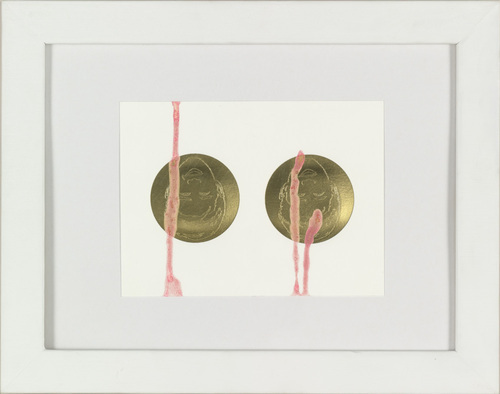
The image “Untitled” accompanying today’s post by Bernardo Ortiz Camp (2008).
08/29/2013 (12 Moons Solo Project Day 241)

image

12 Moons Solo Saxophone Project Day 241

Date: 08/29/2013

Instrument: Tenor saxophone

Location: The rec room of my childhood home in Edmonds, WA

Notes:

While practicing this afternoon I decided to tailor an improvisation around a particular 3-note chord cluster.  As in my improvisation from two days ago (12 Moons improvisation day 240), this cluster is a very mystical assemblage of three very close tones.  Instead of having more a nondescript tonal center, to me this is more a grouping with a very definite, consonant quality to it.  The grouping has a total distance of 2 whole steps plus a quarter step.  It’s comprised of the following pitches (in the tenor key of Bb): C, E (quarter step flat), F (quarter step flat), and used the following fingering:

(Left Hand) B-A keys, Octave // (Right Hand) E-D, Side F, Low C.

The improvisation as a whole is centered around 4 sound areas.  Sound area one, which opens the improvisation is an F# in two octaves.  As the improvisation evolved, I began adjusting my embouchure to make the bottom pitch somewhat sharp and oscillated between unison and the more dissonant interval created by the slight difference in intonation.  This sound used the following fingering: (Left Hand) B key, Octave // (Right Hand) E-D keys, Low C, High F#, Side F.

The second sound area moved into a consonant, de-tuned minor chord with a C# in the upper register, and a muted F (quarter step flat) in the middle register: (Left Hand) B key, Octave // (Right Hand) E-D keys, Low C, Side F.

This chord then firmly becomes a major chord, again with the C# in the upper register, and the muted F moving up a quarter step to sit squarely on pitch, creating a major chord in first inversion.  (Left Hand) B key, Octave // (Right Hand) D key, Low C, Side F.

The fourth and final sound area was the chord cluster described above, which I explored in a quiet, improvised fashion, moving between pitches in the chord and exploring sound color.  I then began opening and closing the B and A keys in the left hand to create a very punctuated, repetitive sound cycle which closes the improvisation.  Overall during this piece, I wanted to impart a feeling of quiet, patient action.  Despite the many held chords, I constantly focused on the pre-planned higher energy trilling that enters towards the end of improvisation.

-Neil

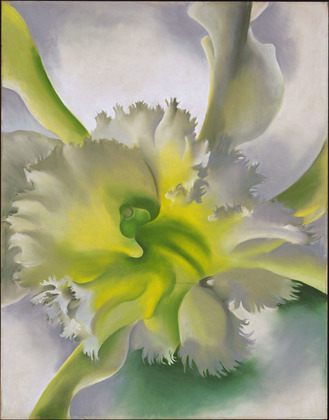
The image “An Orchid” accompanying today’s post by Georgia O'Keeffe (1941).

08/28/2013 (12 Moons Solo Project Day 240)

image

12 Moons Solo Saxophone Project Day 240

Date: 08/28/2013

Instrument: Tenor saxophone

Location: Orchestra room at Chief Sealth High School.  Seattle, WA 

Notes:

*I recommend using headphones when listening to this piece in order to clearly hear the sustain in the piano strings.*

I had a limited amount of uninterrupted time before teaching this morning.  In these situations I find that my artistic output can be very creative and fluid or at an absolute standstill.  Fortunately this morning I found tremendous influence in the use of the Steinway baby grad that sits inside the orchestra room at Chief Sealth High School.  Like just about every instrumentalist I know, I’m fascinated by the idea of continuous resonance, overtones and harmony possible by using the sustain pedal on a piano.  I decided to tackle a small spectrum of this technique and improvise a piece that used selected sound environments, which when performed acoustically still have an amazing amount of resonance with just the saxophone and myself alone.  The finger cycles used in this piece are very familiar to me and are often used when I perform because of the amazing resonance they create out of the instrument, and the natural harmony that results.  By playing this into the piano and keeping the sustain pedal on, the sounds take on a new life and seem to overwhelm both instruments with a tremendous torrent of sound.

The core fingering used during this piece was as follows:

(Left Hand) B-A keys, Low Bb // (Right Hand) F-E-D keys, Side Bb, Low C

This fingering produces a very slight pitch differentiation that includes a chord cluster of two pitches only a semi-tone apart, most closely linked to a Concert G and Ab.  The Ab is about a quarter step sharp and the G is so sharp is lies slightly below an Ab.  Each of these tones are possible independently with this fingering, or in the two note grouping together.  By opening and closing the Side C and Middle C keys, I created cycles of sound that explored this possibility by sliding between the notes, or allowing the two to collide together momentarily.  

There are other more resonant sounds possible by playing into the piano in this fashion, such as playing the Low Bb in subtone, which dramatically fills the piano’s soundboard.  However, in this improvisation I wanted to retain more of the core sound of the saxophone in the piano strings, and allow more subtle overtones to resonate in the strings alongside the pure tone of the horn.

-Neil

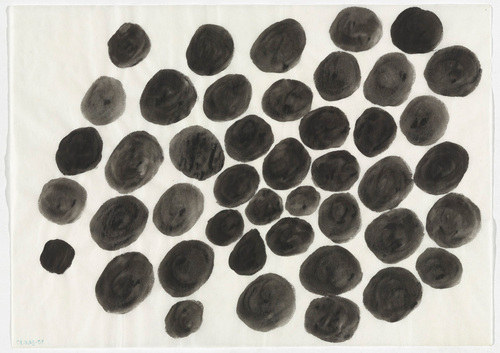
The image “Two over Halley’s Comet” accompanying today’s post by Terence Koh (2003).

08/27/2013 (12 Moons Solo Project Day 239)

image

12 Moons Solo Saxophone Project Day 239

Date: 08/27/2013

Instrument: Tenor saxophone

Location: Home studio in Clinton, WA (Whidbey Island)

Notes:

I developed this piece over the course of several hours today.  I wanted to capture joy in this improvisation.  Open, willful, intense joy.  For me these moments contain a depth to them that almost sets me apart from myself. It’s as though I’m able to step outside my body and watch myself experiencing something in its purest state of being.  To try and capture this experience musically, I wanted to work with mystical sounds today, sounds that are profoundly moving but are rarely heard unless their subtly is given a magnifying glass.  The mystical sounds I explored in this improvisation include sounds only capable by putting my instrument, my focus and my body into the right space at the right time.  The improvisation is based off of two fingerings, which are separate in execution but complimentary in scope.

By singing into the horn against a fingering pitch, rich overtones can enter into the sound field that are so easily glossed over if they aren’t given focus.  During this piece I wanted to feature this reality.    The first fingering, and main body of the piece, used my voice to pull out these tones and was as follows: 

(Left Hand) B-A-G keys, Low Bb // (Right Hand) F key, Low C. 

This fingering creates a Concert D#, and below it sang a Concert B.  When paired with this Major Third interval, I brought out many overtones and quiet whistle tones by slowly trilling the Low C key.

Following this section, I introduced a sound world which I had explored for about an hour while practicing today.   This is a pitch cluster, and just a micro second it’s possible to put 3 whole steps together.  There are other far denser, more complex multiphonics possible, but to have 3 pitches so close together is something truly special.  This section can be heard at 1:43.  The pitches were: B, C#, D# (each about a quarter step high).  To create this, I used the following fingering:

(Left Hand) B-A-G keys, Octave, Low Bb // (Right Hand) F key, Low C, High F.

-Neil

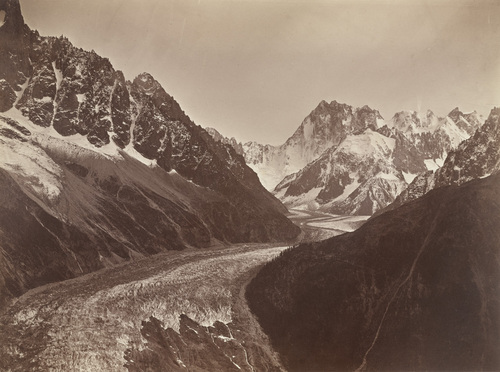
The image “Mont Blanc” accompanying today’s post by Louis-Auguste Bisson with Auguste Rosalie Bisson (1860 or 1861).

08/26/2013 (12 Moons Solo Project Day 238)

image

12 Moons Solo Saxophone Project Day 238

Date: 08/26/2013

Instrument: Tenor saxophone

Location: Home studio in Clinton, WA (Whidbey Island)

Notes:

In my improvisation today, I explored clear melodic and harmonic ideas that were stated plainly–directly.  They then morphed to become part of a broader, thicker texture and took on an indirect role.  This could be akin to the experience of being a single individual amidst a crowd of people.  To outline this concept, I used two fingerings to create 2 direct sound environments, and then adjusted my embouchure and air flow to include these same sounds indirectly into the larger web of action.  

I began the improvisation with a single pitch which becomes a kind of touchstone throughout the piece.   The other chords contain it in the bottom of their voicing as well.  This first tone, and subsequently the note above it, used the first fingering to achieve the first chord.  This included the notes D and F (quarter step sharp), with the following fingering:

(Left Hand) B-A-G keys, Fork F, Octave, Low B // (Right Hand) F-E keys, Side F# key.

The second chord, comprised of the pitches D and F natural, used same fingering above but added the Low C key.  I alternated between these two chords to create the first direct statement of sound. From here I added the second melodic idea, again stated as directly as possible.  This idea was a simple folk-like melody built off the first fingering alone, played by adjusting my embouchure and air flow.  This melody used the pitches Eb, F, G, F, Eb and can be heard for the first time at 1:10

I then alternated between the two fingerings, slowly adding and taking away the Low C key to bring out a full color spectrum inherent in these fingerings.  The transition into and beginning of this section can be heard at 1:53.  As stated above, I then tried to fold in the two ideas above in a more indirect manner, changing the focus towards a more sound-texture environment, and only rarely played them in their original or “direct” state.

-Neil

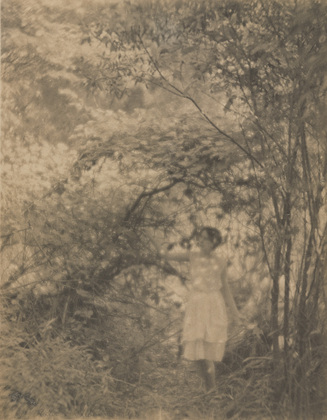
The image “Lady in Woods” accompanying today’s post by Paul L. Anderson (1915).