08/11/2013 (12 Moons Solo Project Day 223)

image

12 Moons Solo Saxophone Project Day 223

Date: 08/11/2013

Instrument: Tenor saxophone

Location: The rec room of my childhood home.  Edmonds, WA

Notes:

While practicing this afternoon, the saliva and condensation moving through my horn welled up a bit in my Palm F key, causing a momentary delay in sound.  This would occur when the key was opened, generally when done so slowly, but also occasionally when opened quickly.  A bubbling effect would take place, and the sound could barely escape from the tone hold because the saliva would expand out, forming a bubble between the tone hole and the leather pad.  This happens quite often, but generally a player will blow the spit out so as not to cause any delay in the action of the sound or any undesired ambient noise.  Today I decided to work with the sound variation this bubbling would create.

I used a single fingering during this improvisation, which was as follows:

(Left Hand) Fork F, C key, Octave, Low B // (Right Hand) F-E keys, Side F# key.

Because the Fork F only opens the Palm F key about 50%, initially when I would use the above fingering the bubble would happen nearly every time.  Eventually however it came pass more infrequently because the saliva was beginning to move out of the key cup.  I then noticed that the pitch was going down as a result of this.  I intentionally welled up more saliva onto the pad, and the pitch went up.  It settled around a Concert G.  This G would speak when air was initially forced into the horn and the bubble would expand, causing a surprising amount of back-pressure in my body.  Once the bubble would burst, the Concert G shifted down to a Concert Eb, which was also just one in a series of pitches within a mutliphonic.  The bursting of the bubble can clearly be heard on the recording when the pitch shifts down.  The sound then expands and pops out naturally.  Because of my mic placement, there is also a great deal of key clacking that can be heard throughout this improvisation.

-Neil

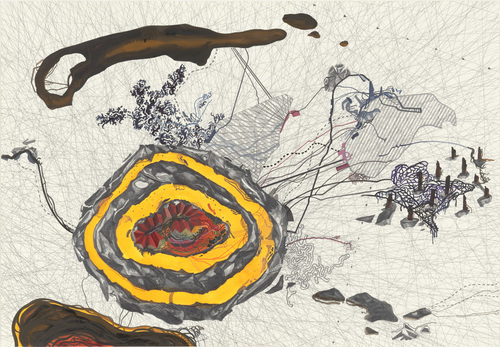
The image “Untitled (Mental Map: Peak Season” accompanying today’s post by Franz Ackermann (2003)

08/10/2013 (12 Moons Solo Project Day 222)

image

12 Moons Solo Saxophone Project Day 222

Date: 08/10/2013

Instrument: Tenor saxophone

Location: Home studio in Clinton, WA (Whidbey Island)

Notes:

Last night in briefly rained for only the second time in over a month.  This is one of the driest summers in my memory.  It didn’t rain hard but the jolting difference in soundscape pulled me from my sleep several times last night.  After waking this morning I walked outside, the air felt clear and clean, and the wind blowing from the South brought the smell of the ocean with it.  While practicing and improvising this morning I felt like the rain wanted to speak through my horn.  I decided to record a joyful, quiet piece with continuous flows of resonant sound.  There is a steadiness to the rain that I wanted to impart in this improvisation.  My attempt at this was through two complimentary major chord shapes with a quiet, understudied drone beneath.

In the simplicity of these chord shapes, I wanted to explore cyclic patterns of both rhythm and harmony, and to focus on the interrelationships of sound.  I considered sound in very broad terms here, those being the beauty of the chords, slight changes in low octave difference tones, and pitches that wanted to “speak” more than others depending on how I interpreted a rhythm, among others characteristics.  For me the creation of beauty in this piece was a delicate balance in the mechanics of the fingerings, and ultimately the sounds they produced.  There is something extraordinary about finding equal beauty in both sides.   

In this improvisation I focused on two chord shapes.  I began by presenting each of these in their “pure” state, that being the point from which they were initially executed while practicing.  These “pure” states are in the rhythms and pitches written below.  Then I would introduce rhythmic variations and new cycles with these chords.  During various points in the piece, I would let the sound settle into only the common bottom most notes in each of the chords, the wonderful Concert Eb drone that rang throughout the entire improvisation.  The two chord shapes were as follows (written in the tenor key of Bb):

Chord shape 1

Rhythm: 1 e & a 2—-

Pitches: F (drone) C#, F

Fingering: B-A keys, Octave, Palm Eb, Low B  //  (Right Hand) Low C

Chord shape 2

Rhythm: 1 e & a 2 3—–

Pitches: F (drone) Eb

Fingering: B-A keys, Octave, Palm Eb, Low B  //  (Right Hand) F key, Low C

To create the full cycles I also used the alternate F# fingering, F key, and C fingering.  In various combinations with the fingerings above, these created the bulk of the pitch material in this improvisation.

-Neil

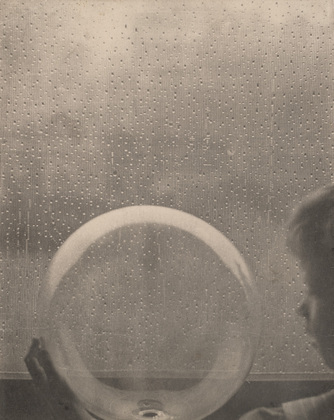
The image “Drops of Rain” accompanying today’s post by Clarence H. White (1903).

08/09/2013 (12 Moons Solo Project Day 221)

image

12 Moons Solo Saxophone Project Day 221

Date: 08/09/2013

Instrument: Tenor saxophone

Location: Home studio in Clinton, WA (Whidbey Island)

Notes:

During my practice session this morning, I worked with establishing pitch centers and then interrupting these centers with variations in pitch stability.  This was done by using alternate fingerings that were slightly de-tuned from one note to another.  In this improvisation, I identified 3 pitches, and worked to create subtle sonic variation within them.  This was done by intentionally pitting one pitch against its counterpart a semi tone above or below.  I felt that this piece had a bluesy quality to it, and I wanted to explore how changes in intonation can heighten or diminish our musical experience as a listener in the blues.  The three separate pitches included: Concert A (low octave , E (mid and upper octave) and G (upper octave) represented my pitch material to select from.  

While improvising it is much easier for me to feel emotionally connected to grittier, denser textures.  They are very evocative of mood for me, and this is particularly the case when the sounds are thicker and more aggressive.  In this improvisation I wanted to pair quieter varieties of these sounds alongside more traditional pitches, the later having slightly different tuning than the former.  As I experienced this piece as a sort of blues, the mood throughout was a major focus for me as a listener.  To bring out my own melancholic sound in the blues, I used variations in pitch centers, periods of silence, and a focus on the minor third interval between the G and E.

The pitches used, as well as their fingerings were as as follows:

Concert A (low octave)

(Left Hand) B-A-G keys, Low B // (Right Hand) F-E-D keys, Low C.  Trill the C key in the left hand constantly.

Concert F# (mid octave) 

(Left Hand) B-A-G keys, Octave, Low B // (Right Hand) F-E-D keys, Low C.  Trill the F# key in the right hand constantly.  Note: To pull out a slightly different tuning in this note, while also broadening the pitch into a wider series of overtones, I would take away the octave key.

Concert A (mid octave) 

(Left Hand) B-A keys, Octave, Low B // (Right Hand) F-D keys, Low C.  Trill the F# key in the right hand constantly.

Concert A (quarter step sharp than that above) 

(Left Hand) B-G keys, Octave, Low B // (Right Hand) F-D keys, Low C.  Trill the F# key in the right hand constantly.

Concert F# (upper register) same Concert A (quarter step sharp) fingering above.

-Neil

The image accompanying today’s post is a series of oil blobs from the Deepwater Horizon oil spill.

08/08/2013 (12 Moons Solo Project Day 220)

image

12 Moons Solo Saxophone Project Day 220

Date: 08/08/2013

Instrument: Tenor saxophone

Location: Home studio in Clinton, WA (Whidbey Island)

Notes:

During todays improvisation I focused on my familiar theme of phasing in and out of sounds within a single fingered motion.  Some of the sound textures explored in this piece cross-faded between one another, and others began or ended abruptly.  As opposed to other improvisations I’ve done in this series with a similar improvisatory model, I aimed to focus more in transition rather than direct movement.  The periods of transition became essential in regards to my perspective on shaping the improvisation.  I tried to establish in my mind a state of calm and focus, and to use this clear-mindedness as a guide to help me phase between sections of the horn.  I recorded this improvisation around 9am after having woken up around 5am and trying for over an hour to fall back asleep.  I felt calm and pensive this morning, and experienced the morning in a very contemplative state of mind.  In many ways my mood felt uncontrolled, but strangely my realization of this fact was a comfort to me.

A wide variety of pitches very used, including single tones, split tones, and multiphonic chords, and there were several direct pitch relationships I seemed to gravitate towards.  These included (in the tenor key of Bb):

-C to D in the upper octave.  This was a trilled figure between these two pitches.

-E (quarter step flat) in the middle octave

-C (quarter step flat) in the upper octave

-E in the upper octave

C to E (quarter step flat) in the upper octave.  This was a trilled figure between these two pitches.

I used a single fingering while continuously trilling the Palm Eb.  I trilled in a variety of tempos and varied the pacing of the trill tempo at will.  There were a few select periods during this improvisation where I stopped trilling momentarily and this occurred while holding out single pitches.  It was not done intentionally but rather subconsciously.   The fingering used was as follows:

(Left Hand) B-A-G, Low B // (Right Hand) F-E, Low C.  Continuously trill the Palm Eb in the Left Hand.

-Neil

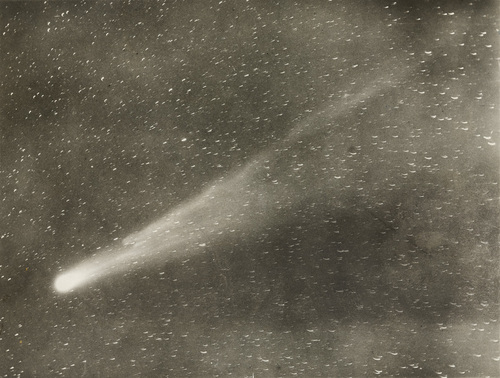
The image “Haley’s comet as It Looked in 1910” by United Press International (1910)

08/07/2013 (12 Moons Solo Project Day 219)

image

12 Moons Solo Saxophone Project Day 219

Date: 08/07/2013

Instrument: Tenor saxophone

Location: The orchestra room at Chief Sealth High School.  Seattle, WA

Notes:

I set up to record in the center of 6 or so steel drums this afternoon.  As I’ve discussed during this project in months past, the orchestra room at Chief Sealth is a very dead space, and the steel drums seemed to give it some humanity for me.  To explore the dichotomy between the vacuum-like quality of the room and the amazing gift of resonance from the steel drums, I decided to improvise a piece based off of extreme dynamic gestures.  I used wide arches of air flow to push and pull at the sound, swiping the air with my tongue and slight movements of my fingers.  I centered on two fingerings in this piece, each of which pulled out beautiful overtones and lasting resonance out of the steel drums.  My aim was not to exploit this resonance but rather to use it in such a way as to give the impression of a room with warm acoustics.

The improvisation is based off the oscillation of a Concert A and Ab.  The fingerings for these two pitches were as follows:

Concert A:

(Left Hand) B-G keys, Low B // (Right Hand) F-E-D keys, Low C.  This fingering also allows for a split-tone chord of A and Gb, which can be heard at times. 

Concert Ab:

(Left Hand) B-G keys, Low Bb // (Right Hand) F-E-D keys, Low C

As a general approach, I would not play the Ab (the second of the two pitches) without having played the A above it and sliding down into the Ab.  To make this transition as smooth as possible, I would not lift my finger from the Low B to play the Bb, but rather pivot it so as to be able to easily trill between the two.  As the piece progressed, I also began singing through the horn to pull out grittier clusters, as well as trilling the Side C.  

-Neil

The image “Dinamismo di un foot-baller (Dynamism of a soccer player)” by Umberto Boccioni (1913)