08/06/2013 (12 Moons Solo Project Day 218)

image

12 Moons Solo Saxophone Project Day 218

Date: 08/07/2013

Instrument: Tenor saxophone

Location: Home studio in Clinton, WA (Whidbey Island)

Notes:

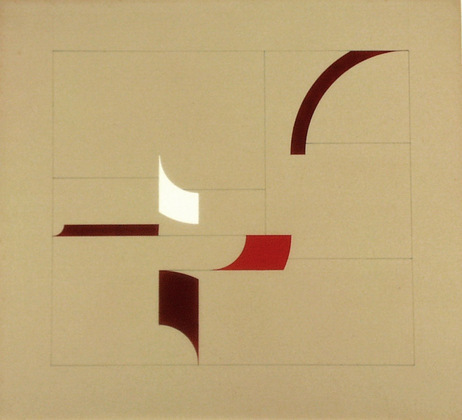
Evolution was my theme for today’s improvisation.  In nature there are of course extreme examples of evolution within an animal or an environment, and then there are more subtle adaptations.   Today I was concerned with the evolution of slight sound traits, the evolution which is subtly shaped as a response to changes in a given environment.  During this piece I considered 2 points of action within 2 sections.  They are respectively labeled below as Section A, Actions 1 and 2  //  Sections B, Actions 1 and 2

Section A, Action 1: Pitches (in ascending order and in the tenor key) C, Db, Ab

(Left Hand) C key, Octave, Low B // (Right Hand) F-E keys, Low C

Section A, Action 2: Pitches (in ascending order and in the tenor key) Db, Bb, Gb

(Left Hand) B key, Octave, Low Bb // (Right Hand) F-E keys, Low C

Section B, Action 1: Pitches (in ascending order and in the tenor key) C, Db, F

(Left Hand) C key, Octave, Low B // (Right Hand) F-E keys, Side F, Low C.  Slowly trill the side F key.

Section B, Action 2: Pitches (in ascending order and in the tenor key) Db, B, Gb

(Left Hand) B key, Octave, Low Bb // (Right Hand) F-E keys, Side F, Low C.  Slowly trill the side F key.

I was fascinated by the sound colors that just the root fingerings Action 1 and Action 2 could create.  While preparing to record this piece, I would hold each of these chords out independently.  This ringing out of the chord was used in the improvisation today as an intermediary between the two sections.  Section A was dominated by the pulsing sound heard at the outset of the improvisation, and Section B included alterations to the rhythm cycle that had been established.  I viewed this evolution as the necessary response to the changing environment of the piece.  This can be heard the first time at 2:35.  I experienced the entirety of the piece without any jolt of action whatsoever, but rather just a slight, continuous evolution as the big picture sound unfolded.

-Neil

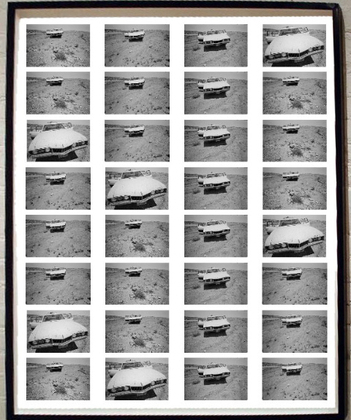
The image “4-Part Variation” accompanying today’s post by Stephen Shore (1969)
08/05/2013 (12 Moons Solo Project Day 217)

image

12 Moons Solo Saxophone Project Day 217

Date: 08/05/2013

Instrument: Tenor saxophone

Location: Home studio in Clinton, WA (Whidbey Island)

Notes:

In my practice session today, I worked to incorporate harmony within my single pitched melodies.  For this improvisation I maintained this concept by, in the moment, gravitating towards a small number of multiphonics and split tones with very predictable patterns of sound.   With the chord structures clearly in my mind as I was playing, I tried to get myself in the headspace of a pianist, in that I wanted the flexibility of independent melodic voices, harmony, and a combination of the two together, and finally to make these relationships very intimate and balanced with one another.  Specific sections of the improvisation are centered more heavily on single pitch melodies, and others on phasing melodies in and out of chords.  In other musical moments, such as the mid point of the improvisation, moving between one chord to another chord with no single note melodies became the point of action.

Some selected multiphonics/split tones used during this improvisation were as follows (in the tenor key)

F (quarter step flat), Ab, Gb

(Left Hand) B-A-G keys, Octave, Low Bb  //  (Right Hand) F-E keys

E/C#

(Left Hand) B-A-G keys, Palm Eb // (Right Hand) F-E keys, Low C

F#(low octave) G (middle octave), C# (upper octave)

(Left Hand) B-A-G keys  //  (Right Hand) E-D keys, Low C

Ab, Bb (quarter step flat)

(Left Hand) B-A keys, Low Bb // F-E-D keys, Low C

F, Eb

(Left Hand) Fork F, A-G keys, Low Bb // (Right Hand) F-E keys, Low C

-Neil

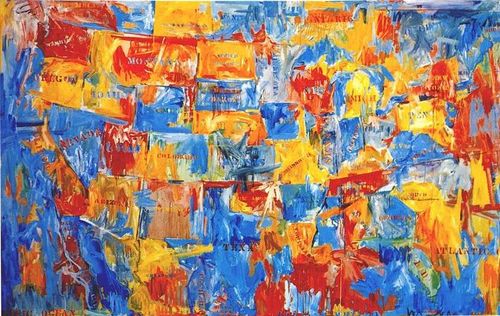
The image “Map” accompanying today’s post by Jasper Johns (1961)

08/04/2013 (12 Moons Solo Project Day 216)

image

12 Moons Solo Saxophone Project Day 216

Date: 08/04/2013

Instrument: Tenor saxophone

Location: Home studio in Clinton, WA (Whidbey Island)

Notes:

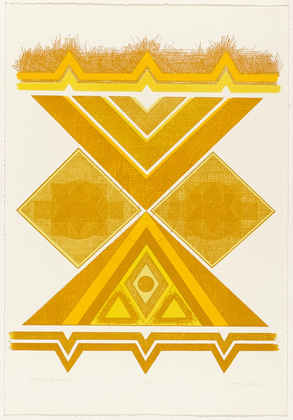
The use of singing through my horn as a means toward sound-color creation is a concept I’ve worked with for some time now.  In today’s improvisation, I began with a steady chord created by singing a Concert Db through my horn.   This Db became a drone throughout most of the improvisation, and then I focused on 3 sound areas that incorporated the drone in order to create an environment dependent on the sining.  The first sound area created was an open, almost tuvan throat-singing pitch series built off of perfect Fifth and Fourths.  By taking away a single key, an opposing, second sound world emerges with tight pitch clusters and fainter, more dissonant overtones.  I generally moved between these two fingerings/sound worlds during this piece.  Lastly, a third pitch series with still tighter, but more muted tone clusters emerges.  

At the mid point of the improvisation I began fracturing the first sound world by incorporating pockets of higher tone clusters.  From this point I also began to diverge from a more controlled atmosphere and began to create busier, more fractured pitch relations.  I then began to sing between the constant Db drone and an Eb a whole step above it, before returning at the improvisation’s close again at the Db.

-Neil

The fingerings used were as follows:

Sound world 1.  Pitches in ascending order: (Sing the low Db constantly.  Above it were Ab, Db.  The Db in the mid register was also sung at times along with the Db in the lower octave).

B-A-G keys, Low Bb // (Right Hand) F-D keys, Low Eb, Side Bb

Sound world 2.  Pitches in ascending order: Sing the low Db constantly.  Above it were Eb and G

B-A-G keys, Low Bb // (Right Hand) F-D keys, Low Eb

Sound world 3.  Pitches in ascending order: Sing the low Db constantly.  Above it were Low octave Eb and middle octave D, E and upper octave Bb).

B-A-G keys, Low Bb // (Right Hand) F-E-D keys, Low Eb, Low C.  

-Neil

The image “Metaesquema No. 179” accompanying today’s post by Helio Oiticica (1957).

08/03/2013 (12 Moons Solo Project Day 215)

image

12 Moons Solo Saxophone Project Day 215

Date: 08/03/2013

Instrument: Tenor saxophone

Location: Home studio in Clinton, WA (Whidbey Island)

Notes:

In today’s improvisation I focused on the use of continuous double-tonging with crescendoing shapes.  The piece maintains a root fingering system that sustaines the Concert C heard throughout.  The continuity of the sound becomes momentarily interrupted by sound dots from additional grace note pitches, as well as longer interruptions on slightly de-tuned Concert C pitches.  I generally used the longer pitch interruptions to sustain a false Concert C fingering by adding the palm D to the root fingering.  This false fingering has a much brighter tone color, and was used to help accentuate the fingering sound as I crescendoed through it.

(Left Hand) B-A-G keys, Low B // (Right Hand) F-E-D keys.  Open and close the B key in the left hand, while simultaneously opening and closing the side C key in the right hand.  

While performing the cyclic action above, this fingering creates a muffled, ambient sound when the tongue strikes the reed.  This can be heard immediately as the recording begins.  It however does not seem to occur when the Palm D key is added.  I suspect this is because the root fingering has a great deal of back pressure, whereas the inclusion of the Palm D has very little back pressure.  This results in the tongue striking the reed more easily by comparison.

-Neil

The image “The Communicating Vessels” accompanying today’s post by Diego Rivera (1938)

08/02/2013 (12 Moons Solo Project Day 214)

image

12 Moons Solo Saxophone Project Day 214

Date: 08/02/2013

Instrument: Tenor saxophone

Location: The rec room of my childhood home in Edmonds, WA

Notes:

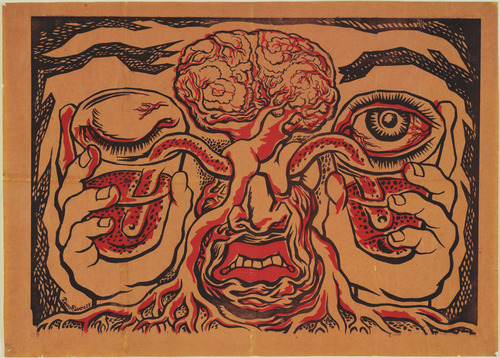
This afternoon my horn, reed, and body conditions were aligned for me to discover a new chord fingering.  This fingering, notated below, allows for only a brief spark of energy before the sound dies.  To create it, a great deal of lip pressure was required against the reed.  The chord could be held out to sustain itself, but only if I used an excessive amount of pressure.  However in order to incorporate other, more nuanced chords shapes around it I could only momentarily grip the reed harder.  This resulted in a major chord sound world that reminded me a particle accelerator, where light particles collide with each other in a hyper controlled environment near the speed of light.  Though the encounter is extraordinary, the explosion can only happen for an infinitesimal amount of time.  In my improvisation today, I explored the concept of creating melodies and sound shapes with momentary interruptions of this super-charged sound world.

The momentary chord in this discussion can first be heard about 6 seconds into the improvisation, and then throughout.  The fingering used to create it was as follows:

(Left Hand) Octave Key, Low Bb // (Right Hand) Low C

This created a Concert G major chord with the pitches (in ascending order): D, B, and G.  The chord spoke the most easily when momentarily flicking the F key in the right hand.  I thought of my air as the force traveling behind the sound action, and the flicking of the key as akin to the final pressure exerted on the sound particles to make the explosion finally occur.  The melodic shapes explored in this improvisation, most notably a triplet figure with the pitches: D#, E, B, D, B were created by using the above fingering, but also flicking open and closed the side F#, Fork F, and Palm F.

-Neil

The image “Eye from Oaxaca” accompanying today’s post by George Ortman (1966)