08/01/2013 (12 Moons Solo Project Day 213)

image

12 Moons Solo Saxophone Project Day 213

Date: 08/01/2013

Instrument: Tenor saxophone

Location: Practice room A at South Whidbey High School.  Langley, WA (Whidbey Island)

Notes:

Between students this afternoon, I recorded in my teaching space at South Whidbey High School.  The past several days my improvisatory focus has laid more on conceptual process with little melodicism, and I decided to try and tackle both fronts today.  In this improvisation I developed two chord progressions, each with slightly different fingering systems but with a common melodic shape.  In the two chord systems, written below as Sound Cycle 1 and Sound Cycle 2, I explored parallel minor and major resolution.  I define them as “Sound Cycles,” because though they are definitive chord shapes, their application relayed more heavily on the creation of evolving sound scape’s rather than plainly stated chords.

I approached the improvisation with the feeling of a definitive pulse taking place at all times, but I tried to let this area evolve naturally.  This included increases/decreases in tempo, areas of more dominant presence in one of the Sound Cycles over the other, and the addition of more ornamentation such as trills and grace notes, all of which affected how I would approach tempo variations.

Sound cycle 1 (total of 4 actions, with the notated pitch below being the primary melodic focal point in my mind)

Pitch E

(Left Hand) B-A keys, Octave, Palm Eb, Low Bb // (Right Hand) E-D keys, High F# key

Pitch D#

(Left Hand) B-A keys, Octave, Palm Eb, Low Bb // (Right Hand) E-D keys

Pitch G#

(Left Hand) B-A keys, Octave, Low Bb // (Right Hand) E-D keys

Pitch B

(Left Hand) B-A keys, Octave, Palm Eb, Low Bb // (Right Hand) E-D keys

Sound cycle 2 (total of 4 actions, with the notated pitch below being the primary melodic focal point in my mind)

Pitch E

(Left Hand) B-A keys, Octave, Palm Eb, Low B // (Right Hand) E-D keys, High F# key

Pitch D#

(Left Hand) B-A keys, Octave, Palm Eb, Low B // (Right Hand) E-D keys

Pitch G#

(Left Hand) B-A keys, Octave, Low B // (Right Hand) E-D keys

Pitch C (quarter step flat)

(Left Hand) B-A keys, Octave, Palm Eb, Low B // (Right Hand) E-D keys

-Neil

The image “Welcome III” accompanying today’s post by Hurvin Anderson (2004)
07/31/2013 (12 Moons Solo Project Day 212)

image

12 Moons Solo Saxophone Project Day 212

Date: 07/31/2013

Instrument: Tenor saxophone

Location: A small practice room adjacent to the orchestra room.  Chief Sealth High School in Seattle, WA

Notes:

Before beginning my teaching schedule this morning, I attempted to record in two separate locations.  The first was the back alley behind a massive Target store at a nearby mall, and the second was the main orchestra room at Chief Sealth high school.  In both cases, interruptions prevented me from feeling fully committed to my improvisations.  In the back alley, several cars would drive by and, rightly so, stare at me and wonder what I was doing with a saxophone in an alley behind a mall at 7:30am in the morning.  After leaving and attempting to record in the high school orchestra room, I found that I had unfortunately chosen the half hour the custodians needed to wash and wax the floors.  I ended up in the small practice room I teach in each week.  This room is fully padded and insulated with specialized sound absorbing material.  The tiny room swallows up the rich overtones of the saxophone and leaves behind the most barren sound I think I’ve ever experienced in a room.  I recorded an improvisation that utilized the deadness of the space, and paired this against the false illusion of reverberation by creating comparatively richer sound colors.

I opened the improvisation with a tempo that I devoted to throughout the improvisation.  As in yesterday’s improvisation, I explored cross-fading from one sound-scape to another.  However unlike yesterday’s piece, I also utilized abrupt sound transitions.  I maintained a repetitive cycle of opening and closing the Side C, High F, and Side F# keys.  This acted as the binding agent for the various sound colors I chose.  Some of these sound colors had a reverberant quality, while others had a dryer, more arpeggiated sound.  Part of this was due to working with a fingering and then either applying or taking away the octave key.  Doing so helped to gently alter the chord by either introducing more high tones or low tones respectively.  The fingerings chosen were determined in the moment, but were based on an initial fingering:

(Left Hand) B-G keys, Low Bb // (Right Hand) F key, Low C

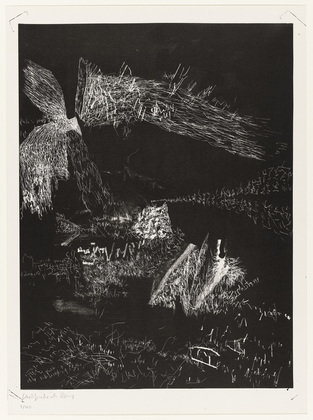
The image “Untitled” accompanying today’s post by Carlfriedrich Claus (ca. 1988)

07/30/2013 (12 Moons Solo Project Day 211)

image

12 Moons Solo Saxophone Project Day 211

Date: 07/30/2013

Instrument: Alto saxophone

Location: My car, in the Madison Neighborhood East of Capital Hill.  Seattle, WA

Notes:

A strange but familiar spot for me to practice has always been my car.  Whether camping, stuck in a ferry boat line, or between points of travel during the day, my horn is almost always with me.  I recently purchased a new car and realized today that I haven’t practiced in it yet.  This afternoon I decided to ready the space by recording an improvisation that used the dead, isolated sound of the car’s interior.  I recorded in a quiet neighborhood next to a shaded tree in the Madison neighborhood, East of Capital Hill.  I improvised a piece that focused on cross-fading three primary areas of the horn within two separate fingerings.  The fingerings were as follows:

(Left Hand) B-A-G keys, Low Bb // (Right Hand) F-E-D keys

(Left Hand) B-A-G keys, Low Bb // (Right Hand) F-E-D keys, Low Eb

While exploring sound color within the constraints of these two fingerings, I also focused heavily on developing a melodic shape.  I used very little articulation, but used the pitch changes between the two chords to punctuate the movement between them.  The three constraints I focused on included: 1. Lower octave multiphonic with a second wide oscillating multiphonic.  2.  Two upper octave single pitches.  3.  Two multiphonics in the upper register with very similar, tight oscillating tone color.  The first of the two chords in no. 3 rings a very clear major chord sound.

-Neil

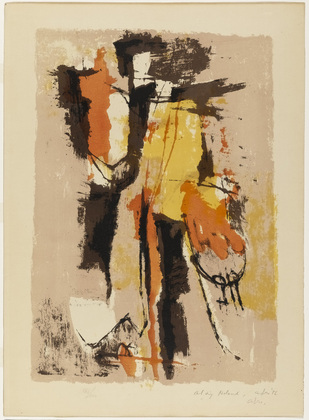
The image “Untitled” accompanying today’s post by Afro (Afro Basaldella) 1956

07/29/2013 (12 Moons Solo Project Day 210)

image

12 Moons Solo Saxophone Project Day 210

Date: 07/29/2013

Instrument: Tenor saxophone

Location: Home studio in Clinton, WA (Whidbey Island)

Notes:

This past year or so I’ve become more interested in directly incorporating key clacking within a melodic-based composition.  To explore this idea, today I maintained a continuous roll which acts as a kind of percussive drone beneath the pitches that were played.  To make the listener subconciously aware of its use, I made a simple melodic figure with the high C# that overwhelms the percussive sound, but still allows it to be quietly audible.  The clacking roll has very little room for dynamic shaping, versus the C# which can range from whisper soft to blatantly loud.  The C# figure opens the improvisation, and it’s application was for use as both a melodic figure, but also a simple point of focus to almost draw more attention to the continuous roll beneath it once the C# finally disapears.  

After the first minute or so I abruptly abandoned the C# melodic figure in favor of the clacking only.  Though the C# figure does fade back in verbatim, this initial dropping out signals a change in the piece, and from this point forward the new melodic material is more diverse in range, volume and sound textures explored.

The fingering system used during this improvisation was as follows:

(Left Hand) Bis Bb key only, Octave // (Right Hand) Rapidly trill the upper right hand clutch key.

The upper octave tones, as well as the pitch bends were then created by slowly opening and closing the Fork F key (about ¾ the way open in total) in the Left Hand.  The slight trill interruptions which begin near the end of the piece were done by quickly flicking open and closed the F Palm key in the Left Hand as well.

-Neil

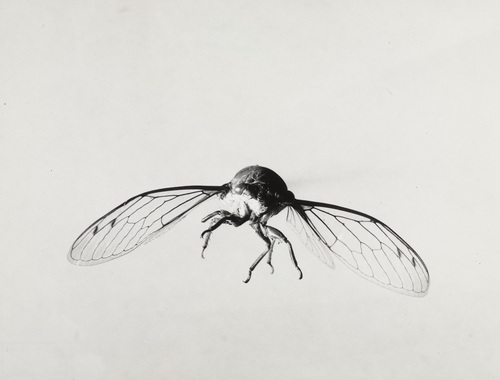
The image “Cicada” accompanying today’s post by Dr. Harold E. Edgerton (1939 or before).

07/28/2013 (12 Moons Solo Project Day 209)

image

12 Moons Solo Saxophone Project Day 209

Date: 07/28/2013

Instrument: Tenor saxophone

Location: Home studio in Clinton, WA (Whidbey Island)

Notes:

During my practice session I focused on the pairing of very specific, yet diverse regions of the instrument.  This led me to explore in this improvisation a broad center of sound with three primary developmental aspects and one secondary aspect.  Each occupies a unique place within the sound spectrum and were played at will.  I placed each aspect next to another, thought the execution was paced somewhat slowly as I tried to move from one aspect to another in an unhurried way.  The primary developmental aspects included: 

1.  The use of and extremely wide range spanning three octaves with the pitches low Bb and altissimo C.

2.  Indeterminate pitches within the upper middle register, played in tight pairing with one another.

3.  A multiphonic with an increasing level of volume.  Fingered as follows: (Left Hand) B-A-G keys, Octave, Low B // (Right Hand) F-E-D keys, Low C

The secondary developmental aspect included:

4.  The Low B fingering, played as an oscillating chord with an evenly paced wave form.  

-Neil

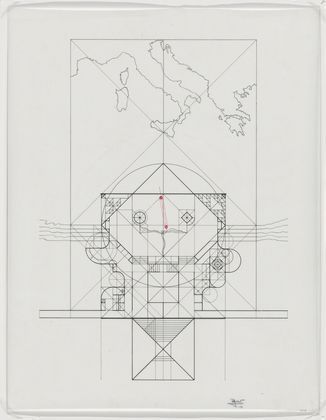
The image “Fountain House, Generative Geometries, project, Plan” accompanying today’s post by Rodolfo Machado and Jorge Silvetti (1942).