07/27/2013 (12 Moons Solo Project Day 208)

image

12 Moons Solo Saxophone Project Day 208

Date: 07/27/2013

Instrument: Soprano saxophone

Location: The rec room of my childhood house.  Edmonds, WA

Notes:

For reasons of a personal nature, this was a very difficult day for me.  As this series has progressed my improvisations have more and more taken on an critical role in helping me understand these days.  I decided to confront my reality with a more uplifting piece.  This improvisation was of the kind that I could embrace for use as my medicine, in the astounding way art is able to fully transform us, if even for a small period.  This brief, very active improvisation centered around the Concert C major triad, and a multiphonic with three diatonic tones inside of it.  The multiphonic was fingered as follows:

(Left Hand) B-A-G keys, Octave, Low B // (Right Hand) F# key

This fingering created the middle octave tones E,D and the upper register C.  Though they were a bit flat in intonation, I would balance these diatonic pitches primarily against the C major triad.  In the upper register, I also developed an improvised figure with the pitches E-F-E-C— which I would interject between the split tones and the arpeggios.

-Neil

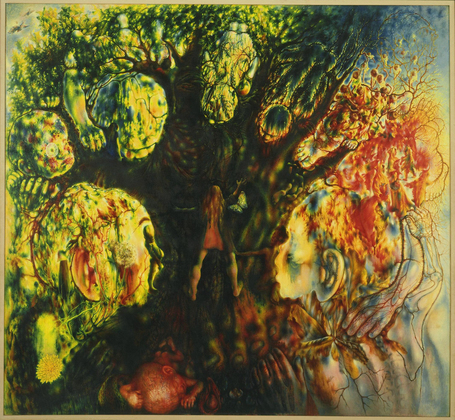
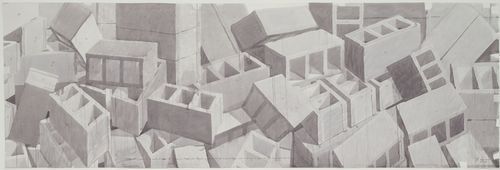
The image “Hide and Seek, Derby, Vermont June 1940-June 1942 and New York” accompanying today’s post by Pavel Tchelitchew
07/26/2013 (12 Moons Solo Project Day 207)

image

12 Moons Solo Saxophone Project Day 207

Date: 07/26/2013

Instrument: Tenor saxophone

Location: Home studio in Clinton, WA (Whidbey Island)

Notes:

After two separate recording attempts today that led to limited results, I decided to consider a firmer approach to a piece.  I improvise based on the unfolding of sound within a repeating fingering system.  During my practice session I focused on wide vibrato as a base approach to every pitch I played.  I tried to eliminate the use of pure tone to make the more animated vibrato sound the dominant voice.  This eventually influenced my recorded improvisation in that I applied the concept of pliable pitch centers in a broader context, by using this as the true improvisatory element and the repeating fingering system as the more concrete composition.

In this improvisation the initial muted gesture that opens the piece becomes the springboard for exploring the width of tone bending.  As my embouchure spreads the pitch, the intonation begins to drift sharp and flat, eventually reaching a breaking point at which altissimo tones enter the field.  This particular fingering system also allowed for multiphonic chords, which were achieved by applying more pressure against the reed while repeating the fingering system.  Other split tones, particularly those in the extreme upper register, were done instead by applying very little pressure on the tip of the reed.  The improvisation uses changes in dynamic range as well as tempo to further explore the bending of pitches and elaboration of sound textures.  

-Neil

The image “Untitled” accompanying today’s post by Ishimoto Yasuhiro (c. 1950)

07/25/2013 (12 Moons Solo Project Day 206)

image

12 Moons Solo Saxophone Project Day 206

Date: 07/25/2013

Instrument: Tenor saxophone

Location: Home studio in Clinton, WA (Whidbey Island)

Notes:

My afternoon was spent working on chromatic exercises with octave displacement, arranged in angular, disjointed shapes.  This largely influenced my improvisation today.  I became interested in the idea of pairing more precise wide intervalic material with a loose, repetitive theme.  Except for the repeated theme itself, the melodic material in this piece was fully improvised.  There is inflection used throughout the improvisation, such as trilling, double tonging, extreme dynamic shifts, false fingerings and a wide array of articulation variations.  However, I avoided the use of any kind of vibrato and reserved this instead for the main theme only.  This was done to punctuate its use more dramatically against the other melodic material.  I used fingerings for the main theme that allowed for wider bends with the vibrato. I also decided to burry the main theme inside melodic phrases so as to create an interruption each time it begins and ends.

For the main theme, the fingerings used were as follows (in the tenor key of Bb):

Pitches: B-C 

(Left Hand) C key, Octave, Low B  // (Right Hand) F-E-D keys, Low C

Pitch: D

(Left Hand) C key, Octave, Palm Eb, Low B  // (Right Hand) F-E-D keys, Low C

Pitches Ab-Bb

(Left Hand) B-A keys, Octave, Low Bb  // (Right Hand) F-E-D keys, Low Eb

Pitch: E (quarter step low)

(Left Hand) Fork F, C-G keys, Octave // (Right Hand) F-E-D keys, Low Eb

Pitch: E

(Left Hand) Fork F, C-G keys, Octave, Palm Eb // (Right Hand) F-E-D keys, Low Eb

-Neil

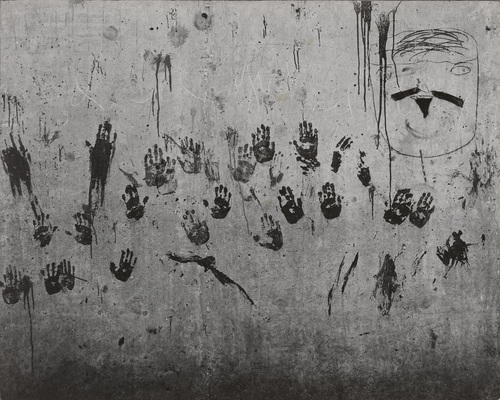
The image “Proyecto de Acumulacion de Materiales (Project of Accumulation of Materials)” accompanying today’s post by Alexandre Arrechea, Dagoberto Rodriquez, Marco Castillo (1999)

07/24/2013 (12 Moons Solo Project Day 205)

image

12 Moons Solo Saxophone Project Day 205

Date: 07/24/2013

Instrument: Soprano saxophone

Location: Home studio in Clinton, WA (Whidbey Island)

Notes:

This morning I attempted to record a piece around 6am but was discouraged by the results.  My aim was to create a palette of whisper soft upper register tones, but after many attempts at an improvisation I decided to take the day to think about how better to shape the piece.  I tried again around 7:00pm, and found myself feeling fully inspired and prepared to record.  The improvisation I decided to tackle used three primary pitches at its center: altissimo F#, G# and A (in the soprano key of Bb).  Alternating beneath and above these tones I created additional layers of melodic activity.  I worked to balance thin with thick textures while trying never to loose sight of the 3 primary pitches.  Instead of playing at a whisper soft dynamic level I recorded at medium volume.

Notated below, the fingerings for these pitches allowed for a wide array of textural shaping, including traditional pitches, split tones and full multiphonic chords.  I also occasionally added the C# in middle octave to help punctuate the extreme difference between the brighter high whistle tones and this comparatively fuller middle octave tone color.  Sometimes I chose to create tight melodic cycles, and at other times thinned the textures to explore repetition with more subtle elements.  The simultaneous use of varying layers of action in several octaves became central to this improvisation.

The fingerings were as follows:

Altissimo F#

(Left Hand) Fork F, C key, Octave, Low Bb // (Right Hand) Low C

Altissimo G#

(Left Hand) Fork F, C key, Octave, Low Bb // (Right Hand) High G key, Low C

Altissimo A

(Left Hand) Octave key, Low Bb // (Right Hand) High G key, Low C

-Neil

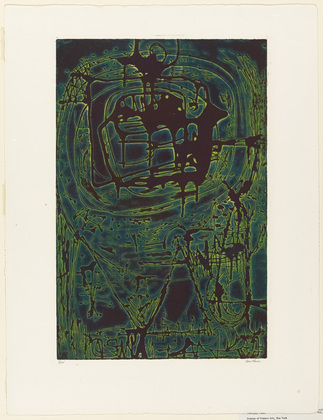
The image “Gargantua” accompanying today’s post by Sam Kaner (1954)

07/23/2013 (12 Moons Solo Project Day 204)

image

12 Moons Solo Saxophone Project Day 204

Date: 07/23/2013

Instrument: Tenor saxophone

Location: Home studio in Clinton, WA (Whidbey Island)

Notes:

An improvisation with a steady pulse of energy was my aim today; something that began with action and maintained it throughout.  During this piece I explored chord clusters with a variety of tone colors and tried to immediately begin the improvisation with hightenened energy.   The larger sound picture gave me the impression of multiple musicians interacting at the same time, and I used three fingering actions as points of departure to do this.  Fingering action 1 uses a simple major chord shape.  Fingering action 2 is a split pitch gesture that bends up from a Concert D  (quarter step flat) to a Concert F (quarter step flat).  Fingering 3 is the single pitch F (quarter step flat) which is noticeably more accented than the other tones.  These fingering actions are stitched together with a recurring intermediary fingering cycle described below.

While playing this piece I found myself focusing on textural themes in Gamelan music.  I imagined a symphony of mallet percussion with interlocking melodic figures that combine in equal intimacy with rhythmic cycles.  In that music I hear a great deal of individualism, but only insofar as the larger group will allow for this without compromising the vision of the entire ensemble.  I worked to balance these overarching themes as I played.

The fingerings and pitches were as follows (all notated in the tenor key and in ascending order of pitch)

Fingering action 1: Ab muted difference tone, E quarter step flat, C

(Left Hand) B-A-G keys, Octave, Low B // (Right Hand) F-E keys, Low C

Fingering action 2: E quarter step flat, G quarter step flat.  Use embouchure to bend from E to G.

(Left Hand) B-A-G keys, Octave, Low B // (Right Hand) F# key, Low C, High F# key 

Fingering action 3: G quarter step flat.

(Left Hand) B-A-G, Octave, Low B // (Right Hand) E-D keys, Low C, 

The intermediary finger cycle that combines Fingering action 1 and 2 is done by opening the F key (right hand), followed by the B key (left hand) and finally the B key is then put back down (but the F remains open), each in turn with the overall cycle happening very rapidly.

-Neil

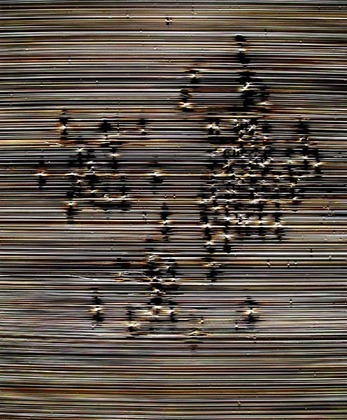
The image “Pan (C-337)” accompanying today’s post by Marco Breuer (2003)