07/23/2013 (12 Moons Solo Project Day 204)

image

12 Moons Solo Saxophone Project Day 204

Date: 07/23/2013

Instrument: Tenor saxophone

Location: Home studio in Clinton, WA (Whidbey Island)

Notes:

An improvisation with a steady pulse of energy was my aim today; something that began with action and maintained it throughout.  During this piece I explored chord clusters with a variety of tone colors and tried to immediately begin the improvisation with hightenened energy.   The larger sound picture gave me the impression of multiple musicians interacting at the same time, and I used three fingering actions as points of departure to do this.  Fingering action 1 uses a simple major chord shape.  Fingering action 2 is a split pitch gesture that bends up from a Concert D  (quarter step flat) to a Concert F (quarter step flat).  Fingering 3 is the single pitch F (quarter step flat) which is noticeably more accented than the other tones.  These fingering actions are stitched together with a recurring intermediary fingering cycle described below.

While playing this piece I found myself focusing on textural themes in Gamelan music.  I imagined a symphony of mallet percussion with interlocking melodic figures that combine in equal intimacy with rhythmic cycles.  In that music I hear a great deal of individualism, but only insofar as the larger group will allow for this without compromising the vision of the entire ensemble.  I worked to balance these overarching themes as I played.

The fingerings and pitches were as follows (all notated in the tenor key and in ascending order of pitch)

Fingering action 1: Ab muted difference tone, E quarter step flat, C

(Left Hand) B-A-G keys, Octave, Low B // (Right Hand) F-E keys, Low C

Fingering action 2: E quarter step flat, G quarter step flat.  Use embouchure to bend from E to G.

(Left Hand) B-A-G keys, Octave, Low B // (Right Hand) F# key, Low C, High F# key 

Fingering action 3: G quarter step flat.

(Left Hand) B-A-G, Octave, Low B // (Right Hand) E-D keys, Low C, 

The intermediary finger cycle that combines Fingering action 1 and 2 is done by opening the F key (right hand), followed by the B key (left hand) and finally the B key is then put back down (but the F remains open), each in turn with the overall cycle happening very rapidly.

-Neil

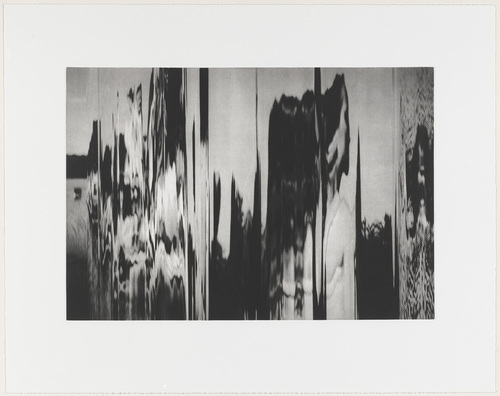
The image “Pan (C-337)” accompanying today’s post by Marco Breuer (2003)
07/22/2013 (12 Moons Solo Project Day 203)

image

12 Moons Solo Saxophone Project Day 203

Date: 07/22/2013

Instrument: Tenor saxophone

Location: Home studio in Clinton, WA (Whidbey Island)

Notes:

In my improvisation today, I explored the concept of moving forward through the lens of our own experience.  As an improvisor I draw from the well of my own knowledge and those around me.  Every day I’m so encouraged by the thought that for every bit I draw from myself my knowledge becomes replaced ten fold by life experience.  In relation to my improvisation today, I wanted to encounter my own work in real time from a place of acceptance, and allow the piece to push forward at all times.  I tried not to second guess in any way my thought process while playing, and to use this bit of ego to help fuel the decisions that came in each new moment.  During this improvisation I didn’t have a starting or ending point in mind, but instead made it my goal to allow my thought process itself to point me towards something of a complete whole.  

From the initial sound that begins the piece, I was struck by the beautiful dissonance of the chord and the upper register Eb that spoke so much clearer than the other tones.  I then began a fingering system that exploited this high octave Eb, which created a recurring melodic action during the piece (pitches written in ascending order): G-Ab-Eb.  This became the dominant fingering action:

(Left Hand) B-A keys, Octave, Low B // (Right Hand) F-E keys

With this sound color I began incorporating rhythmic cycles into the improvisation, as well as several small events.  These events would include a few seconds of focus within a particular register, sound clusters, shifts between octaves, extreme dynamic shaping, etc.  An additional action which became a recurring theme was the held multiphonic with accents on each beat.  This can be heard for the first time at 2:42.  This accented sound was created by taking away and then re-applying the octave key in time, using the central fingering notated above.

-Neil

The image “Untitled (4 days, 3 nights, 1 sumer) accompanying today’s post by Joey Kotting (2001)

07/21/2013 (12 Moons Solo Project Day 202)

image

12 Moons Solo Saxophone Project Day 202

Date: 07/21/2013

Instrument: Tenor saxophone

Location: A trailside clearing in Ravenna Park.  Seattle, WA

Notes:

I spent the day on the mainland teaching, rehearsing, and playing.  On Sunday’s I generally feel fueled by the energy of the city and look forward to participating in it, but today I felt swallowed up by the pace of it.  Several hours of my day were spent commuting by car and bus, and my improvisation was a sound reflection of over 100 miles of city and suburb commuting, a beautiful sky overhead, piles of trash, friendly strangers and endless lines of houses.  I decided to record in Ravenna Park, which is a wonderful wooded space located in Seattle’s University district.  I set up the mic next to a babbling creek on the edge of a walking trail.  Airplanes occasionally flew overhead, trucks drove by, couples walked and talked with one another in the distance and birds sang overhead.

During this improvisation I explored tiny sound clusters without any melodic center.  I tried to let tones  within the clusters naturally poke out with more presence than the others to help further this feeling of instability. I bound the small, nondescript points of action together with swooping floods of air to carefully swell the volume.  I thought about creating extreme dynamics below a very low ceiling of volume.  A point of interest to me lately in my practicing, it trying to explore the furthest limits of an idea, in this case volume, when the limits themselves are very restrictive compared to what is actually possible on the instrument.  I find that with such a low ceiling for volume, I feel liberated to explore the quietest of figures up to simply “lower volume” figures and experience very clear definition between them.

-Neil

The image “Sade for Sade’s sake” accompanying today’s post by Paul Chan (2009)

07/20/2013 (12 Moons Solo Project Day 201)

image

12 Moons Solo Saxophone Project Day 201

Date: 07/20/2013

Instrument: Tenor saxophone

Location: Home studio in Clinton, WA (Whidbey Island)

–Due to a mix-up in my daily count, today’s post is now Day 202.  This is correct since it’s now the 202nd day of the year.  Yesterday’s count was 200, which as it turns out was incorrect.  Each improvisation in this daily series is still accounted for, but there was a duplication in my daily count at some point in the past 202 days which has now been caught!–

Notes:

In my improvisation today, I explored quiet, sustained altissimo pitches with occasional underlying melodies.  The piece opens with three pitches that become the main source material: Concert C, C# and D.   I recorded this improvisation very quietly, and tried to make use of the tiny dots of sound that wanted to pop out in these upper octave sustained notes.  It was extremely difficult to hold onto these notes at such a quiet level of volume, and I practiced simply sustaining them for a very long time during my practice session before attempting to record an improvisation.  

A recurring theme in my music these days is the interplay between two opposing elements on the instrument.  In this case it was the interplay in volume between the high pitches and the melodic action underneath.  There are times where I tried to cross-fade from one to the other, allowing each to speak the most present in turn.  At other times the switch was more abrupt or one was temporarily phased out completely.

The fingerings for the sustained notes were as follows:

Concert C

(Left Hand) Pearl key, Octave // (Right Hand) Side Bb

Concert C#

(Left Hand) Pearl key, Octave // (Right Hand) Side Bb, High F# key

Concert D

(Left Hand) Pearl key, A key, Octave // (Right Hand) Side Bb

The melodic action beneath these sustained tones was done through slowly closing and re-opening the Fork F fingering or G key (each in the left hand).

-Neil

The image accompanying today’s post by Marcel Dzama

07/19/2013 (12 Moons Solo Project Day 200)

12 Moons Solo Saxophone Project Day 200

Date: 07/19/2013

Instrument: Tenor saxophone

Location: Home studio in Clinton, WA (Whidbey Island)

Notes:

I felt like evoking a joyous spirit song in my imposition today.  A few days ago I played a show at Egan’s in Ballard, and towards the end of our set I took a solo that has been a long time coming.  This solo was a culmination of a recent resurgence in a desire for me to play more straight ahead jazz playing, and also my longtime study of John Coltrane’s music.  During our set we played a piece that had a feeling similar to one of my favorite Coltrane tunes, Chasin’ the Trane.  I felt free on that stage, and that solo fulfilled something in me I hadn’t known was lacking lately.  I felt liberated in this moment. My soul felt naked and my mind clear.  I felt expressive, controlled and willing to devote myself fully to the music I was a part of.  It was beautiful for me.  It wasn’t intentional during the recording of this piece, but it’s clear to me that this improvisation is directly linked to the parallel between my longtime search for a way to evoke Coltrane’s musical voice through my own means.

In this piece I used the amazingly universal scale the Major Pentatonic. This is a beautiful, versatile scale found in all musical traditions.  I channeled the joy in my heart I’ve carried with me the past few days.  The improvisation has a dance-like quality to me, and in fact I was uncharacteristically more expressive in my body movements while recording.  The improvisation had no particular melodic framework, though on repeated listenings it’s clear to me that there were several figures I referred to.  I used double tonging and false fingerings to help give the piece a percussive motion.  I didn’t follow any particular meter, but instead used these techniques to help create melodies that were distinct and full of forward motion.  The improvisation uses the Major Pentatonic scale in the key of Db. In ascending order, the pitches are: Db, Eb, F, Ab, Bb, Db

-Neil

The image “Drying Teddies, P.Q. Canada” by David Marshall Graham (1982)