07/18/2013 (12 Moons Solo Project Day 199)

12 Moons Solo Saxophone Project Day 199

Date: 07/18/2013

Instrument: Tenor saxophone

Location: Practice Room A at South Whidbey High School.  Langley, WA (Whidbey Island)

Notes:

During this improvisation I explored a simple melody with that used a fingering system with single and split tones.  This folk-like melody is centered around the first three notes of the major scale.  Each of the pitches was a quarter step high, making them sound tempered in relation to one another despite being very out of tune in a traditional sense.  The fingerings gave each of the pitches a very warm timbal quality that I immediately gravitated towards.  The three pitches: Bb, C and D (again, each a quarter step high) were created with only 2 fingerings.  The Bb was created as follows: (Left Hand) B-A keys, Octave, Palm D.  The C and D used the same fingering with the addition of the Side F key: (Left Hand) B-A keys, Octave, Palm D // (Right Hand) Side F key.  The sliding between pitches or occasional cross-over into two pitches at the same time was done with my embouchure.  I made it my goal to shift from the 2nd to the 3rd pitch when my embouchure naturally wanted to engage.  Sometimes is happened quickly and other times very slowly, but regardless I tried to remain immediately aware of when the shift was about to take place in order to respond appropriately.

After the initial exploration of the Bb, C and D, I began adding the altissimo G in the upper register.  This tone was created with the traditional fingering, and therefore with tempered tuning set against the non-tempered notes below it.  As with the split tone fingering above, I tried to let it naturally speak based on the conditions of my embouchure at that moment.  This accounts for the variation in volume and character of the note (bright, dark, muffled, etc.). Eventually I added another chord to the sound field, which used the following fingering: (Left Hand) B-A keys, Octave, Palm D // (Right Hand) F key.  This tone was first introduced at 1:42 (the sustained tones).  As the improvisation progressed I began intertwining the chords more freely and stretching the harmony by adding other tones from outside the chord shapes.

-Neil

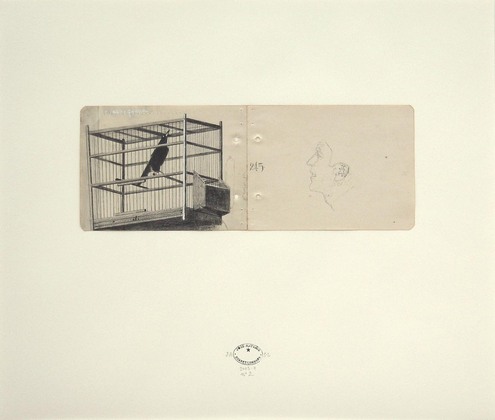
The image “no world from An Unpeopled Land in Uncharted Waters” by Kara Walker (2010)
12 Moons Solo Saxophone Project Day 198

Date: 07/17/2013

Instrument: Tenor saxophone

Location: The loading dock behind a Target Store, at the Westwood Village Mall in White Center.  Seattle, WA

Notes:

I was in the South-West side of Seattle by 8am this morning, and spent a bit of time thinking about a site-specific location for an improvisation.  I originally planned to record in White Center at the Pea-Patch community garden.  White Center is one of the most culturally diverse neighborhoods in the Northwest.  When I walked through the community garden there were already folks out enjoying their little plots.  I decided to leave them to their solitude and look for another spot.  I ended up at the Westwood Village shopping Mall in a freight loading dock behind a Target super store.  The space turned out to be one of my favorite performance locations so far in the 12 Moons project.  

As with most modern big box stores, the building was made of cinder block.  The loading area behind the store had a retaining wall at least 200 yards long, and I would estimate to be 15 feet high.  This retaining wall held out the hillside beyond the shopping area.  There were baseball sized holes all along the wall which I believe were actually water drainage pipes inset into the wall.  I recorded at the far edge of the building in a 90 degree corner between the building and the retaining wall.  During the recording a sound similar to the rustling of leaves can occasionally be heard.  These were actually small piles of trash that were being caught in tiny tornadoes spinning around me.  In the distance garbage trucks, semi trucks and busses can be heard, as well as two separate car alarms.  

I approached the improvisation without a pre-scripted idea in mind.  The result was a piece that balanced the reverberation inside the retaining wall with aggressive swatches of sound that filled the vacant space between the Target and the wall.

-Neil

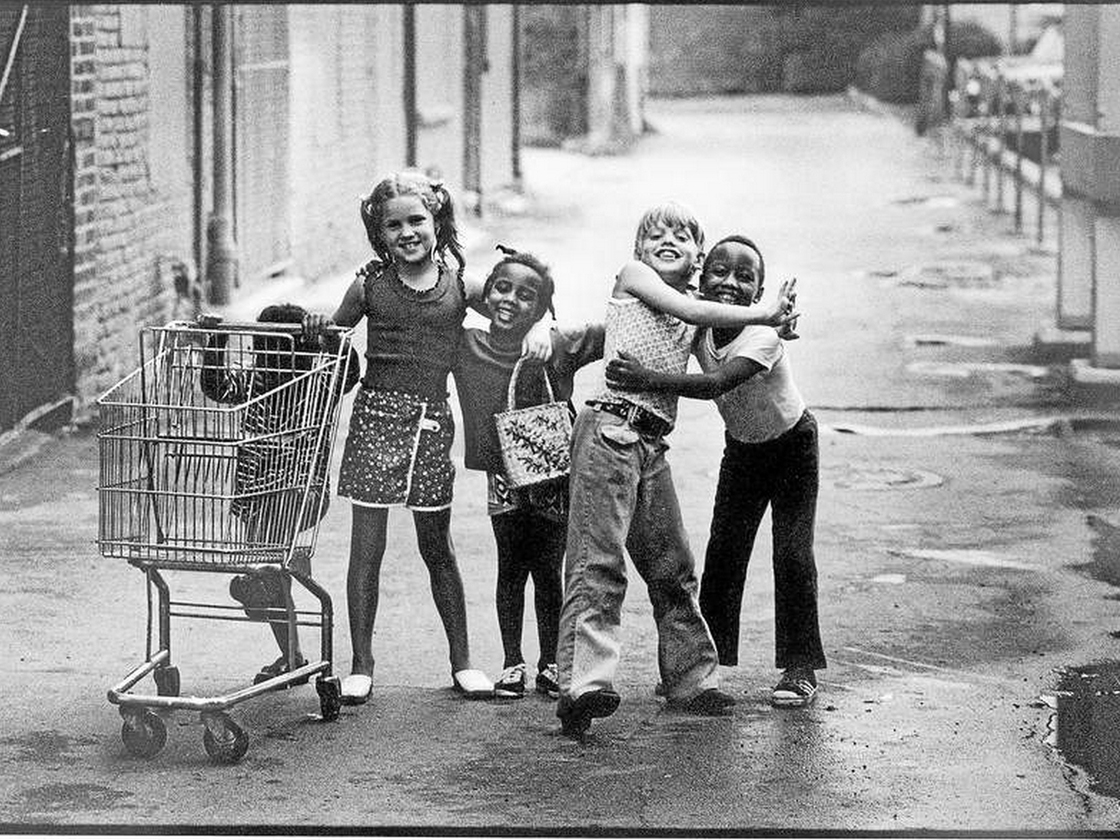
The image accompanying today’s post by Joseph Crachiola (1973)

07/16/2013 (12 Moons Solo Project Day 197)

image

12 Moons Solo Saxophone Project Day 197

Date: 07/16/2013

Instrument: Tenor saxophone

Location: Home studio in Clinton, WA (Whidbey Island)

Notes:

I practiced for a very long time this morning before arriving at this improvisation.  I woke up and started my day feeling a hollowness in me.  I’ve slept badly the past two nights, which I’m sure is related to it, but more importantly I felt this morning like I was in a constant search for something I couldn’t fulfill.  I carried this feeling into my practice session.  It seemed that no matter what I worked on, or how I hard I worked at it I could not be satisfied with the results and did not feel invested in what I was working on.  After following dead end after dead end in my improvisations, I eventually abandoned what I had been practicing and tried to open myself up.  What came out in this improvisation I feel very much represented a culmination of my life energy this morning.  It was almost a cry to purge this mood from me, or at least to embrace it with creative energy instead of allowing a destructive mental state to continue on.

After creating a fingering cycle and listening to the spirit of it, I set out to record this improvisation with no plan except to sing into the horn.  I gravitated towards two pitches, the Concert Bb and C (each a quarter step flat), and used them to sing into the horn with my voice.  As the piece progressed, the return back to the Concert Bb became almost a sonic respite for me that I just yearned to return to.  I built three developmental sections during this piece, each time climbing higher in pitch and letting the sound begin to fracture instead of center inward as in the lower tones.  After each build, on the return back to the Concert Bb and C the sound is noticeably more tense.  This improvisation uses a cyclical fingering system based around two fingerings.  

Fingering 1:

(Left Hand) B-A-G keys, Low B // (Right Hand) F-E-D keys.  Open and close the B, and side C in a cycle of 4 actions.

Fingering 2:

 (same as above, but open the low C# in the left hand instead of depressing the Low B).  This fingering was used during the three building sections where the sound begins to climb and distort.

-Neil

The image “Untitled” accompanying today’s post by Jose Antonio Suarez Londono (2005-2007).

07/15/2013 (12 Moons Solo Project Day 196)

image

12 Moons Solo Saxophone Project Day 196

Date: 07/15/2013

Instrument: Tenor saxophone

Location: Home studio in Clinton, WA (Whidbey Island)

Notes:

I was up early this morning and had a steady flow of students form the morning until early evening.  Between students I worked on the fingering system used in this improvisation.  I recorded several interpretations of this piece before doing a final take that explored the concepts captured in today’s improvisation.  This fingering system was as follows:

(Left Hand) B-A keys, Octave // (Right Hand) High F# key, clutch key above the low F key (manually press it down with the thumb).  The High F# key should be played with the pinky or ring finger.  To help facilitate the upward bends, I would also occasionally put down the Low C key in the right hand as well.

This fingering naturally creates a steady open fifths drone with the tenor middle octave B, an F# a fifth above it, and an additional F# in the upper register.  I tried at serval points throughout the day to perform a version of this piece that explored sound clusters combined with tiny changes in wave vibrations.   In these versions the piece held a steadiness with very few blatant interrupts, but because of the back-pressure with the fingering, I fought to hold back high register tones that wanted to enter into the sound field.  Near the end of the day I eventually embraced these higher tones and recorded the improvisation here.  This is a piece that uses the open fifths drone sound, but with occasional bursts of high octave color that would bend upwards to become the main focus, only to recede again into the drone.

-Neil

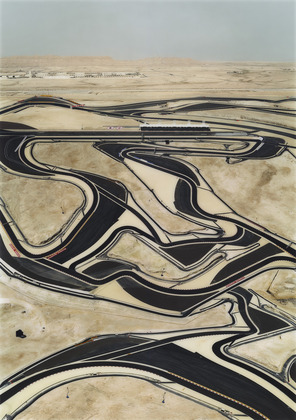
The image “Bahrain I” accompanying today’s post by Andreas Gursky (2005)

07/14/2013 (12 Moons Solo Project Day 195)

image

12 Moons Solo Saxophone Project Day 195

Date: 07/14/2013

Instrument: Tenor saxophone

Location: Home studio in Clinton, WA (Whidbey Island)

Notes:

This morning I was interested in creating slight bends within pitches, and trying to combine these bends with the “walking” trill technique I’ve been developing.  I used a fingering action that allows for a variety of sound colors, and worked to introduce sound choices at various points until they became intertwined together.  The finger action was as follows:

(Left Hand) B key down, Octave.  Slightly open and close the Palm F key with the pinky in the left hand, while slightly opening and closing the Fork F key with the right hand.  

When depressing the Fork F key, the Palm F key naturally opens about 50%.  By using the pinky in the left hand I’m able to then open it fully.  When I close the Fork F key I’m able to reintroduce the sound with the Palm F instead, and create a panning-like effect on the instrument as the fingerings go back and forth.  With this as a starting point, I then used the walking trill technique with my index and middle fingers rapidly trilling against the Fork F key.  Other techniques included two interpretations of a drip-like sound, the first by momentarily allowing the F key to close against the key cup, and the second the momentary release and then immediate depression of the octave key.

-Neil

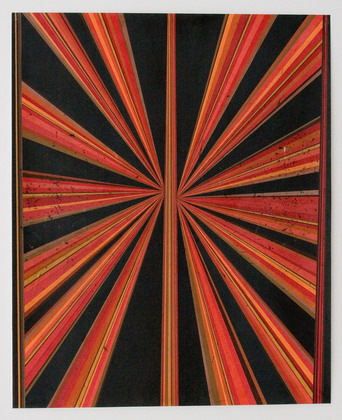
The image “Untitled (Red, Orange, Brown and Black Butterfly) #581” accompanying today’s post by Mark Grotjahn.