12 Moons Solo Saxophone Project Day 194
Date: 07/13/2013
Instrument: Tenor saxophone
Location: Home studio in Clinton, WA (Whidbey Island)
Notes:
My improvisation today consisted of continuous rhythmic cycles in 4 beats, with three variations on the same core fingering action. I modeled this improvisation off a similar concept explored in a composition from a few years ago. In the composed piece and in my improvisation today, I pair three fingering actions with three tempos: slow, medium, and fast. Built off the initial fingering system, the three total fingering actions each have their own characteristic sound. They vary in actual pitch structure, but most importantly they vary in the natural rhythmic cycles which emerge as a result of the fingerings themselves.
During this piece I followed a structure which presented each of the three actions independently for some time. I continuously followed the pattern of Slow (Fingering 1) Medium (Fingering 2) Fast (Fingering 3). As they were repeated, I gradually began to shorten the amount of time between actions, until each was played only once before moving on to the other. Finally, in the end of the improvisation I began to stretch the length of each series once again to add a feeling of space to the overall composition. The fingering actions were as follows:
Slow (Fingering 1)
(Left Hand) B-A-G // (Right Hand) F-E, Low C
(Left Hand) B-A-G // (Right Hand) F-E
(Left Hand) B-A // (Right Hand) F-E
(Left Hand) B-A-G // (Right Hand) F-E
(Left Hand) B-A-G // (Right Hand) F-E, Side F#
(Left Hand) B-A-G // (Right Hand) F-E
(Left Hand) B-A // (Right Hand) F-E
(Left Hand) B-A-G // (Right Hand) F-E
(Left Hand) B-A-G // (Right Hand) F-E, Side C
(Left Hand) B-A-G // (Right Hand) F-E
(Left Hand) B-A // (Right Hand) F-E
(Left Hand) B-A-G // (Right Hand) F-E
(Left Hand) B-A-G // (Right Hand) F-E, Side F#
(Left Hand) B-A-G // (Right Hand) F-E
(Left Hand) B-A // (Right Hand) F-E
(Left Hand) B-A-G // (Right Hand) F-E
Medium (Fingering 2)
Same series as above, but on each third cycle (within the 4 finger groupings) lift the C key up in the left hand instead of the G
Fast (Fingering 3)
Same series as above, but on each third cycle (within the 4 finger groupings) lift the B key up in the left hand instead of the G
-Neil
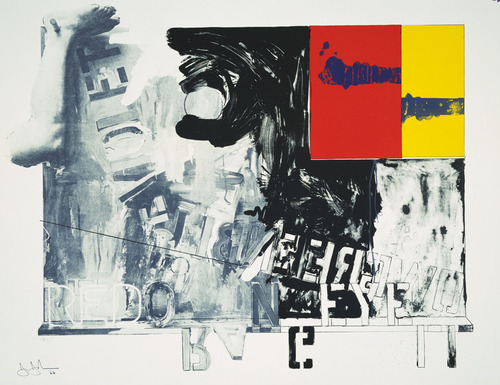
The image “Passage I” accompanying today’s post by Jasper Johns (1966)
07/12/2013 (12 Moons Solo Project Day 193)
12 Moons Solo Saxophone Project Day 193
Date: 07/12/2013
Instrument: Tenor saxophone
Location: The rec room of my childhood home in Edmonds, WA
Notes:
Today’s improvisation is a response to the early rising I’ve been doing lately, and the combination of physical and phycological implications that a dramatic shift in routine can cause, better or worse. I enjoy waking up early. I feel at the end of these days that I’ve been more productive by having a jump on the morning. After 5 consecutive days with this abrupt change in my sleep cycle, I’ve noticed that my mind feels a bit fuzzy about 2 hours after waking up, when typically it feels very clear during this stage in the early day. My improvisation today explores this feeling.
In this improvisation I tried to develop a dream-like state where activity is occurring but the motions of it have a hazy after glow. The chord progression that opens the piece has a very rich sound to it, with multiple layers of tones that interact so differently as I shape my embouchure. The fingering action was as follows:
(Left Hand) B key, Octave // (Right Hand) F-D keys, Low C, Side F. Slowly close and open (as in a slow trill) the C key in the left hand.
The hazy tone color of the progression is accompanied by interruptions from an equally ambiguous melody, played with the following pitches (notated descending as in the recording): Db B A Ab Gb E D Bb B A G. While improvising this piece, my challenge was to balance the two very different sound worlds of chord movement and single note melodicism. Sometimes I chose to side the two one after the other, and at other times to leave some space between them. I used slight changes in tempo and volume to help shape these transitions and the improvisation as a whole.
-Neil
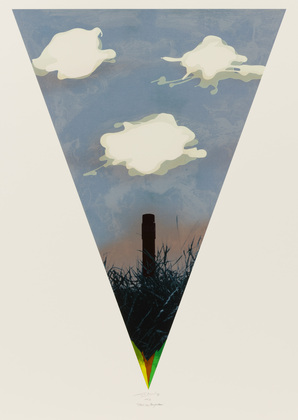
The image “Paal 120, Durgerdam” accompanying today’s post by Ger van Elk (1991)
07/11/2013 (12 Moons Solo Project Day 192)
12 Moons Solo Saxophone Project Day 192
Date: 07/11/2013
Instrument: Tenor saxophone
Location: Home studio in Clinton, WA (Whidbey Island)
Notes:
I recommend reading this post after listening to the music–not during or before.
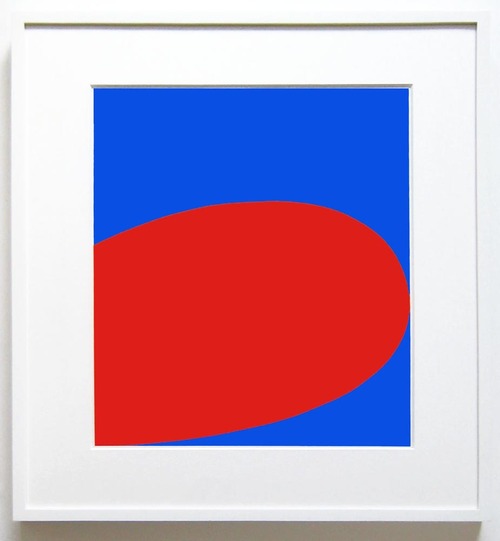
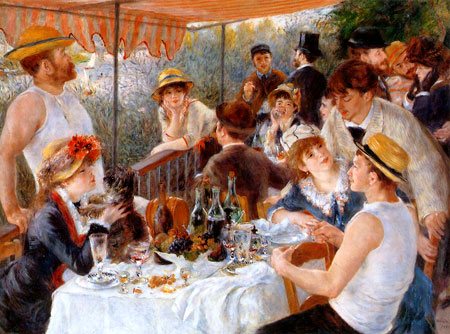
This morning I read an NPR article about the 90th birthday celebration of American artist Ellsworth Kelly. In his work, Kelly uses strong color tones, often with basic geometric shapes or simple curvatures. Of his own paintings, Kelly said “I feel that I like color in its strongest sense. I don’t like mixed colors that much, like plum color or deep, deep colors that are hard to define. I liked red, yellow, blue, black and white." He discussed the work of the Impressionist painter Renoir, and his work "Luncheon of the Boating Party,” saying “The happiness that Renoir was able to get into the picture is very visible..I don’t know if Americans have painted a picture quite like this." Kelly described a need for joy in his own paintings, and a hope that others will find joy through them. I found the direct parallel of joy in art between Kelly and Renoir to be incredibly inspiring. My improvisation today is a response to Kelly’s work, and my own search for an equivalent method of bringing joy through sound in our own way.
I reflected on Kelly’s work the entire day, thinking about his methodology and the amazingly active space this his canvases occupy. While practicing I searched for an equivalent method in my own playing, and slowly began to arrive at the final product heard on this improvisation. I considered strongly what I as a listener feel is the root sound of joy. After trying a variety of techniques, improvisation models and sound approaches of varying styles I eventually arrived at the notion that the most joyous of sounds to me is simply the tone of the saxophone itself. Though, for a listener I know this may not be enough, and I tried to consider further the most direct method of sound creation that immediately evokes beauty. This is of course ultimately subjective. When I open my eyes to look at a Kelly painting, I am stuck immediately by the simple vibrance of it. It feels uncluttered, unpretentious and the totality of it is presented to the viewer immediately. I decided that the clearest representation of this in sound would be a Major Third interval. It contains in it’s simple, profound sound an incredible amount of power that can pulls us into a very personal space. It’s not a melody but a mood.
I meditated on a Kelly painting while playing this piece. The two opening notes of the improvisation represent the image itself, created here through the notes G to Eb. The repetitive Eb to follow I feel is the texture of the work. It represents the simplest of shape and sound boundaries that frame the first two pitches. I used specific ornamentation in these repeated Eb’s: slight staccatos, vibrato, natural breathing, slight increases and decrease in volume, with a feeling of sound continuance overall. I decided that the total length of time I repeated this Eb made no difference. I played until I just stopped, not because of boredom or the completion of an aesthetic but simply when my mind and body did not wish to continue. After listening to this improvisation, I would not have been surprised if the piece totaled 30 seconds or 20 minutes. It is a shape that for the listener must be accepted or rejected and nothing between.
-Neil
Quotation source: "At 90 Elllsworth Kelly Brings Joy With Color Canvases.” National Public Radio online edition, by Susan Stamberg.
The images “Blue/Red” by Ellsworth Kelly and “Luncheon of the Boating Party” by Pierre-Auguste Renoir
07/10/2013 (12 Moons Solo Project Day 191)
12 Moons Solo Saxophone Project Day 191
Date: 07/10/2013
Instrument: Tenor saxophone
Location: Orchestra Room at Chief Sealth High School. Seattle, WA
Notes:
I found myself this morning at Chief Sealth High School over an hour before my teaching day was to get started. My wife and I were out the door by 5:45am with only a few hours sleep, but it was one of those rare days when being exhausted and unrested actually fueled me. School is out of session and the building was incredibly quiet. The only room that I found open was the orchestra space, which is acoustically treated to absorb as much sound as possible so as not to bleed into the other classrooms nearby. I’ve recorded in this space once before during this project, but today the quiet room was bearing down on me, and I decided to record an improvisation that took advantage of the artificially dry sound. I used a trilling technique I’ve worked with extensively lately. In this technique, I take two fingers, and while keeping them straight, outset at a 45 degree angle, I “walk” the fingers back and forth extremely fast against the key. The trill must float the key above the key cup and never, or at least seldom makes contact with the cup itself. By doing this an incredibly fast trill is possible.
I focused on particular pitches that would bring about the brightest, clearest tone color while doing the trill. The improvisation begins with a trill on the open C# key. I used my index and middle fingerings to walk on top of the C clutch key, which is only traditionally depressed while closing one of the left hand keys, and never independently. To utilize the dryness of the room, I tried to vary the colors I pulled out of the horn. Some pitch centers used stuffy, multi-toned chords, and others, such as the C# described above, were starkly dry in comparison. The piece was improvised freely on a small number of total sound actions. Some of the fingerings used were as follows:
Multiphonic/Overtone Chord (introduced at :30)
(Left Hand) B-A-G keys, Octave, Low B // (Right Hand) F-D keys. Use the right hand thumb to hold down the F key, and pinky to hold down the D key. Then trill the F# with the index and middle finger.
Multiphonic Chord (Introduced at 1:52)
(Left Hand) B-A-G keys, Octave, Low B, Palm Eb. Use the index and middle fingers in the right hand to trill the F clutch key in the right hand.
-Neil
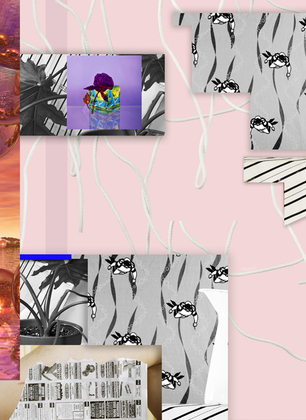
The image “Not So Optimal” accompanying today’s post by Michele Abeles (2012)
07/09/2013 (12 Moons Solo Project Day 190)
12 Moons Solo Saxophone Project Day 190
Date: 07/08/2013
Instrument: Tenor saxophone
Location: Home studio in Clinton, WA (Whidbey Island)
Notes:
In my practicing today, I focused on creating harmony with multiple chords that gave me a gut reaction. I tried to reflect on how the chords that affected me aligned with my mood. For the past several days I’ve been trapped in melancholy, but I also feel myself now emerging from this cycle. What brought either end of this on I couldn’t say, but I feel that this improvisation is a reflection of my internal multi-day experience with this, and now the beginnings of my relief. I feel joy and sorrow intertwined in this piece. The chord progressions used on this improvisation were not notated down, but were slowly arrived at in the old fashioned song writing way of creating sound to fit a moment.
I hear this improvisation as having three chord actions. Each of those written below can be heard at various points in the improvisation, but I’ve also included a notation as to where they can be easily found (for reference sake).
Chord action 1 (this chord progression opens the improvisation)
(Left Hand) Fork F, Octave, Low B // (Right Hand) F-D keys, Low C
(Left Hand) Fork F, C key, Octave, Low B // (Right Hand) F# key, Low C
Chord action 2 (the chord progression first appears at 1:45 in the slow, and quiet middle section)
(Left Hand) Fork F, C key, Octave, Low B // (Right Hand) F-E keys, Low C
(Left Hand) Fork F, C key, Octave, Low B // (Right Hand) F key, Low C
Chord action 3 (this chord progression closes the improvisation)
(Left Hand) Fork F, Octave, Low B // (Right Hand) F key, Low C
(Left Hand) Fork F, Octave, Low B // (Right Hand) F-E keys, Low C
-Neil
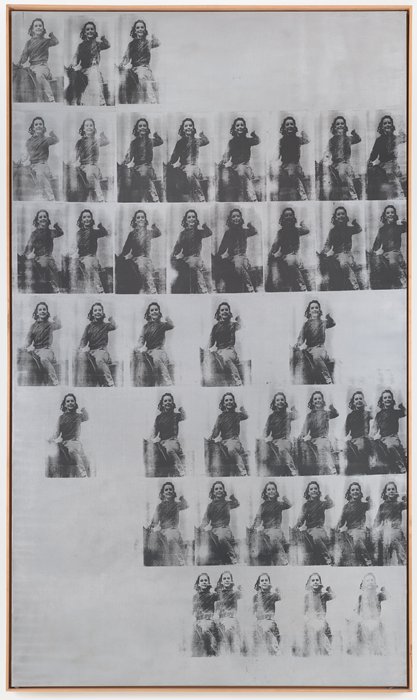
The image “National Velvet” accompanying today’s post by Andy Warhol (1963)