07/10/2013 (12 Moons Solo Project Day 191)

12 Moons Solo Saxophone Project Day 191

Date: 07/10/2013

Instrument: Tenor saxophone

Location: Orchestra Room at Chief Sealth High School.  Seattle, WA

Notes:

I found myself this morning at Chief Sealth High School over an hour before my teaching day was to get started.  My wife and I were out the door by 5:45am with only a few hours sleep, but it was one of those rare days when being exhausted and unrested actually fueled me.  School is out of session and the building was incredibly quiet.  The only room that I found open was the orchestra space, which is acoustically treated to absorb as much sound as possible so as not to bleed into the other classrooms nearby.  I’ve recorded in this space once before during this project, but today the quiet room was bearing down on me, and I decided to record an improvisation that took advantage of the artificially dry sound.  I used a trilling technique I’ve worked with extensively lately.  In this technique, I take two fingers, and while keeping them straight, outset at a 45 degree angle, I “walk” the fingers back and forth extremely fast against the key.  The trill must float the key above the key cup and never, or at least seldom makes contact with the cup itself.   By doing this an incredibly fast trill is possible.

I focused on particular pitches that would bring about the brightest, clearest tone color while doing the trill.  The improvisation begins with a trill on the open C# key.  I used my index and middle fingerings to walk on top of the C clutch key, which is only traditionally depressed while closing one of the left hand keys, and never independently.  To utilize the dryness of the room, I tried to vary the colors I pulled out of the horn.  Some pitch centers used stuffy, multi-toned chords, and others, such as the C# described above, were starkly dry in comparison.  The piece was improvised freely on a small number of total sound actions.  Some of the fingerings used were as follows:

Multiphonic/Overtone Chord (introduced at :30)

(Left Hand) B-A-G keys, Octave, Low B // (Right Hand) F-D keys.  Use the right hand thumb to hold down the F key, and pinky to hold down the D key.  Then trill the F# with the index and middle finger.

Multiphonic Chord (Introduced at 1:52)

(Left Hand) B-A-G keys, Octave, Low B, Palm Eb.  Use the index and middle fingers in the right hand to trill the F clutch key in the right hand.

-Neil

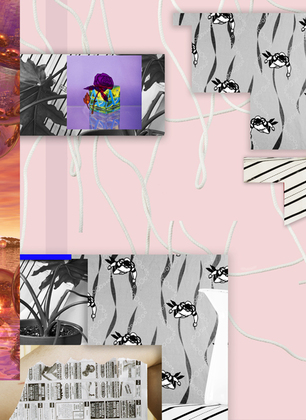
The image “Not So Optimal” accompanying today’s post by Michele Abeles (2012)
07/09/2013 (12 Moons Solo Project Day 190)

12 Moons Solo Saxophone Project Day 190

Date: 07/08/2013

Instrument: Tenor saxophone

Location: Home studio in Clinton, WA (Whidbey Island)

Notes:

In my practicing today, I focused on creating harmony with multiple chords that gave me a gut reaction.  I tried to reflect on how the chords that affected me aligned with my mood.  For the past several days I’ve been trapped in melancholy, but I also feel myself now emerging from this cycle.  What brought either end of this on I couldn’t say, but I feel that this improvisation is a reflection of my internal multi-day experience with this, and now the beginnings of my relief.  I feel joy and sorrow intertwined in this piece.  The chord progressions used on this improvisation were not notated down, but were slowly arrived at in the old fashioned song writing way of creating sound to fit a moment.

I hear this improvisation as having three chord actions.  Each of those written below can be heard at various points in the improvisation, but I’ve also included a notation as to where they can be easily found (for reference sake).

Chord action 1 (this chord progression opens the improvisation)

(Left Hand) Fork F, Octave, Low B // (Right Hand) F-D keys, Low C

(Left Hand) Fork F, C key, Octave, Low B // (Right Hand) F# key, Low C

Chord action 2 (the chord progression first appears at 1:45 in the slow, and quiet middle section)

(Left Hand) Fork F, C key, Octave, Low B // (Right Hand) F-E keys, Low C

(Left Hand) Fork F, C key, Octave, Low B // (Right Hand) F key, Low C

Chord action 3 (this chord progression closes the improvisation)

(Left Hand) Fork F, Octave, Low B // (Right Hand) F key, Low C

(Left Hand) Fork F, Octave, Low B // (Right Hand) F-E keys, Low C

-Neil

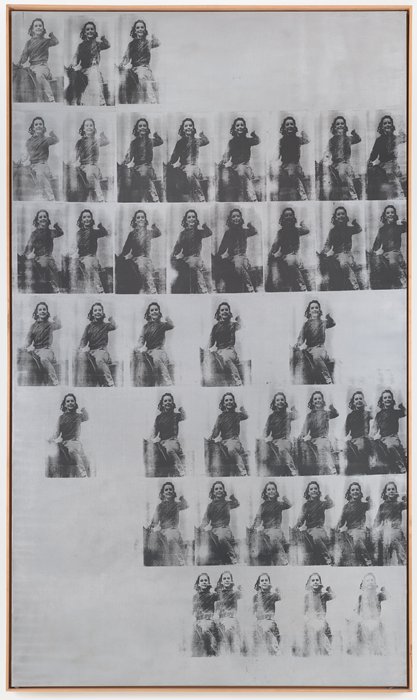
The image “National Velvet” accompanying today’s post by Andy Warhol (1963)

07/08/2013 (12 Moons Solo Project Day 189)

12 Moons Solo Saxophone Project Day 189

Date: 07/08/2013

Instrument: Tenor saxophone

Location: Practice Room A at South Whidbey High School.  Langley, WA (Whidbey Island)

Notes:

This afternoon I worked with rougher, unfinished textures to try and create tiny microcosmic worlds with a wide range of color inside of them.  My improvisation today is my shortest recording to date on this project, and was intended to be a very focused, bright burst of color.  This piece uses a single fingering, which traditionally produces a very stable, de-tuned major chord multiphonic, but in this case was used to create a much wider range of sound.  This fingering was as follows:

(Left Hand) B-A-G keys, Low C# // (Right Hand) F-E-D keys, Low C, Side C

A month ago I participated in a concert with the legendary saxophonist Roscoe MItchell.  In his adaptation of Nonaah for Cello Quartet, the torrent of sound rises to a climax in the final pitch of the piece, which held out at full volume in a terrifying chord which then slowly, achingly falls away into silence.  Listening to it from the audience I felt like I was a body at the shore line being uncontrollably pulled out into the ocean.  There was a power to it that simply amazed me, and during this improvisation the source of my ending almost certainly stemmed from this concept.  

-Neil

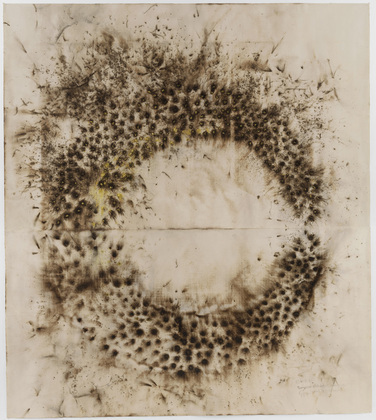
The image “Drawing for Tansient Rainbow” by Cai Guo-Qiang (2003)

07/07/2013 (12 Moons Solo Project Day 188)

12 Moons Solo Saxophone Project Day 188

Date: 07/07/2013

Instrument: Tenor saxophone

Location: Home studio in Clinton, WA (Whidbey Island)

Notes:

This morning I woke up, went into my practice space and immediately recorded an improvisation.  I decided to go with my gut feeling, and arrived at a piece that explored the cross fading of sounds at a low level of volume.  I’m amazed that every fingering can be made to elicit a world of sounds when  simple changes in perspective are applied.  A large part of this process is simply imagination.  I imagine what sound I would like to come out of the horn and more often than not, if I am aware and open to possibility the horn will respond in kind.

During this improvisation I worked within the mid to upper octave in the horn’s traditional range.  I used alternate fingerings to create ebbs and flows in the sustained pitches, and as described above I imagined the creation of sound.  This included lower pitches, higher pitches, or the fading of one pitch into two or two into one.  I went directly to the horn this morning to get that initial burst of creative energy that takes place before the duties and obligations of the day began to weigh on me.  I did only have 20 or so minutes to work and record, but I was amazed at how focused I can become under situations where time is precious.  But unlike most days, this morning time felt new.  

-Neil

The image “Mapping the Internet” accompanying today’s post by Barrett Lyon (2003)