07/06/2013 (12 Moons Solo Project Day 187)

12 Moons Solo Saxophone Project Day 187

Date: 07/06/2013

Instrument: Tenor saxophone

Location: Home studio in Clinton, WA (Whidbey Island)

Notes:

The morning I worked on playing a challenging piece of solo music that I’ve written as part of a new large ensemble piece.  The music is inspired by the saxophonist Julius Hemphill, and in my brief study of his music, I’m amazed by his compositional structures.  He will pair an improvisation with the unlikeliest of melodies, or set multi-horn writing to melodies which sound solo specifically like an avant solo line.  The the idea of pairing strong elements together to create a unique whole became the theme for my practice session today, and also my recorded improvisation.

I decided to work with a fundamental element–the triad.  This improvisation is in the key of G major, with the first pitch staring on the 3rd, and the triad is played in a very common pattern called “thirds."  I cycled this same triad at the same tempo, with the same articulation multiple times.  I decided to vary only the potential volume use and the length of the final concert G altissimo pitch.  The abrupt shift to the noisier, block chord multiphonic represented pairing of "strong” compositional elements.  There are two multiphonics used here, which are each, as the triad, very commonly used.  The first is a G major chord which is slightly sharp, and slightly de-tuned, and the second is a de-tuned G major multiphonic with a center a bit closer to tempered pitch.  The fingerings used for each multiphonic were as follows:

G major chord #1

(Left Hand) B-G keys, Octave, Low C# // F-D keys, Low C

G major chord #2

(Left Hand) B-A-G keys // (Right Hand) F-E keys, Low C

-Neil

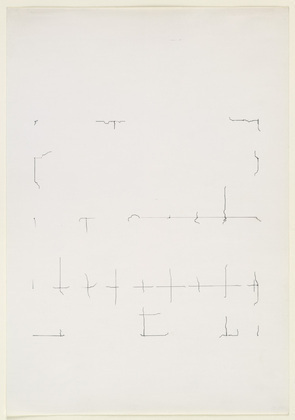
The image “Untitled” accompanying today’s post by Rosalind Nashashibi (2003)
07/05/2013 (12 Moons Solo Project Day 186)

image

12 Moons Solo Saxophone Project Day 186

Date: 07/05/2013

Instrument: Tenor saxophone

Location: Home studio in Clinton, WA (Whidbey Island)

Notes:

In my improvisation yesterday I worked with a very active sound environment with a looser sensibility.  Today I decided to perform the antithesis of that improvisation, and worked on improvising a piece with a very centered, very controlled environment.  This piece was recorded quietly and I worked for some time to eliminate as much air and saliva crackles from my sound as possible.  As my friend Ivan Arteaga calls it, I tried to achieve the “pure saxophone sound."  The fingering system used during this improvisation was a very noisy one, partially because of lost motion on the octave clutch, where there is a fraction of a millimeter of movement that takes place before the key engages.  This results in a bit of extra noise coming from the keys.  This improvisation also simultaneously uses the secondary octave key on the side of the horn.  Again this has a bit of lost motion in it as well, where the key does not quite make contact with the clutch that is intended to stop it from rising any further.  Because of both bits of lost motion, there is a fraction of a millimeter where the two overlap, causing a very unique sound environment in both the pitches produced and the key clacking.  This would not interfere at all while playing the horn under most circumstances, but I focused specifically on exploiting it during this improvisation.

The two pitches that served as springboards were the Concert A, and the Concert C (a bit flat).  The finger system used was as follows:

(Left Hand) B key, Octave, Low Bb // (Right Hand) Slowly open and close the G key (normally used in the ring finger of the left hand).

The fingering notation above is only a starting point.  The pliability of sound, including the bends, split pitches, octave leaps, and "dripping” notes were achieved by listening very carefully to the horn, focusing on air flow, and thinking hard about where I would like the sound to move to next.  

-Neil

The image “Untitled” accompanying today’s post by Stanislav Kolibal (1975)

07/04/2013 (12 Moons Solo Project Day 185)

image

12 Moons Solo Saxophone Project Day 185

Date: 07/04/2013

Instrument: Tenor saxophone

Location: The rec room at my childhood home in Edmonds, WA

Notes:

Lately I’ve come to realize that I shy away from some textures that make me sound less refined.  The phrase “some textures” is a tricky one, because it’s hard to say exactly what I might be avoiding, but like pornography you know it when you see it.  Ultimately I tend to favor sounds that are either more controlled, or those that leave the door wide open–such as an energy piece where I’m screaming through the horn.  The sounds explored on my improvisation today initially sound somewhat unrefined to me and I assume possibly the listener.  When I first started working on this piece I almost stopped and abandoned it because it wasn’t up to my personal standards of how I want my saxophone to sound.  This is ego.  To me I sounded almost like a young, novice player here at times, which I eventually found to be incredibly interesting to work with, because as the improvisation evolved I tried to paint a picture for the listener that the sound itself is only a starting point.  Instead of fighting my ego I decided to engage it.  The improvisation does not change drastically from start to finish, but simply is what it is.

The initial figure is the core of this improvisation.  It is a detuned dominant 7th chord in second inversion: Bb, Db, Eb, G.  The first three pitches are all played with the same fingering, where I play the saxophone like a bugle to adjust the pitch up from one note to another.  The final pitch–altissimo G, used the traditional fingering.  For the Bb, Db and Eb, the fingering was as follows:

(Left Hand) B-A keys, Octave, Palm D // (Right Hand) F-D keys, Low C

The upward and downward bends were created by flicking open and closed the High F# key in the right hand, while again maintaining the single fingering for the three pitches Bb, Db and Eb.  The  bends that connect one note to another were what initially deterred me from wanting to continue practicing this figure.  I then decided to commit to the loose simplicity of it, and worked with it enough to experience the sounds as something very beautiful, and then tried to gain greater control over them.  

-Neil

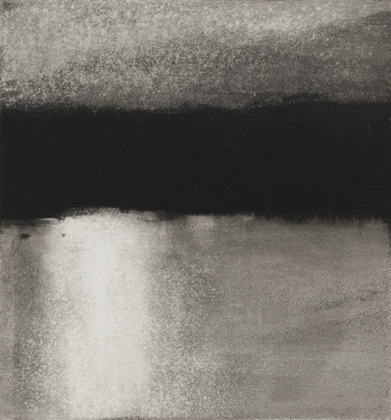
The image “Low Sun from Loon Lake: Eleven Drawings” accompanying today’s post by Ellen Phelan (1983)

07/03/2013 (12 Moons Solo Project Day 184)

12 Moons Solo Saxophone Project Day 184

Date: 07/03/2013

Instrument: Tenor saxophone

Location: Home studio in Clinton, WA (Whidbey Island)

Notes:

I focused today on the technique of melody with harmonic accompaniment.  I often work on combining harmony with internal melodies, as opposed to the playing of a series of chords followed by a melody–one separate from the other.  In this improvisation I tried to combine both approaches, that is, using an independent single pitch melody followed by a secondary melody which takes places within a series of chords.  I began by playing bluesy figures, and decided to work with this spirit.  

To begin sculpting this improvisation, I used a series of multiphonic fingerings with very consonant chords.  These were 2-note mutliphonics, with the upper tone being far more present in volume than the lower.  The chord pairs were are follows (first note is the top note, and the second the bottom):

Db/E

C/Eb

Bb/D

The upper (first notated) pitches create a descending minor shape: Db–C–Bb.  The lower (second notated) pitches create a descending chromatic shape: E–Eb–D.  With these chords as my starting point, they were ultimately used to create a chord progression with an internal “secondary” melody using the notes written above.  I then began playing a single note melody with the pitches G, Ab, G, and E.  These notes make up the primary melody, which opens the improvisation.   I thought of the improvisation as being in the key of Bb, with the secondary melody (that using chords) really establishing this mood, and the primary melody being more of a bluesy ornamentation.  In the mid point of the improvisation I began adding a third and more harmonically dissonant melody, which used the perfect forth interval on the pitches B and E.  

The multiphonic fingerings (for the secondary melody) were as follows:

Db/E (Left Hand) B-A, Octave Palm Eb // (Right Hand) F-E keys, Low C, Side F

C/Eb (Left Hand) B-A, Octave Palm Eb // (Right Hand) F-E keys, Low C

Bb/D (Left Hand) B-A, Octave Palm D // (Right Hand) F key, Low C

-Neil

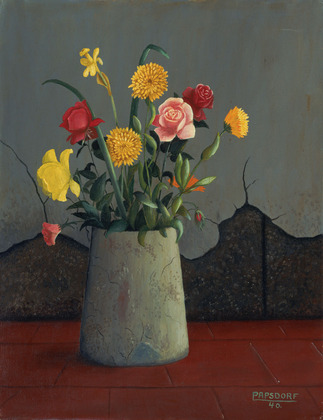
The image “Flowers in a Vase” accompanying today’s post by Frederick Papsdorf (1940)

07/02/02013 (12 Moons Solo Project Day 183)

12 Moons Solo Saxophone Project Day 183

Date: 07/02/2013

Instrument: Tenor saxophone

Location: Home studio in Clinton, WA (Whidbey Island)

Notes:

This morning my wife and I bought a card game called “Set” which uses pattern-based pictorial recognition.  The cards are laid face up on the table for all to see, and the first person to spot a correct pattern wins the cards.   I was surprised by how challenging this game was for me, and I decided to cary this theme into my practice session.  During the game, if a pattern does exist in the cards in play, it is laying on the table waiting to be discovered.  The only hurdle is the right mind to see it. This evening I set out to find a new fingering system with what ought to be an obvious choice I have yet to use.  The moment I came upon the system used during this improvisation, I was incredibly surprised that I had not specifically improvised with it before.  The finger shape is simple, but it is the embouchure shape that brings out the wide variety of color.  It’s of course very likely that I’ve played this fingering system in the past, but I’m almost certain this is the first time I’ve played it in an isolated fashion.  

The fingering system used a very common recurring theme for me, which is a static drone with melodic action above it.  The drone is a Concert Bb (quarter step high) in the upper register of the tenor.  By continuously trilling the G key with the right hand (crossing over into what is usually the territory of the left hand), various shapes emerged, including recurring minor third intervals and other sustained altissimo pitches.  I used my embouchure to bend tones up and down while the drone and minor third shapes continued below.  Near the end of the piece, I released the octave key but maintained the same finger system.  This resulted in a much more focused, middle octave drone on a concert C (quarter step flat).  The fingering used was as follows:

(Left Hand) B-A keys, Octave, Palm D.  Continuosly trill the G key with the right hand index finger.  To create further sound colors, I also slowly opened and closed the B or A keys in the left hand.

-Neil

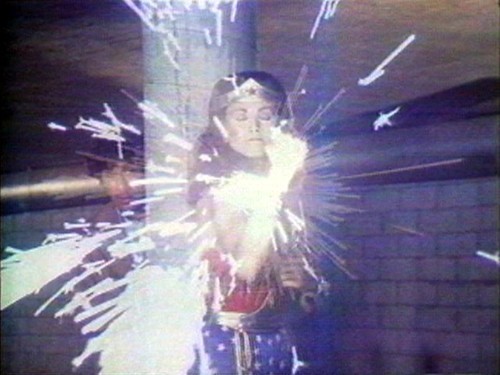
The image “Technology/Transformation: Wonder Woman” accompanying today’s post by Dara Birnbaum (1978-1979)