06/29/2013 (12 Moons Solo Project Day 180)

12 Moons Solo Saxophone Project Day 180

Date: 06/29/2013

Instrument: Soprano saxophone

Location: A forest clearing inside Moran State Park.  Orcas Island, WA

Notes:

This weekend my wife and I are staying at Moran State Park on Orcas Island.  Orcas is located in the San Juan island chain, about a 1 hour ferry boat ride from the mainland, and another hour and a half to Seattle from there.  The island is accessible only by boat, and is filled with pristine old growth forests, mountains, and several lakes.  Today we’re staying at a camp ground, the bulk of which is dug out of a steep, thickly forested mountain side.  This morning I decided to take my horn and trudge up the mountain in search of solitude and inspiring natural surroundings.  I did not follow any established path, and instead carved my own straight up the hill.  I had to climb over recently fallen timber, old nursing logs and thick underbrush.  I hiked for about 20 minutes, until the campsite below was far behind me, and the feeling of it–the laughing children, camp fires, parents and cars were out of sight, mind and earshot.  

I arrived at my recording location as though it were prepared for me.  Playing from the top of a hill, a gully below made a steep, cup shaped downward slope that pushed my sound outward.  I placed the mic about 50 feet below me, and listened to my surroundings.  The birds were out in abundance with their variety of calls, and I decided to create my own recurring melodic shape by using upper register overtones.  I stayed within an octave or so range, dipping the sound up, and occasionally down and up to settle on a pitch that the horn called out for.  I tried to pace my melodic action based on the duration of silence between the other calls around me.  I used a single fingering in this improvisation, which was as follows:

(Left Hand) Fork F, G keys, Low B or Low Bb // (Right Hand) F-E keys.  To help facilitate a more even downward to upward bend, I would occasionally slowly trill the Low C key in the right hand.

-Neil

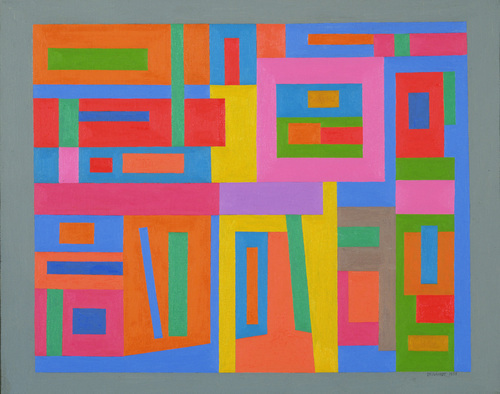
The image “Graphis 89, for a drama” accompanying today’s post by Dick Higgins (1961).
12 Moons Day 180 delayed until Sunday

Tomorrow’s 12 Moons post will be delayed until Sunday. I’m off to camp in the woods on Orcas Island and won’t have an internet connection. Expect some maddening recording from the wild!

-Neil

06/28/2013 (12 Moons Solo Project Day 179)

12 Moons Solo Saxophone Project Day 179

Date: 06/28/2013

Instrument: Tenor saxophone

Location: Home studio in Clinton, WA (Whidbey Island)

Notes:

While practicing this morning, and during my recorded improvisation today, I worked on orchestration within dense clusters of sound.  I explored several fingering systems before arriving at the one used here.  I was particularly interested in this system because of the half step clusters that were placed at various points throughout the registers.  The piece centers around the upper to extreme upper register of the horn.  While improvising I looked for markers in the sound–those being particular colors, melodies or rhythms that caught my ear and then became developmental tools.  An example of this is the upper octave Concert Bb pulse that is used in repetition at various points.   The pulse also became a recurring theme in sections of the improvisation where upper register bright tones were the focus.

I worked to maintain a tight sense of control over the sound clusters, but at certain points I would loosen my embouchure to allow extreme upper register tones to enter into the field.  These pitches are much more unstable than the lower tones, but are also more flexible in how they can be bent or combined together in tight groupings.  During these events I would then pull down the lower tones in volume, or cross fade back into the lower tone clusters after exploring the upper tones for some time. My fingers kept a fairly regular cycle of movement throughout, even in the areas of the piece that were much lighter in texture.  While improvising a piece like this, I often try to detach myself from the fingering cycle taking place, and even let it evolve a bit into a slightly new rhythmic feel.  To detach my brain from my fingers allows me to focus more on sound.  To work on doing live orchestration in an improvisation like this, I’ll often let my mind latch onto a sound and see if I can combine it, or let it interact with other sounds of interest.  In this way orchestration feels compositionally central to the improvisation, even when the overall sounds are abstract in nature.

The core fingering system used below was flexible in rhythm, and to which keys could be trilled at any given time:

(Left Hand) Fork F, C keys, Octave, Low B // (Right Hand) F-D keys, Low C

Trill options: Fork F, Side Bb, Side C, Low F#.

-Neil

The image “Untitled"  accompanying today’s post by Ad Reinhardt (1938)

06/27/2013 (12 Moons Solo Project Day 178)

image

12 Moons Solo Saxophone Project Day 178

Date: 06/27/2013

Instrument: Tenor saxophone

Location: A forest between Maxwelton Road and Highway 522.  Langley, WA (Whidbey Island)

Notes:

I welcomed the transition from afternoon to evening with this improvisation.  After teaching and rehearsing for the bulk of the day, on the way home I stopped at a pullout in the forest.  It looked to be an old logging road that cut up into a now very overgrown forest–nature is taking it back.  The forest was somewhat thinned out, but plenty of mature douglas fir and cedar remained all around me.  I recorded this improvisation with the mic gain turned extremely high, and played at a whisper soft volume.  Though the setting was very tranquil, the busy highway could be heard only a few hundred yards away.  It was a reminder that the river of car noise could become part of the beauty of my experience.

During this improvisation I worked with a delicate texture.  The full melody used two fingerings, each with the same sustained drone beneath.  The improvisation opens at the highest point of volume and introduces the major 7th interval, which I resolved up to nearly meet the bottom pitch an octave higher.  But like my surroundings, the figure was imperfect.  I could not fully reach the true second octave.  Even in this very consonant resolution, there is the smallest amount of ever present dissonance.  I tried to create a texture as subtle as the fading afternoon around me, and I truly felt a part of that natural transition.  Also of note, near the end of the improvisation there is a high pitched buzzing.  This was a mosquito!

The fingerings used were as follows:

(Left Hand) Fork F, A key, Octave // (Right Hand) F key, Side F#

Eb quarter step high drone with D in upper register.

(Left Hand) Fork F, A key, Octave // (Right Hand) F-E keys, Side F#

Eb quarter step high drone with Eb semi tone flat in upper register.

-Neil

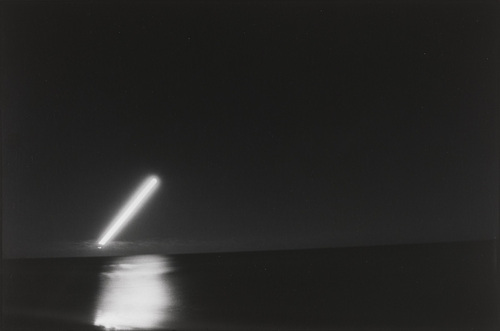
The image “Observation: The Sun-1” accompanying today’s post by Hiroshi Yamazaki