06/26/2013 (12 Moons Solo Project Day 177)

image

12 Moons Solo Saxophone Project Day 177

Date: 06/26/2013

Instrument: Tenor saxophone

Location: Home studio in Clinton, WA (Whidbey Island)

Notes:

My improvisation today was inspired by bird songs.  On a recent radio program, I listened to common and exotic bird calls slowed down with the pitches maintained.  As they say about a powerful melody, a great song works at any tempo.  I was particularly fascinated by my own reaction to hearing the slowed-down and natural tempo bird calls set against one other.  There always seemed to be a definite connection between the two for me, though when I stepped back and thought about it, I’m fairly certain that if I were give a “blindfold” test and the various calls were mixed up, I would have a very difficult time making the connections between slow and at tempo.  With this in mind, I practiced a repetitive melodic sequence–my own personal bird call, at tempos ranging from extremely slow to as fast as possible for me to play.  

The differences from extremely slow to extremely fast are very apparent, but there is a subtlety to the lines that seems to be lost when comparing between tempos.  Just like the bird calls I listened too, each tempo seemed to occupy it’s own sound world but was fundamentally connected to the bigger picture.  I should also mention how remarkably consistent the pitch was in the bird calls with each repetition.  I suppose that comes from a literal lifetime of singling the same melody over and over.  The fingerings used for this 6-pitch sequence were as follows:

Pitch 1 (Concert Bb)

(Left Hand) B-A-G keys, Octave, Low B (Right Hand) F-E-D keys, Side C

Pitch 2 (Concert C)

(Left Hand) B-A-G keys, Octave, Low B (Right Hand) F-E-D keys

Pitch 3 (Concert Bb semi tone sharp)

(Left Hand) A-G keys, Octave, Low B (Right Hand) F-E-D keys

Pitch 4 (Concert Db)

(Left Hand) B-A-G keys, Octave, Low B (Right Hand) F-E-D keys, High F key

Pitch 5 (Concert C).  Same as Pitch/Fingering 2

(Left Hand) B-A-G keys, Octave, Low B (Right Hand) F-E-D keys

Pitch 6 (Concert Bb semi tone sharp).  Same as Pitch/Fingering 3.

(Left Hand) A-G keys, Octave, Low B (Right Hand) F-E-D keys

-Neil

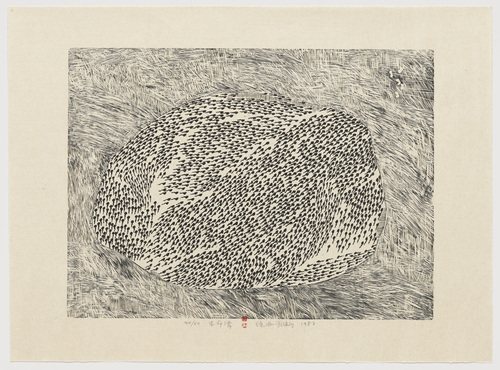
The image “Life Pond” from “Series of Repetitions” accompanying today’s post by Xu Bing
06/25/2013 (12 Moons Solo Project Day 176)

image

12 Moons Solo Saxophone Project Day 176

Date: 06/25/2013

Instrument: Tenor saxophone

Location:  Home studio in Clinton, WA (Whidbey Island)

Notes:

My wife and I spent the day up at our small, one room cabin in the cascade mountains.  It’s located off Highway 2 on the West side of the pass.  It rained most of the day, so we sat by the fire and kept it burning for several hours.  I came home this afternoon with such a clearer mind than I left with this morning.  Though I was tempted to record at the cabin, I decided to wait for my familiar practice space back at home.  The result was a piece not directly inspired by mood or place, but more the state of my mind.

I practiced for about an hour before recording this improvisation.  The current condition of my reed lent itself towards double-tonging, and I decided to sculpt a piece around this use of this technique.  The improvisation covers a medium range on the tenor, from the low F# to the high F#.  I used the initial figure as a springboard for chromatic and whole-step actions in lower register.  This used the following fingering:

(Left Hand) B-A-G keys, Low B // (Right Hand) E-D keys.  Trill open and close the low C in the right hand and the G key in the left hand.

In the mid point of the improvisation I departed from the chromatic action to play a scalar figure that ascended up two octaves and stopped on the high F#.  I would also occasionally play the same scale and stop on the middle octave A, or I would combine this scale with the longer version and the lower octave chromatic action.  During this improvisation I also explored the pacing of pitches.  I would try to give the impression that melodies were speeding up or slowing down despite the fact that the articulation remained static.

-Neil 

The image “Vlad Tcepec (Paper Mask) plate VII from the series Prints for the Counter Chronicle” accompanying today’s post by Gustav Kluge (1984)

06/24/2013 (12 Moons Solo Project Day 175)

image

12 Moons Solo Saxophone Project Day 175

Date: 06/24/2013

Instrument: Tenor saxophone

Location: Practice room hallway at South Whidbey High School.  Langley, WA (Whidbey Island)

Notes:

Today I found myself at the end of my working day feeling physically low, sapped of energy and with a general feeling of malaise.  I fashioned this improvisation as a wounded battle cry for myself and tried to purge these feelings from my body.  Like a bugle, I used a single fingering to create simple melodic shapes with overtones.  I used the following fingering to do so:

(Left Hand) B-A-G keys, Low B // (Right Hand) F-E-D keys

The initial upper register two-note figure with the pitches Bb to Db became my melodic refrain.  When descending below this figure in pitch, I also descended in volume.  The two pitches below the main melodic shape were Gb and C, which became points of rest between the clarion call of the two upper pitches.  At two points I also introduced a bluesy figure with the altissimo pitches Gb and E.  The large, ominous multiphonic chord played only once near the mid point of the improvisation was again derived from the same fingering, and therefore was a collection of all the pitches played.  In ascending order of range they were: C, Gb, Bb, Db, E, Gb.

-Neil

The image “Outlet” accompanying today’s post by Ernestine White (2010)

06/23/2013 (12 Moons Solo Project Day 174)

12 Moons Solo Saxophone Project Day 174

Date: 06/23/2013

Instrument: Tenor saxophone

Location: The Aurora Bridge and 50th street.  Seattle, WA

Notes:

This afternoon between a very busy day of teaching, a rehearsal and a show, I found myself at the intersection of Aurora Ave N and 50th street near the Woodland Park Zoo in Seattle.  The spot is wooded with a large, gravel covered parking area, and because of an event taking place in the Zoo adjacent to it the area was full of people.  Despite this I played, at least to my knowledge, for only myself and the trees, going undetected by the people in the parking area below or the tigers and bears only a block away.  I’ve recorded in this space during this project 4 times now, and it’s proximately to both nature and the urban environment of cars whizzing by makes it a favorite spot of mine.  

During this improvisation I decided to play what I felt was a beautiful chord, made possible only by the momentary flicking open of a side key.  The multidimensionality of this chord shape is very apparent during my moments of breath, where the rich clusters fall out.  The pitches used, in ascending order were: Concert Eb (muted, sustained tone), A, Eb, E. The fingering was as follows:

(Left Hand) Fork F, A-G keys, Octave, Low B // (Right Hand) F key, Low C.  Flick open and closed the side F# key to create the chord shape.

-Neil

The image “A Bronx Morning” accompanying today’s post by Jay Leyda (1931)

06/22/2013 (12 Moons Solo Project Day 173)

image

12 Moons Solo Saxophone Project Day 173

Date: 06/22/2013

Instrument: Tenor saxophone

Location: Home studio in Clinton, WA (Whidbey Island)

Notes:

I spent several hours this morning and afternoon working on a new piece for large ensemble, which I’ll debut at the Racer Sessions in July.  In my writing I worked on atonal chorale figures that have bluesy melodies played on top of them, or at times buried inside the melody of the chorale itself.  With this in mind today I improvised a blues inflected piece that had a recurring harmonic theme, which a complimentary melody within it.  However, the melody is full of nonsequitur rhythms and phrasing that has no single approach, but rather an overall feeling of forward momentum.  The chords themselves have a slightly de-tuned quality, and even though they do have a strong sound of dominant–tonic, they also have instability in their nature.  

I tried to give this piece an unfinished quality, and I began it as though I were caught in mid phrase.  This consonant tonality explored in this improvisation is played by centering on two multiphonics with the following fingerings and pitches:

Pitches:High D, Middle Octave E, Low Octave G

(Left Hand) B-A-G, Octave // (Right Hand) E-D

Pitches: High D, Middle Octave F, Low Octave G quarter step high.

(Left Hand) B-A-G, Octave // (Right Hand) E-D, Side F#

The melodic figures in the piece often overlap with the multiphonic fingerings, so there is a feeling at times that the harmony sits inside the melody.  This is because the mutliphonic chords speak two or more pitches, but also have strong single pitch sounds at their core.  To help differentiate the chords from the melody I struck closely to the rhythm (1&–2) when playing the harmony.

-Neil

The image “Drawing-Asymmetry #7” accompanying today’s post by post by Jackson Mac Low (1961)