
Neil Welch, Continuous Resonance Project
Date: 11/25/2014
Location: Performance Hall at Chief Sealth High School. Seattle, WA
Instrument: Tenor saxophone
Notes:
Yesterday evening it was announced that officer Darren Wilson was cleared of all criminal charges against him in the shooting death of the unarmed, African-American 18 year old Michael Brown. Today’s improvisation is a cry for peace and justice. It is a folk-piece for Michael Brown and for the deeply divided country in which we live.
The image accompanying today’s post is Michael Brown.
11/22/2014 (Continuous Resonance Solo Improvisation)

Neil Welch, Continuous Resonance Project
Date: 11/22/2014
Location: Home studio in Clinton, WA (Whidbey Island)
Instrument: Soprano saxophone
Notes:
Today’s improvisation was once again on my soprano. This piece was in a way a response to my improvisation from yesterday (11/21/14), as I used rapid pitch movement and focused on extreme differences in the octave, but in this improvisation I used traditional tempered pitches. I used the altissimo G key in today’s improvisation as well, though here it was used with the actual G pitch as apposed to a much higher register dot of sound as in yesterday’s piece. There was a very playful motive that I quickly developed before I began recording, and I used this as a focal point throughout the improvisation and referred back to it often as a melodic spring-board.
The image “Longmont, Colorado” (1979) accompanying today’s post by Robert Adams (1979).
11/21/2014 (Continuous Resonance Solo Improvisation)

Neil Welch, Continuous Resonance Project
Date: 11/21/2014
Location: Home studio in Clinton, WA (Whidbey Island)
Instrument: Soprano saxophone
Notes:
The past few days I’ve dedicated a good amount of time to working on my soprano. I’ve taken several months off of this horn as I simply did not feel drawn towards it. However, when I picked up the horn after this sabbatical I felt so joyful that I was truly transported back into a very unique artistic frame of mind.
During this improvisation I made use of flutter tonguing with my teeth near the tip of the mouthpiece. Having my teeth in this position allowed me to flutter tongue without actually letting my tongue come into contact with the reed. I juxtaposed upper register dots of sound by adjusting my embouchure while momentarily opening the High G key, which is actually an altissimo-range key not commonly found on most saxophones.
The image “North of Broomfield, Colorado” (1973) accompanying today’s post by Robert Adams.
11/20/2014 (Continuous Resonance Solo Improvisation)
Neil Welch, Continuous Resonance Project
Date: 11/20/2014
Location: Home studio in Clinton, WA (Whidbey Island)
Instrument: Tenor saxophone/harmon mute
Notes:
It rained last night for the first time in about two weeks. For many days the sky has been clear with little wind and the air bitterly cold. This weather has been most welcome, but I was surprised to find how glad I was on waking this morning to see grey sky and a light wind blowing through the trees.
At the end of my practice session this morning right before I needed to run out the door to teach, I worked to channel the spirit of this day in an improvisation. In this piece I used two trilled fingerings as well as intermittent singing into the horn. The fingerings included the standard Low E and Low D fingerings with the Low Bb key depressed throughout and a constant trilling of the G key in the left hand. The sung melody was improvised within this undulating texture.
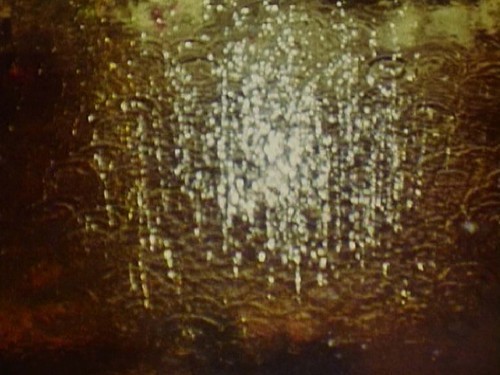
The image “Explosion Under Water” (1980) by Roman Signer.
11/19/2014 (Continuous Resonance Solo Improvisation)

Neil Welch, Continuous Resonance Project
Date: 11/19/2014
Location: Home studio in Clinton, WA (Whidbey Island)
Instrument: Tenor saxophone/harmon mute
Notes:
This improvisation makes use of a harmon mute, which I put inside my bell. This accounts for the rattling sounds as well as many of the bright overtones in the overall sound profile.
The image “the cloud series” accompanying today’s post by Ralph Steiner.