11/19/2013 (12 Moons Solo Project Day 323)

12 Moons Solo Saxophone Project Day 323

Date: 11/19/2013

Instrument: Tenor saxophone

Location: A local garbage dump.  Mount Shasta, CA

Notes:

Today Bad Luck is on our way back home driving North from Los Angeles to Seattle.  After a good 9 hours of driving under our belt, we stopped briefly for me to record in the town of Mount Shasta, CA, located at the base of the beautiful mountain itself.  We headed up a dirt road that went directly towards the smaller Black Butte mountain.  This road eventually led us to the city dump, and finally a second service road ended at a refuse pile for building materials such as old pallets and lumber.  Bordering the pile were neat rows of old oil drums.  The cold wind was blowing hard off of the mountain and it began to rain.  I decided to set up my mic inside one of the oil drums to experience the drums’ perspective on my sound.

I blasted into the oil drum at a high level of volume.  The mic was placed directly onto the bottom, and I tilted the bell of my horn into the hole at the top of drum to play inside.  Throughout the piece, and particularly so at the end, there’s a great deal of distortion from overwhelming the microphone.  This has yet to happen during this project and was not intentional.  This was the result of a miscalculation on my part as to how loud my sound would reverberate inside the drum.  However, the distortion itself is really interesting.  The brightest clipping takes place on the denser multiphonic clusters versus the straight tone.  During these high volume pieces, the highest recorded levels tend to be at the moment of tongue articulation after having have breathed, rather than during a cluster of some kind.  The fact that the clusters themselves overwhelmed the mic is really interesting to me, and something I’d like to explore more in the future.

During this piece I used a single fingering action and articulated my sound with both my tongue and key flicking on the low C.  The fingering was as follows:

(Left Hand) 1-2-3, Low Bb // (Right Hand) 1-2-3.  Flick closed, then opened on the Low C key.  This helped the multiphonics to emerge in denser shapes.

-Neil

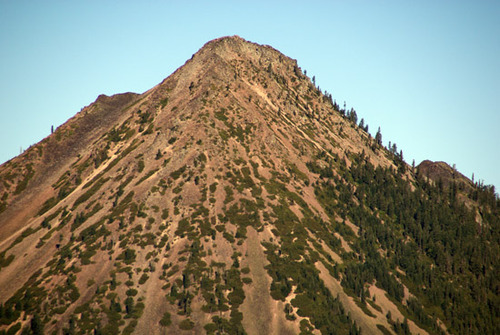
The image accompanying today’s post is Black Butte mountain, Oregon.

11/18/2013 (12 Moons Solo Project Day 322)

12 Moons Solo Saxophone Project Day 322

Date: 11/18/2013

Instrument: Tenor saxophone

Location: An outdoor walkway at CalArts (California College for the Arts).  Valencia, CA

Notes:

This morning Bad Luck drove down from San Francisco to Valencia for a clinic and performance at CalArts.  After the workshop, I walked around the main floor of the building for some time before finding a large outdoor walkway that wrapped around the South side of the building.  A busy, 4-lane road was a few hundred yards beyond the school, and the constant murmur of traffic could be heard while I improvised from the walkway.

Our clinic was a very productive and energy-filled experience, and I wanted to carry this spirit into my improvisation today.  During this piece I explored pockets of action with punctuations of my own silence.  However the constant hum of traffic had its own kind of persistence, with natural ebbs and flows as traffic increased or decreased.  I used my own silence as a very specific barrier to separate my trains of thought, while allowing the traffic noise to act as a bridge between these statements.  There was thematic material that naturally emerged from me while playing, but overall I worked to create a variety of sound textures and stylistic approaches, including hollering, screaming, false fingerings and multiphonics.

-Neil

The image “Orange, White, and Blue” accompanying today’s post by Ger van Elk.

11/17/2013 (12 Moons Solo Project Day 321)

12 Moons Solo Saxophone Project Day 321

Date: 11/17/2013

Instrument: Tenor saxophone

Location: My brother’s apartment in the Haight district.  San Francisco, CA

Notes:

This morning Bad Luck had a two hour clinic in Berkeley, discussing our music, compositional process, and specifically the mixed use of electronics and acoustic playing in our band.  All of my playing is amplified in Bad Luck, and while practicing a bit during a free hour this afternoon I was happy to find myself back in a fully acoustic setting.  I practiced in a small room in my brother’s apartment, with my bell against a wall in front of me.  I improvised a piece that used constant tonging, exploring slight changes in my articulation and the harmonic profile of the improvisation.

During this piece I avoided allowing any of the resonating tones to emerge above a very low level of volume.  For this reason the recording was amplified quite a bit in order to clearly hear the intricacies of the improvisation.  This accounts for the disproportionately louder breathing.  The improvisation uses three fingerings and a light articulation with my tongue against the reed.  The three fingerings were chromatic, and I began with the second of the three.  As I moved from Fingering 2 towards Fingering 1, the harmony descends.  I then ascended back to Fingering 2,  and moved the harmony upwards into Fingering 3, and finally back to Fingering 2.  I followed this basic shape throughout the improvisation, moving at a flexible tempo.  As the piece progressed I began incorporating heavier and heavier articulation, which began gradually slowing the tempo down and adding harder tongue articulation.

The fingerings used during this improvisation were as follows:

Fingering 2 (the fingering which opens the piece) Mid range.

(Left Hand) 2-3, Low B // (Right Hand) 1-2-3

Fingering 3 (Low range)

(Left Hand) 2-3, Low Bb // (Right Hand) 1-2-3  

Fingering 1 (High range)

(Left Hand) 2-3, Low B // (Right Hand) 1-2-3, Eb key

-Neil

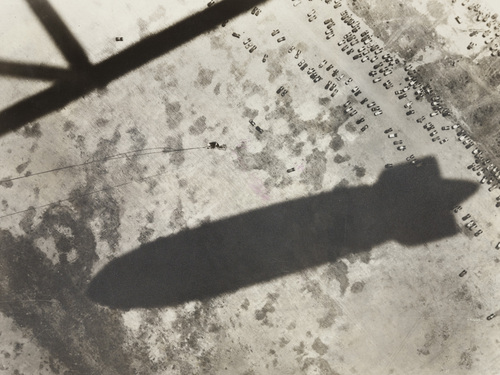
The image “The Shadow of Tragedy” accompanying today’s post by International News Photo (May 16, 1932.

11/16/2013 (12 Moons Solo Project Day 320)

12 Moons Solo Saxophone Project Day 320

Date: 11/16/2013

Instrument: Tenor saxophone

Location: Wolf Creek, Oregon

Notes:

Today is day one of a brief, three day tour with Bad Luck down the west coast from Seattle to Los Angeles.  Our first show is in Berkeley, CA tomorrow morning, and today we’re making the full drive from Seattle down to the bay area.  Just before dark and about seven hours into the trip, I pulled off at the town of Wolf Creek, Oregon.  I followed a two lane road a few miles up into the woods.   It was a landscape of Pine and Madrona tress, with thicker, bramble covered brush underfoot.  Every few hundred yards or so a mobile home was awkwardly placed onto the landscape.   I pulled off at a spot 100 or so feet from some train tracks.  I found a path and walked the short distance until I came into a clearing with the rail line above me.  

I was inspired by the dichotomy of this environment.  The cold air was filled with the scent of pine and the metallic, oily tracks cutting through the wilderness.   I found myself out of eyesight from any people, but trailers were just on the other side of the tracks above me. I played for a few minutes and settled into a piece that combined a folk, picturesque quality with a more industrial, hardened approach to the harmony.  I had no defined pulse but worked to settle into a semi-constant feel. Once having established some small bits of melodic material, I began fracturing the established key center and combined this will trilled chords to work against the single-pitched melodies.

-Neil

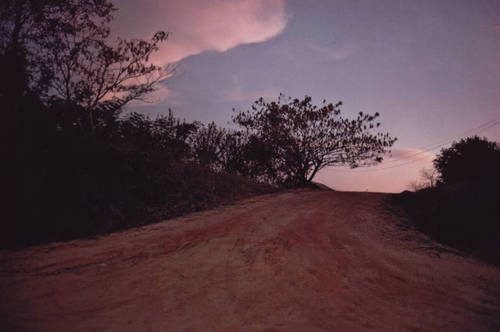
The image “Near Morton, Mississippi” accompanying today’s post by William Eggleston (1972).

11/15/2013 (12 Moons Solo Project Day 319)

12 Moons Solo Saxophone Project Day 319

Date: 11/15/2013

Instrument: Tenor saxophone

Location: Home studio in Clinton, WA (Whidbey Island)

Notes:

The past several weeks I’ve worked with at least half of my students on the music of Duke Ellington, and particularly in the phrasing and ornamentation styles of Johnny Hodges and Paul Gonsalves.  The popular high school festival Essentially Ellington is accepting auditions soon, and virtually every high school in the Seattle area sends in an audition tape.  With my alto students, we spend a lot of time listening to the original recordings and learning to imitate the wide, upward bends and deep vibrato that were such a stylistic hallmark of Hodges’ sound.  In today’s improvisation, I decided to work with my own interpretation of these upward bends, but with a much more animated and aggressive approach.

During this improvisation I followed a common Hodges approach into the bend, which included momentarily pushing against a pitch a perfect fifth below the final note that is held.  However Hodges’ approach was generally much more gentle and much slower than my own interpretation here.  I also occasionally used false fingerings to expand the vibrato between pitches of a greater distance from one another.  Again, Hodges tended to hold only a single fingering and use vibrato with about a whole step in total distance.  

-Neil

The image accompanying today’s post is of the great saxophonist Johnny Hodges.