11/16/2013 (12 Moons Solo Project Day 320)

12 Moons Solo Saxophone Project Day 320

Date: 11/16/2013

Instrument: Tenor saxophone

Location: Wolf Creek, Oregon

Notes:

Today is day one of a brief, three day tour with Bad Luck down the west coast from Seattle to Los Angeles.  Our first show is in Berkeley, CA tomorrow morning, and today we’re making the full drive from Seattle down to the bay area.  Just before dark and about seven hours into the trip, I pulled off at the town of Wolf Creek, Oregon.  I followed a two lane road a few miles up into the woods.   It was a landscape of Pine and Madrona tress, with thicker, bramble covered brush underfoot.  Every few hundred yards or so a mobile home was awkwardly placed onto the landscape.   I pulled off at a spot 100 or so feet from some train tracks.  I found a path and walked the short distance until I came into a clearing with the rail line above me.  

I was inspired by the dichotomy of this environment.  The cold air was filled with the scent of pine and the metallic, oily tracks cutting through the wilderness.   I found myself out of eyesight from any people, but trailers were just on the other side of the tracks above me. I played for a few minutes and settled into a piece that combined a folk, picturesque quality with a more industrial, hardened approach to the harmony.  I had no defined pulse but worked to settle into a semi-constant feel. Once having established some small bits of melodic material, I began fracturing the established key center and combined this will trilled chords to work against the single-pitched melodies.

-Neil

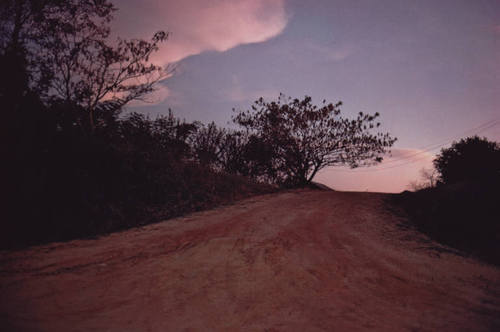
The image “Near Morton, Mississippi” accompanying today’s post by William Eggleston (1972).

11/15/2013 (12 Moons Solo Project Day 319)

12 Moons Solo Saxophone Project Day 319

Date: 11/15/2013

Instrument: Tenor saxophone

Location: Home studio in Clinton, WA (Whidbey Island)

Notes:

The past several weeks I’ve worked with at least half of my students on the music of Duke Ellington, and particularly in the phrasing and ornamentation styles of Johnny Hodges and Paul Gonsalves.  The popular high school festival Essentially Ellington is accepting auditions soon, and virtually every high school in the Seattle area sends in an audition tape.  With my alto students, we spend a lot of time listening to the original recordings and learning to imitate the wide, upward bends and deep vibrato that were such a stylistic hallmark of Hodges’ sound.  In today’s improvisation, I decided to work with my own interpretation of these upward bends, but with a much more animated and aggressive approach.

During this improvisation I followed a common Hodges approach into the bend, which included momentarily pushing against a pitch a perfect fifth below the final note that is held.  However Hodges’ approach was generally much more gentle and much slower than my own interpretation here.  I also occasionally used false fingerings to expand the vibrato between pitches of a greater distance from one another.  Again, Hodges tended to hold only a single fingering and use vibrato with about a whole step in total distance.  

-Neil

The image accompanying today’s post is of the great saxophonist Johnny Hodges.

11/14/2013 (12 Moons Solo Project Day 318)

12 Moons Solo Saxophone Project Day 318

Date: 11/14/2013

Instrument: Tenor saxophone

Location: Home studio in Clinton, WA (Whidbey Island)

Notes:

This morning I felt extremely pressured for time.  During the 12 Moons project my days have spanned the gamut from several hours of flexible practice time, to quite literally only a half hour of uninterrupted space in the course of an entire day.  Less frequent were days like today, where I set out believing that I had only a half hour open to me, but my artistic process took on a much slower pace than my allotted time.  I ended up working and practicing instead for about 2 ½ hours, and then had to rearrange the commitments of my day in order to make up for this time now redistributed.  Today was an excellent reminder that no matter how busy my day may seem, I always have time to practice.

During this improvisation I explored the phasing of pitch material between different ranges of the horn through two different fingerings, combined into a single action.  These fingerings were as follows:

Fingering 1

(Left Hand) 1-2-3, Low Bb // (Right Hand) 1-2, Low C

Fingering 2

(Left Hand) 1-2-3, Palm Eb key only, Low Bb // (Right Hand) 1-2, Low C.  I also eventually began incorporating the Palm Key F into Fingering 2 to add further colors.

After more than 2 hours of practicing my work still felt stunted.  I decided to move between these two fingerings without any improvisational model other than simply to explore sound.  What resulted in the piece were many examples of “interruptions” in the flow of sound by more indeterminate elements, such as one note abruptly speaking more than others within a cluster.  I decided to embrace each of these moments, and used each “interruption” as a pivot point to incorporate a new motive into the sound cycles.   

-Neil

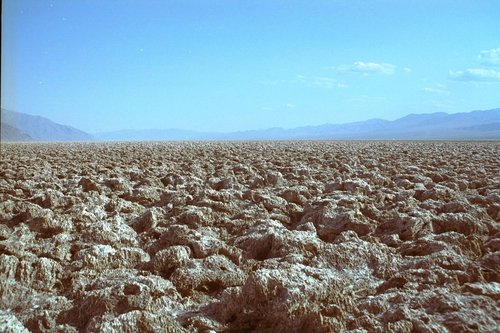
The image “Death Valley” accompanying today’s post by John Donohue.

11/13/2013 (12 Moons Solo Project Day 317)

12 Moons Solo Saxophone Project Day 317

Date: 11/13/2013

Instrument: Tenor saxophone

Location: Home studio in Clinton, WA (Whidbey Island)

Notes:

This improvisation explores a specific tonging technique while singing or growling into the horn.  During this piece my tongue stays away from the reed, never making contact with it.  Instead, the quick, percussive sound mounds are done by singing into the horn while moving my tongue with “o” and “e” vowel sounds in rapid succession.  This same vowel shape was explored in another 12 Moons improvisation early on in the project.

When done out loud without the saxophone and using the voice only, these vowel sounds create a very similar physical movement in my mouth as that I experience while playing with the actual horn.  About 1/3 down from the tip, the tongue rises to meet the roof my mouth.  This rise and fall, combined with the two distinct vowel sounds and my singing, create a variety of colors.  To explore this concept in a more controlled fashion, I chose a specific base fingering that allowed for more pliability of these sounds.  This base fingering also allowed these pitches to bend without easily chirping.  This fingering was as follows:

(Left Hand) 1-2-3, Low Bb, Palm D // (Right Hand) 1-2, Low C.  I also closed the D key in the right hand (3), opened the Side Bb, Side F# key, and switched the Palm D to the Palm Eb (this single palm key only).  However this was only momentary.  

-Neil

The image “Luminous City” accompanying today’s post by Mark Innerst.

11/12/2013 (12 Moons Solo Project Day 316)

image

12 Moons Solo Saxophone Project Day 316

Date: 11/12/2013

Instrument: Tenor saxophone

Location: The main performance hall at Chief Sealth High School.  Seattle, WA 

Notes:

This improvisation uses an Ab concert pitch center with microtones gravitating around it at various tempos.  I explored six specific fingerings and cyclic rhythmic patterns, allowing the slight differences in pitch to interact with one another.  In this piece I wanted to develop an expectation of the static Ab sound, and to let dynamic and rhythmic shaping give the improvisation more dimension.  Most of the rhythmic cycles were of a medium tempo, with the exception being moments of rapid execution.  

From the outset the room took these false fingerings and pulled out beautiful upper register overtones, adding an amazing amount of color to the overall sound.  In the mid point of the improvisation I began playing extremely quiet and dipped momentarily into the upper register Concert Ab and surrounding microtones.  After briefly returning back to the previously established mid octave Ab, I began abruptly using indeterminate double tongue pitch articulations.  I did this to break up the flow of constancy, but also to the let the room interact with the more puckish articulations.  I eventually settled on recurring double tonging shapes with the six fingerings to unify the broader sound-scape of constancy having been established at the beginning of the improvisation.

The six Ab fingerings, each with slightly different tuning are written below.  These were combined at-will.

(Left Hand) 1, Low Bb // (Right Hand) 1-2-3. Low C

(Left Hand) 1-2, Low Bb // (Right Hand) 1-2-3. Low C

(Left Hand) 1-2, Low Bb // (Right Hand) 1-2-3. Side Bb Low C

(Left Hand) 1-3, Low Bb // (Right Hand) 1-2-3, Low C

(Left Hand) 1-3, Low Bb // (Right Hand) 1-2-3, Side Bb, Low C

(Left Hand) 1-3, Low Bb // (Right Hand) 1-2-3, Side Bb, Low C

-Neil

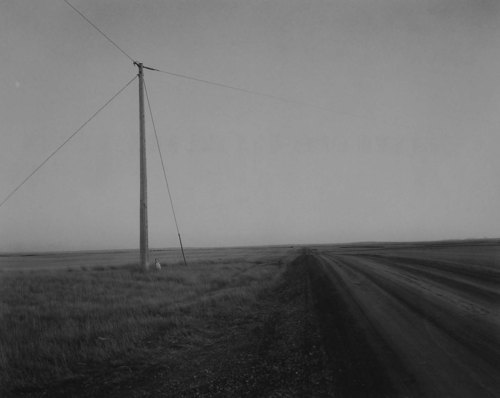
The image “30th Street West, West Lethbridge (Evening)” accompanying today’s post by Geoffrey James (1997).