11/03/2013 (12 Moons Solo Project Day 307)

12 Moons Solo Saxophone Project Day 307

Date: 11/03/2013

Instrument: Tenor saxophone

Location: Home studio in Clinton, WA (Whidbey Island)

Notes:

While practicing briefly this morning, I began improvising melodies that used heavy ornamentation, specifically centering around grace note gestures with occasional trills.  I approached my improvisation today in a similar fashion, performing a piece that stayed within the given range of the horn, maintained a heavy amount of ornamentation throughout, and used freely improvised melodies.  However, I also decided to incorporate 3 multiphonic fingerings with specific melodic cues to help give the piece further grounding.

Multiphonic Figure 1 was only executed after having played a Concert E in the lower register.  This multiphonic shared a concert E as the highest note in the chord voicing.  This multiphonic was fingered as follows:

Figure 1.  Pitches (in ascending order) G#, E.  

(Left Hand) 1-3, Octave, Low B // (Right Hand) 1-2, Low C

Multiphonic Figures 2 and 3 were each played as part of a melodic shape,  one after the other.  The melodic figure and fingerings were as follows:

Figure 2.  C-B-Multiphonic chord——

(Left Hand) 1-3 // (Right Hand) 1-2-3, Low Eb

Figure 3.  B-A#-Multiphonic chord——–

(Left Hand) 1-2 // (Right Hand) 1-2-3, Low Eb

-Neil

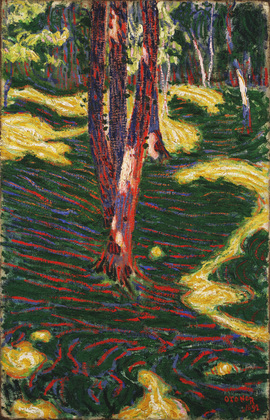
The image “The Galde” accompanying today’s post by Roderic O'Conor (1892).

11/02/2013 (12 Moons Solo Project Day 306)

12 Moons Solo Saxophone Project Day 306

Date: 11/02/2013

Instrument: Tenor saxophone

Location: Home studio in Clinton, WA (Whidbey Island)

Notes:

During today’s improvisation, I worked with two split-tone fingerings that each used a minor 7th interval.  The first of the two fingerings used tempered tuning with the concert pitches G# (mid register) and E (upper register).  The second used non-tempered tuning, with a concert G (quarter step sharp) in the middle register and a concert Eb in the upper register.  These were fingered as follows:

Fingering 1.  Pitches: G#/E

(Left Hand) 1, Octave // (Right Hand) 2-3

Fingering 2.  Pitches: G (quarter step high)/Eb

(Left Hand) 1-2 Octave // (Right Hand) 2-3

I was interested in the beautiful timbal qualities brought out in these two fingerings by cycling open and closed keys, and well as flicking open and then closed other keys.  This included the Side C, Side Bb, High F, as well as the Side F#.  The first example of the “flicking” open of a key takes place about :20 into the improvisation, when I began flicking open and closed the side F# key.  As the piece progressed I began gradually incorporating sound cycles into the soundscape as a more prominent feature.  I also incorporated a melody into the two chords, which became a theme I repeated a number of times throughout the improvisation.  The melody used the following pitches: Eb, D, B, Ab.  This melody was finished with a final pitch–G (quarter step high), which was also a split tone with a concert Eb in the upper register.  This final sound in the melody used Fingering 2, as acted as a bridge away from the single pitched melody back into the two split tone fingerings.

-Neil

The image “Untitled” accompanying today’s post by Charline von Heyl (2003).

11/01/2013 (12 Moons Solo Project Day 305)

12 Moons Solo Saxophone Project Day 305

Date: 11/01/2013

Instrument: Tenor saxophone

Location: Home studio in Clinton, WA (Whidbey Island)

Notes:

This morning a fellow islander and VW lover drove over to help me with some mechanical issues plaguing my 78 Bus.  Owning an old Volkswagen I’ve come to get used to long periods of mechanical problems with this car.  In every conversation about vintage bugs and busses, it invariably is discussed that VW’s are intuitive and easy to work on, and that VW’s are infinitely fixable.  VW owners talk about how simple these engines are, yet the smallest mechanical issue can stop it dead in its tracks, and conversely, many issues are so simple they can be fixed in minutes.  It’s an elegently understated machine, with an amazing network of variables that makes it operate properly.  In today’s improvisation I wanted to explore this same theme.  I chose a sound profile that on the face of it appears to be very simple, but the actual combination of fingerings and mouth shapes used to create them were very complex in their execution.

The improvisation uses 4 actions, each added to the figure that came before it.  This improvisation is one of my shortest yet during the 12 Moons project, as I wanted to present the piece in a very compact fashion.  The improvisation centers around 2 fingerings which were each played at the beginning and end of the improvisation.  They were as follows:

Fingering 1.  Pitches: F (quarter step flat) C, E (quarter step sharp)

(Left Hand) 1-2, Octave, Low Bb // (Right Hand) 1-2-3, High F

Fingering 2.  Pitches: F#, F#

(Left Hand) 1-2, Octave, Low B // (Right Hand) 1-2, Side F#

-Neil

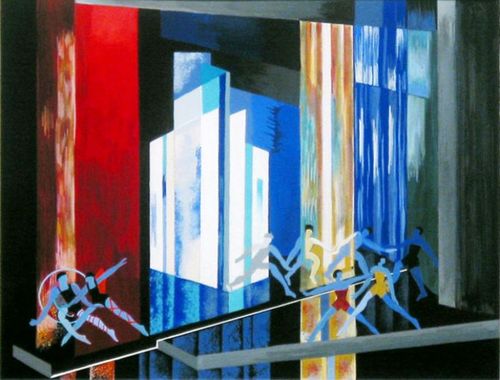
The image “Decors De Theatre” accompanying today’s post by Alexandra Exter (1927).

10/31/2013 (12 Moons Solo Project Day 304)

12 Moons Solo Saxophone Project Day 304

Date: 10/31/2013

Instrument: Tenor saxophone

Location: Practice room C at South Whidbey High School.  Langley, WA (Whidbey Island)

Notes:

The weather has been colder this past week, and last night there was finally a bit wind to go along with this change.  The winds tend to blow like mad in the Fall on Whidbey, but the days and nights have been so still from the Summer clear through the beginning of Fall.  Before going to bed last night, I stepped outside for a few minutes to feel, smell and listen to the wind.  I stood on my porch motionless and let the wind whip around me.  While beginning my recording this afternoon I found that this experience was still with me and I decided to record an improvisation that explored these conditions last night.   In my improvisation I used a fixed fingering and moved the air flow up and down the horn with my voice, exploring various colors at every point between.

During this improvisation I used mostly unbroken phrases while singing.  I sung within a comfortable range that allowed me to maintain control, and did various executions of the same ascending and descending shapes to see how the colors would change with repetition.  At times I also focused within a particular range of the horn, trying to learn what overtones I could expect in this area and to allow these overtones to interact in new ways once I had moved on.  The fixed fingering used in this improvisation was as follows:

(Left Hand) 1-2-3, Low B // (Right Hand) 2-3, Low C, Side F#

-Neil

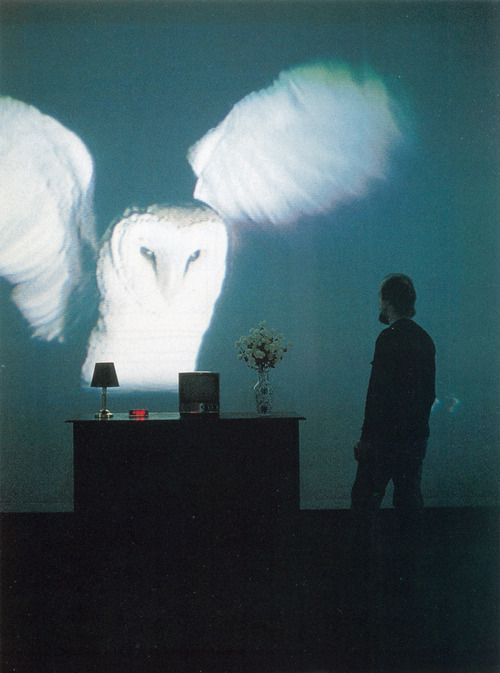
The image “The Sleep of Reason” accompanying today’s post by Bill Viola (1988).

10/30/2013 (12 Moons Solo Project Day 303)

12 Moons Solo Saxophone Project Day 303

Date: 10/30/2013

Instrument: Tenor saxophone

Location: Home studio in Clinton, WA (Whidbey Island)

Notes:

I fell into a very strange mood this afternoon, trapped between exhaustion and a kind of brooding feeling.  This lasted for a few hours without any kind of precursor, but simply came and went.  I recorded this improvisation in the midst of this experience, which included time during my practice session.  In this improvisation I wanted to impart my mental state of mind during this experience.  I wanted a clean, clear-minded approach, without any sadness or mellencholy but the simple recognition of a passing phase.  

In this improvisation I worked with a minor melody in concert F#, played with a combination of heavily bent tempered pitches and chordal accompaniment.  In the chordal accompaniment I chose sombre, beautiful chord shapes, as well as a single, far grittier multiphonic used to break up but none the less compliment the overall texture.  The piece was improvised freely once I had decided on the key center, and finally the chordal accompaniment.  The fingerings used during the chordal accompaniment were as follows:

B/A

(Left Hand) 2-3, Low C# // (Right Hand) 1-2-3, Low C

A/F#

(Left Hand) 1-3, Low B // (Right Hand) 1-2-3, Low C

G#/F#

(Left Hand) 1-2, Low Bb // (Right Hand) 1-2-3, Low C

Multiphonic (leaning heavily on the G#)

(Left Hand) 1-3 // (Right Hand) 1-2-3, Low Eb

-Neil

The image “Independent”, from “August 12, 1999"  accompanying today’s post by Douglas Gordon (1999).