10/30/2013 (12 Moons Solo Project Day 303)

12 Moons Solo Saxophone Project Day 303

Date: 10/30/2013

Instrument: Tenor saxophone

Location: Home studio in Clinton, WA (Whidbey Island)

Notes:

I fell into a very strange mood this afternoon, trapped between exhaustion and a kind of brooding feeling.  This lasted for a few hours without any kind of precursor, but simply came and went.  I recorded this improvisation in the midst of this experience, which included time during my practice session.  In this improvisation I wanted to impart my mental state of mind during this experience.  I wanted a clean, clear-minded approach, without any sadness or mellencholy but the simple recognition of a passing phase.  

In this improvisation I worked with a minor melody in concert F#, played with a combination of heavily bent tempered pitches and chordal accompaniment.  In the chordal accompaniment I chose sombre, beautiful chord shapes, as well as a single, far grittier multiphonic used to break up but none the less compliment the overall texture.  The piece was improvised freely once I had decided on the key center, and finally the chordal accompaniment.  The fingerings used during the chordal accompaniment were as follows:

B/A

(Left Hand) 2-3, Low C# // (Right Hand) 1-2-3, Low C

A/F#

(Left Hand) 1-3, Low B // (Right Hand) 1-2-3, Low C

G#/F#

(Left Hand) 1-2, Low Bb // (Right Hand) 1-2-3, Low C

Multiphonic (leaning heavily on the G#)

(Left Hand) 1-3 // (Right Hand) 1-2-3, Low Eb

-Neil

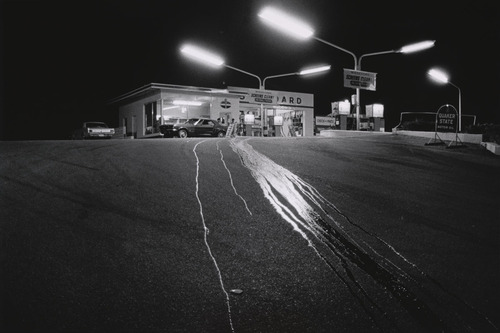
The image “Independent”, from “August 12, 1999"  accompanying today’s post by Douglas Gordon (1999).
10/29/2013 (12 Moons Solo Project Day 302)

12 Moons Solo Saxophone Project Day 302

Date: 10/29/2013

Instrument: Tenor saxophone

Location: The performance hall at Chief Sealth High School.  Seattle, WA

Notes:

In today’s improvisation, I worked with tightly contained bright tones in the upper register of the horn.    I wanted a thick, densely woven sound texture with an overall pitch distance of less than 3 half steps.  I used some dynamic variation, but overall maintained a steady stream of medium-loud volume.  I did occasional dip particular sections in volume or slightly accent specific tones in order to alter the rhythmic profile betting explored.  The tones in this improvisations centered around a concert F and F#, both of which are at the bottom of the altissimo (extreme upper register) range of the horn.  By using false fingerings, I pulled further microtonal pitches that existed between the F and F#, as well as some drifting slightly higher than the F#.  By cycling these pitches in a variety of combinations, I improvised different polyrhythms.

The root fingering from which all the sounds are originated was as follows:

(Left Hand) 1-2, octave, Low Bb // (Right Hand) Side Bb, High F# key.  To create the pitch variations and microtones, I cycled opened and closed the C key, Side C key and side Side F.

-Neil

The image “Kansas” accompanying today’s post by Tod Papageorge (1969).

10/28/2013 (12 Moons Solo Project Day 301)

12 Moons Solo Saxophone Project Day 301

Date: 10/28/2013

Instrument: Tenor saxophone

Location: Home studio in Clinton, WA (Whidbey Island)

Notes:

I approached the horn first thing this morning with eagerness, but despite this my focus was very scattered.  Often while practicing, I work with an abstract texture for some time, and then move on to something extremely different, and at various points in my practice session return back to the original material in an effort to essentially quiz myself.  I do this in order to embed these sounds firmer into my playing.  Even after having worked with a single sound area for 15 to 20 minutes today, I found it more difficult to go back and recollect how I had achieved it.  Somedays a lack of focus is just a simple reality I have to fight against, but today I decided to work with the theme of “scattered source material” in my 12 Moons improvisation to better characterize this reality of my morning. 

During the improvisation I worked with three isolated sounds areas.  I wanted these areas to be distinctive, but none the less complimentary when indeterminately set against one another.  For this reason, I chose more muted timbres.  These areas are described below:

Sound Area 1:

Quiet, quick pitch cluster flutters, followed by a static middle octave Bb chord with a steady pulse of punctuated pitches inside of it.  The pitch flutters were played indeterminately, followed by the Low Bb fingering, with the G key in the left hand trilled continuously.  This is the figure that opens the improvisation.

Sound Area 2:

Muted, and quickly articulated pitches centered around a middle octave F.  I wanted to achieve an echo effect with this sound area, with ascending volume, followed by a mirrored decline in volume.  This area used the middle octave F fingering with the Fork F key also depressed.   In the right hand, the F, E, and D keys were then opened and closed at will.  This figure is first played at :25

Sound Area 3:

Oscillation back and forth between two densely voiced chords.  The top voice begins on an A, then descends to a E.  In the mid register, the top voice begins in an E, then descends to an Eb.  This figure is first played at 1:52

-Neil

The image “Yellow” accompanying today’s post by John Paul Jones (1950).

10/27/2013 (12 Moons Solo Project Day 300)

12 Moons Solo Saxophone Project Day 300

Date: 10/27/2013

Instrument: Tenor saxophone

Location: Home studio in Clinton, WA (Whidbey Island)

Notes:

It rained this morning for the first time in weeks.  The drier weather was very unusual for our region this time of year, and it was a welcome sound hear the rain poring down the gutters.  I felt inspired to go immediately into my practice space to begin practicing and recording this morning.  In today’s improvisation I wanted to capture the welcome change in the weather and its union with my calm, unhurried morning.  This improvisation was recorded at a very low level of volume, and pivoted around a central Low B sound cycle and simple melodic gestures.

During this piece I used the Low B fingering with the octave key depressed.  I maintained a de-tuned B Major sound cycle by blowing into the horn with an overtone shape and trilling the Octave key continuously.  Melodically, the improvisation primarily used 4 pitches: Middle octave B, C#, D, and the upper octave A#.  In the sound cycle the low octave B is maintained along with elements of the major chord, creating an ever present pad beneath the 4 pitches, which I explored freely.  At two points in the improvisation, after playing the A# in the upper register I would take away the B major pad beneath, and bend between the A# and B#.  In the final few moments of the improvisation I released the octave key and began trilling the F key in my right hand, allowing the Low B fingering to resonate more freely for just a moment.

During this improvisation the fingerings used were as follows.  The Octave key should be trilled continuously at all times:

Middle octave B:

(Left Hand) 1-2-3, Octave, Low B // (Right Hand) 1-2-3, Low C.  

Middle octave C#:

(Left Hand) 1-2-3, Octave, Low B // (Right Hand) 1-2-3, Side Bb, Low C.  

Middle octave D:

(Left Hand) 1-3, Octave, Low B // (Right Hand) 1-2-3, Low C. 

Upper octave A#, as well as the A#/B# split tone.

(Left Hand) 1-3, Octave, Low B // (Right Hand) 1-2-3, Side Bb, Low C. 

-Neil

The image “Untitled” accompanying today’s post by Hann Trier (1967).

10/26/2013 (12 Moons Solo Project Day 299)

12 Moons Solo Saxophone Project Day 299

Date: 10/26/2013

Instrument: Tenor saxophone

Location: Home studio in Clinton, WA (Whidbey Island)

Notes:

This morning I learned that Howard Bowker, a father, grandfather, friend to many and joyous person to all passed away.  Howard was the father of my friend Mike Bowker, a close friend and fellow musician I grew up with through middle school and high school.  Howard was one of a few rare souls on this earth that could make a person feel so good, and so central every time I talked with him.  In middle school, when it seemed like every conversation with an adult was cursory, Howard would philosophize about the world with me.  

I’ve spent an amazing day with my wife today, just talking, cooking and driving around the island.  In reflecting on Howard’s passing I thought so much about this today.  There were so many people from my past that excerpted the tiniest bit of influence over me, and it’s often hard to notice it at all with some folks.  Of the memories I have of Howard, it was his unwavering love for his late wife Ann that always struck me the most.  Howard adored Ann, and it was extraordinary to see them together as a unit.  After she died, Howard kept a journal with a daily count numbering the days on this earth he had to spend without her.  I feel so thankful to have known Howard, and to have grown up with a role model that gave me happiness and humor in every conversation.  Of the subtle influences I absorbed growing up, I am so thankful today for Howard and Ann, who showed me what a union between two people could be.

This improvisation is an elegy for Howard Bowker.  

-Neil

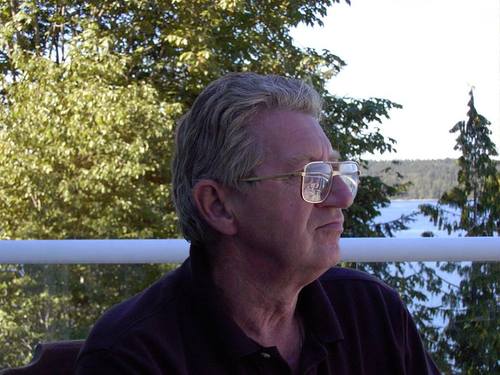
The image accompanying today’s post is Howard.  Rest in peace.