09/27/2013 (12 Moons Solo Project Day 270)

12 Moons Solo Saxophone Project Day 270

Date: 09/27/2013

Instrument: Tenor saxophone

Location: Home studio in Clinton, WA (Whidbey Island)

Notes:

In today’s improvisation I used the internal pitch structure of a multiphonic chord as the bulk of the improvising material.  I had a discussion with my old saxophone teacher Michael Brockman yesterday about the application of multiphonic and split tone chords in composition, and this topic became my source material today.  I structured the improvisation around a chord with the following pitches: C (middle octave), B quarter step flat (upper octave) and F# (altissimo octave).  The chord shape used the following fingering:

(Left Hand) 1-3, Octave, Low B // (Right Hand) 1-2-3, Low C

With each execution of the multiphonic chord, I tried to give the listener some variation in volume. At times I would do a diminuendo shape spread over say 3-4 times playing the chord, do a contrasting crescendo shape,  or more indeterminately play the chord loud or soft.  The 3 pitches C, B, F# that made up the chord were used as the improvising material during the puckish interludes between the swiping chord sounds.   I moved the 3 pitches to various octaves at will and used traditional fingerings.

The swiping chords used at the beginning of the improvisation were rooted in a fingering similar to the main chord above.  However, the pitch content was more unrelated, focusing on an A to Bb motion.  I chose this texture because of it’s muted quality and lower register than the remaining material.  This was in contrast to the more solid mutiphonic chord and the plain-spoken single pitches.  I felt this contributed to an overall balance of textures during the improvisation.

I alternated between two chord shapes to create this sound.  

(Left Hand) 1-3, Low B // (Right Hand) 1-2-3, Low C (same as the primary multiphonic fingering, but without the octave key).

(Left Hand) 1-2, Low B // (Right Hand) 1-2-3, Low C

-Neil

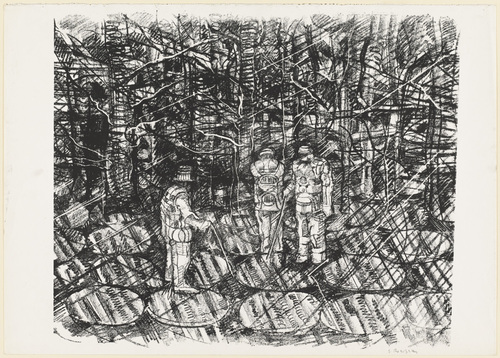
The image “Le Beau Monde” accompanying today’s post by Rene Margritte (1962).
09/26/2013 (12 Moons Solo Project Day 269)

12 Moons Solo Saxophone Project Day 269

Date: 09/26/2013

Instrument: Tenor saxophone

Location: Practice room B at South Whidbey High School.  Langley, WA (Whidbey Island)

Notes:

I tried for about an hour this morning to develop a piece and record it, unsuccessfully.  It’s difficult sometimes to walk away from a piece which you have faith in but untimely does not work.  Looking for further inspiration, on the way out the door to teach I grabbed a newly picked-up book called “To A Violent Grave: An Oral Biography of Jackson Pollock."  Just the subject matter, the font on the pages and a few lines of text gave me the inspiration for today’s improvisation.  After coming up with the initial sound design and sculpting it a bit, I recorded this piece in a single take.

This improvisation is an exploration in contrasting moods in what I hear as a blues piece.  I built sound cycles off of complex chord clusters and tried to balance an analytical approach to my sound with a gut-instinct approach to blues playing.  The improvisation was centered around a Concert Ab with the following pitches: Ab, B, Db.  The gesture overall was in this pitch order: Ab, B, Db, B, Ab—-.  There is a muted sound cycle that opens the improvisation and is returned to a total of 3 times.  The upper register tones in this cycle became progressively more and more the sound focus as the piece evolved. Though it had little tonal reference to the blues melody and chords that are used in the remainder of this piece, I felt this opening sound was the perfect platform.  There is a sad, brooding feeling to it that just fit the mood so well.  The pitches and fingerings were as follows:

The melody: Continuously open and close the Side Bb (right hand) and C key (left hand) in a staggered cycle.

Ab (mid register overtone)

(Right Hand) 1-2-3, Low Bb // (Right Hand) 1-2-3

B 

(Right Hand) 1-2-3, Low Bb, Eb palm key open ½ // (Right Hand) 1-2-3

Db

(Right Hand) Fork F, 2-3, Low Bb, Eb palm key open ½ // (Right Hand) 1-2-3

The muted sound cycle: Continuously open and close the Side Bb and C key (left hand) in a staggered cycle.

(Left Hand) 1-2-3, Low C# // (Right Hand) 1-2-3

The Melodic/Harmonic gesture occasionally played with the figure: Ab, B, Ab was fingered as follows:

Ab

(Left Hand) 1-2-3, Low Bb // (Right Hand) 1-2-3.  Cycle the Side Bb (right hand) and C key (left hand).

B

(Left Hand) 2-3, Low C# // (Right Hand) 1-2-3.  Cycle the Side C (right hand) and B key (left hand).

Ab

(Same as Ab above)

-Neil

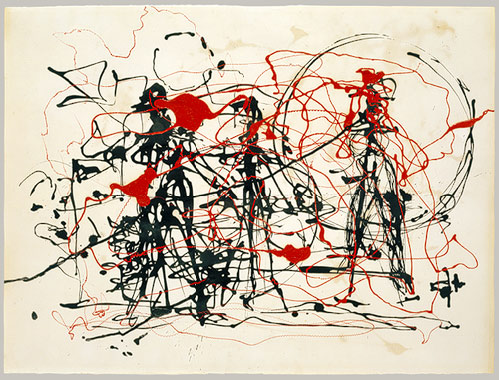
The image "Untitled” accompanying today’s post by Jackson Pollock (circa 1948-49).

09/25/2013 (12 Moons Solo Project Day 268)

12 Moons Solo Saxophone Project Day 268

Date: 09/25/2013

Instrument: Tenor saxophone

Location: Home studio in Clinton, WA (Whidbey Island)

Notes:

In my practice sessions the past week I’ve done a lot of singing into the horn, exploring textures that span the gamut from quiet subtlety to near noise.  The improvisation today is part of my current cycle of exploration in the subtler side of this area, which included singing into the horn the pitches that naturally occur in a split tone fingering.  While normally playing a split-tone there is a major adjustment in embouchure and air flow that needs to take place to accurately balance both pitches.  During this improvisation I created that same shape, but would sing the split tone pitches an octave below.  This allows the top tones to continue to speak a bit, but in more of a muted fashion.  The physical feeling in my throat while doing this is incredibly unique.  It’s very challenging, and it literally felt as though I was singing every microcosm of sound that came out.  The air flow fights back from the horn tremendously, and the sound almost rolls around my throat and chest.  I suspect this is because the split-tone has two pitches played simultaneously, and in my singing I’m only sounding one pitch at a time.  This results in a fight between the single tones and chord tones.

While playing this piece I used the motion of my voice to move up and down between pitches, as in a very slow trill.  Because of the above described physical back-pressure, it’s very challenging to sing these purely in tune.  I decided to make my singing a bit more flexible in pitch, sometimes trying to sit dead-on and other times bending the note up and down to explore textures in the overall chordal sound.  In the last third or so of the improvisation I began a much faster trill with my voice, which was done with a new mouth shape where I moved my tongue up and down in my throat, which when sung out loud makes a phonetic sound like the letters"o-e-o" but at a very rapid speed.  The fingerings and pitches (in the tenor key of Bb) were as follows:

E-C# (each a quarter step flat)

(Right Hand) 1-2-3, Palm Eb // (Right Hand) 1-2, Low C. 

C# (quarter step flat)-D#

(Right Hand) 1-2-3, Palm Eb, Low Bb // (Right Hand) 1-2, Low C. 

D-E-F# tri-chord (each a quarter step flat)

(Right Hand) Fork F, 2-3, Low Bb // (Right Hand) 1, Low C.

-Neil

The image “Untitled” accompanying today’s post by Seymour Rosofsky (1960-61).

09/24/2013 (12 Moons Solo Project Day 267)

12 Moons Solo Saxophone Project Day 267

Date: 09/24/2013

Instrument: Tenor saxophone

Location: The main performance hall at Chief Sealth High/Denny Middle School.

Notes:

This morning my chest and lungs were feeling a bit tight, maybe from a cold on the horizon.  I decided to explore sound action executed within a single breath to celebrate the feeling instead of fight it.   Each gesture in this piece lasted as long as my body could comfortably allow.  I used a single fingering throughout, one which required a great amount of air and had a high degree of back-pressure while playing.  This fingering had a wide sound-spectrum, with colors in tight and wider pitch clusters, gritty multiphonics and brittle altissimo tones.  I made it my aim to simply blow into the horn with a variety of embouchure pressures and directions in air flow.  From the point at which the sound came out of the horn, I would try to carefully work with what was presented to me and to shape it in subtle ways.

The fingering used was as follows/:

(Left Hand) 1-2, Octave, Palm Eb, Low Bb // (Right Hand) 1, Low C

-Neil

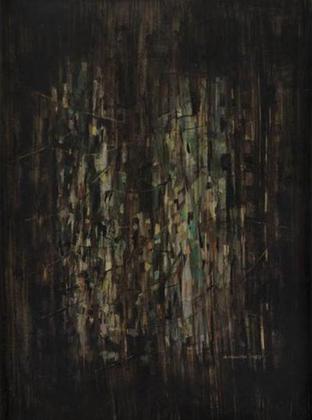
The image “City Night” accompanying today’s post by Norman Lewis (1949).

09/23/2013 (12 Moons Solo Project Day 266)

12 Moons Solo Saxophone Project Day 266

Date: 09/23/2013

Instrument: Tenor saxophone

Location: The rec room of my childhood home in Edmonds, WA 

Notes:

In preparation for a show tonight, I worked on the great saxophonist Rosoce Mitchell’s landmark composition Nonaah during my practice session today.  The wide, disjunct melodic landscape is organized in a brilliant series of chromatic gestures separated by, in my cases, over 2 octaves of displacement.  The piece is both an achievement in composition and a fantastic platform from which to build as an improvisor.  It’s his use of octave displacement in particular that fascinates me, and in today’s improvisation I was interested in exploring the idea of opposing musical forces.  This was represented in my improvisation by using groupings of two pitches, each an octave apart, but with one side starkly more aggressive and loud in volume, and the other more subdued in timbre and significantly quieter.

There was no particular structure to the pitch choice, accept to say that I tended to avoid moving chromatically.  Though it was inadvertent, there were some pitches used very sparingly, such as: Concert, Ab, D, B, Bb, and F#.  Others used very frequently included: G, Db, A.  I had no overarching formal structure to the improvisation other than the simple concept of octave displacement paired with timbre/volume displacement.  As the piece progressed I ebbed and flowed between periods of relative calm and periods of faster, higher density action.

-Neil

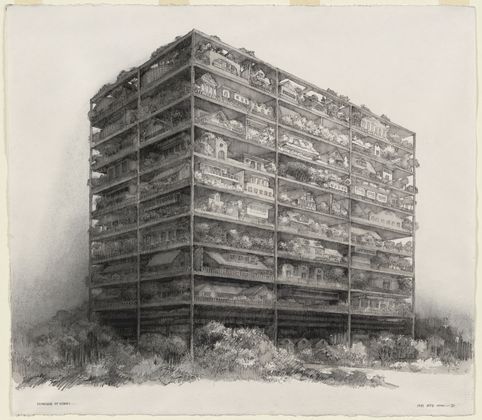
The image “SITE (Sculpture in the Enviornment)” accompanying today’s post by James Wines (1981).