09/24/2013 (12 Moons Solo Project Day 267)

12 Moons Solo Saxophone Project Day 267

Date: 09/24/2013

Instrument: Tenor saxophone

Location: The main performance hall at Chief Sealth High/Denny Middle School.

Notes:

This morning my chest and lungs were feeling a bit tight, maybe from a cold on the horizon.  I decided to explore sound action executed within a single breath to celebrate the feeling instead of fight it.   Each gesture in this piece lasted as long as my body could comfortably allow.  I used a single fingering throughout, one which required a great amount of air and had a high degree of back-pressure while playing.  This fingering had a wide sound-spectrum, with colors in tight and wider pitch clusters, gritty multiphonics and brittle altissimo tones.  I made it my aim to simply blow into the horn with a variety of embouchure pressures and directions in air flow.  From the point at which the sound came out of the horn, I would try to carefully work with what was presented to me and to shape it in subtle ways.

The fingering used was as follows/:

(Left Hand) 1-2, Octave, Palm Eb, Low Bb // (Right Hand) 1, Low C

-Neil

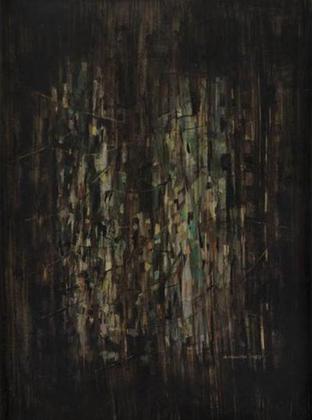
The image “City Night” accompanying today’s post by Norman Lewis (1949).

09/23/2013 (12 Moons Solo Project Day 266)

12 Moons Solo Saxophone Project Day 266

Date: 09/23/2013

Instrument: Tenor saxophone

Location: The rec room of my childhood home in Edmonds, WA 

Notes:

In preparation for a show tonight, I worked on the great saxophonist Rosoce Mitchell’s landmark composition Nonaah during my practice session today.  The wide, disjunct melodic landscape is organized in a brilliant series of chromatic gestures separated by, in my cases, over 2 octaves of displacement.  The piece is both an achievement in composition and a fantastic platform from which to build as an improvisor.  It’s his use of octave displacement in particular that fascinates me, and in today’s improvisation I was interested in exploring the idea of opposing musical forces.  This was represented in my improvisation by using groupings of two pitches, each an octave apart, but with one side starkly more aggressive and loud in volume, and the other more subdued in timbre and significantly quieter.

There was no particular structure to the pitch choice, accept to say that I tended to avoid moving chromatically.  Though it was inadvertent, there were some pitches used very sparingly, such as: Concert, Ab, D, B, Bb, and F#.  Others used very frequently included: G, Db, A.  I had no overarching formal structure to the improvisation other than the simple concept of octave displacement paired with timbre/volume displacement.  As the piece progressed I ebbed and flowed between periods of relative calm and periods of faster, higher density action.

-Neil

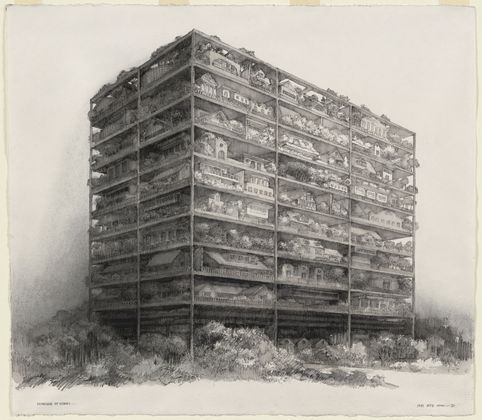
The image “SITE (Sculpture in the Enviornment)” accompanying today’s post by James Wines (1981).

09/22/2013 (12 Moons Solo Project Day 265)

12 Moons Solo Saxophone Project Day 265

Date: 09/22/2013

Instrument: Tenor saxophone

Location: Home studio in Clinton, WA (Whidbey Island)

Notes:

This improvisation used a multilayered “diving” technique I’ve been working on a bit lately.  During this piece I continuously articulate pitches indeterminately in the lower to mid registers, while “diving” pitches down with my voice simultaneously.  During this piece I tried to phase between periodic sections of more and less control over which pitches would be played and sung.  The improvisation opens with a more balanced level of volume end density between what is played and what is sung, but as I explored further this balance ebbed and flowed.  As the piece progressed I began balancing indeterminate singing with occasional unison singing alongside the fingered pitches.  At about the 2/3 mark there is a slower section in the improvisation where the initial attack on the pitch I sang was in unison with the pitches being played on the horn.  But from this point forward I began getting more aggressive with the gruffness of sound being explored and referenced the unison sound pretty infrequently.

During the bulk of the piece every pitch that was sang was also followed by an articulation.  Depending on how quickly I moved in my fingered pitches, sometimes the pitches would move at a ratio of 1 to1, but at other points I would play several fingerings while doing one attack of the voice dive.  This ratio could then increase to 1-2, 1-3, etc.  Throughout there was no set articulation pattern whatsoever, but there are periods of increased repetition, and even some small tonal development in the form of arpeggiation.  As the piece evolved I also began using some double tonging to increase the ratio of “played” versus “sung” pitches.

-Neil

The image “Untitled” accompanying today’s post by Lennart Olson (1940-53).

09/21/2013 (12 Moons Solo Project Day 264)

12 Moons Solo Saxophone Project Day 264

Date: 09/21/2013

Instrument: Tenor saxophone

Location: Home studio in Clinton, WA Whidbey Island)

Notes:

I spent the day composing and fleshing out parts for an upcoming performance.  On days like this I spend far less time on my horn, but I find that I walk away feeling not only artistically fulfilled, but also fulfilled in my practicing.  I decided to wait until the compositional phase of my work today was finished, and recorded right as I ended.  The improvisatoin has little to do with the composition work that came before it, but I found that the spirit of this work highly influenced this piece.  I felt calm, relaxed, and the figures I worked with felt very comfortable and familiar.

The theme of this piece in my mind was the creation of a sound landscape.  This improvisation used a simple, patient melodic shape above a higher density torrent of chords and clusters beneath it.  I used two fingerings, both of which shared two common tones, the Ab and F.  The two fingerings used the Low Bb and Low B traditional saxophone fingerings, but were played with sound cycles by opening and closing the B key (left hand) and the side F key (right hand).  The fingerings used were as follows:

Low Bb fingering with the octave key depressed.  Cycle open and closed the B key and side F key.

(Left Hand) 1-2-3, Octave, Low Bb  // (Right Hand) 1-2-3, Low C.

Melodic shape: Ab-F // Ab-D

Low B fingering with the octave key depressed.  Cycle open and closed the B key and side F key.

(Left Hand) 1-2-3, Octave, Low B // (Right Hand) 1-2-3, Low C

Melodic shape: Ab-F // Ab Eb

The Ab and F were common tones between both chords.  I approached this piece at a mid-quiet level of volume.  The above pitches are part of the overtone series, and the flexibility while moving between them is similar in mouth shape and air speed to simply playing the traditional fingerings without the sound cycles incorporated.  As the improvisation evolved, I occasionally opened the octave key in both fingerings to allow the lower tones in the overtone series to speak.

-Neil

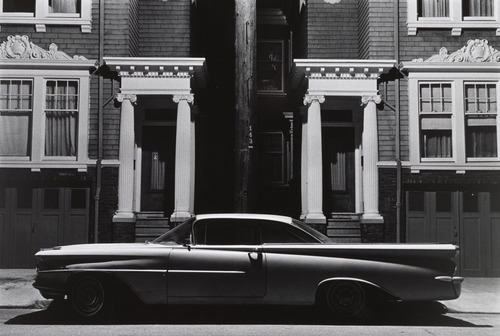
The image “Untitled” accompanying today’s post by William Gedney (1966).

09/20/2013 (12 Moons Solo Project Day 263)

12 Moons Solo Saxophone Project Day 263

Date: 09/20/2013

Instrument: Tenor saxophone

Location: Home studio in Clinton, WA (Whidbey Island)

Notes:

While on a break between students yesterday I flipped through a terrible coffee table book on the history of music.  There was a brief mentioning of the importance of Steve Reich’s music in the development of minimalism, particularly his use of the phasing technique; offsetting rhythmic cycles to create new sets of rhythms, harmony and melodicism–all in a near constant state of evolution.   Phasing is a compositional tool very important to me in my solo playing, and in today’s improvisation I worked on a new phasing technique using vibrato.  I selected a split tone fingering which has different pitch content depending on the octave the fingering is played in.  If I treat the fingering as though it were an overtone and adjust my embouchure and air flow, I can move between these groupings of pitch content with small moments of overlap.  It’s in these moments of overlap where I focus my energy in much of my solo playing.  I generally use a combination of mouth shape with alternate fingerings to create sound and rhythm cycles, again, often with some degree of phasing.  In today’s improvisation I used a continuous flow of vibrato to maintain a fairly static rhythmic pulse while phasing between octaves.  This vibrato not only maintained rhythm but as also use to blend one section of the horn into another.

This improvisation was extremely challenging, and specifically the split tone chord which begins the piece.  I needed a wide and very focused air flow to speak both pitches at once, and while doing vibrato it’s very challenging to find the core shape needed to allow the pitches to speak.  Another challenge was finding an overall mouth shape that could work in all registers.  I did adjust a bit to pull out the different sound regions in this piece, but I needed a core base of muscle control to build from.  

During this improvisation I primarily used a single fingering.  At about the mid point I began adding the octave key, which shifted some of the pitch content up a half step. I would then move between the original and this secondary fingering, all the while maintaining the wide vibrato.  Overall I heard the sound divided in Fingering 1between 3 sections, which are written below.  I did move a bit higher up the horn, but this area of the horn was only fleeting. The pitches and fingerings (in the tenor key of Bb) were as follows:

Fingering I  (primary fingering)

(Left Hand) 1-3, Low B // (Right Hand) F-E-D keys, Low C.  This fingering allowed for the following sound areas.  

-Ab/B  split tone (mid register)

-B.  (mid register.

-A (upper register) Ab/B (mid register).  Same as the first split tone grouping.

Fingering 2 (secondary fingering used sparingly)

(Left Hand) 1-3, Octave, Low B // (Right Hand) F-E-D keys, Low C.  Same fingering as above but with the octave key added.

-C (mid register).  This pitch moved ½ step up from the B (sound 1) in fingering 1.

-A (upper register) C (mid register).  This split tone maintained the same upper note voicing as the A (sound 3) from fingering 1.  However, the Ab in the bottom drops out and the B moves up a half step to become a C.

-Neil

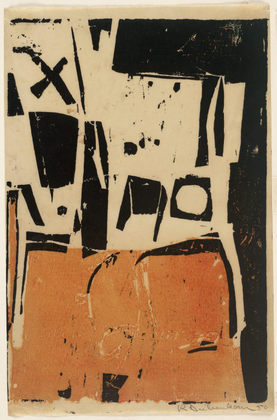
The image “Untitled” accompanying today’s post by Richard Diebenkorn (1950).