08/23/2013 (12 Moons Solo Project Day 235)

image

12 Moons Solo Saxophone Project Day 235

Date: 08/23/2013

Instrument: Tenor saxophone

Location: Home studio in Clinton, WA (Whidbey Island)

Notes:

In today’s improvisation, I used the division of range to create two sound fields.  The first, which opens the piece, is centered from the mid to altissimo register.  The second begins abruptly at :23, and centers around the low register of the horn.  My goal was to create two very strong, but diverse sound environments that were complimentary to one another, and to create a gentle, undulating spirit in the piece.  I used ornamentation in the first sound field (upper register) to create heart flutters within the repetitive cycle.  As the piece evolved I began opening and closing the low bell keys in the second sound field (the lower register).  This added additional pitch material, but also made the melody more ambiguous and less directly stated.

The first sound field used the following fingering:

(Left Hand) B-A keys, Octave, Palm Eb key, Low C // (Right Hand) F-E-D keys, Low C.  Trill the Low F constantly.

The second sound field used the follow fingerings:

Concert B and E: Standard Low C# fingering but trill the Low F key.

Concert A# and E: Standard Low C fingering but trill the Low F key.

Concert G# and E: Standard Low Bb fingering but trill the Low F key.

-Neil

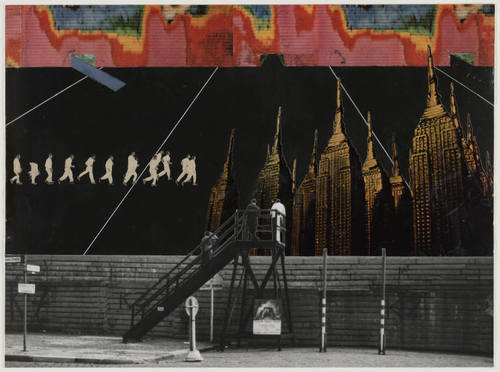
The image “Exodus, or the Voluntary Prisoners of Architecture, Training the New Arrivals, project, Axonometric projection” accompanying today’s post by Rem Koolhaas, Elia Zenghelis, Madelon Vriesendorp and Zoe Zenghelis (1972).
08/22/2013 (12 Moons Solo Project Day 234)

image

12 Moons Solo Saxophone Project Day 234

Date: 08/22/2013

Instrument: Tenor saxophone

Location: Practice room A at South Whidbey High School.  Langley, WA (Whidbey Island)

Notes:

After 4 days in the wilderness with limited time to practice, I carved out time during my teaching day to buckle down and work on very concrete, finite etudes.  I ended my practice session by playing out of the standard saxophone book “25 Daily Exercises For Saxophone by H. Klose."  The pieces in this book are not particularly challenging from a technical standpoint, but require a great deal of focus on breathing, pacing and tempo.  The exercises are tonal and balance the use of linear, note-to-note playing with vertical arpeggios.  In today’s improvisation I explored the idea of balancing two extremes together, and allowed myself to be directly influenced by this book of tonal etudes.

During this piece I improvised a series of triadic chords played in a triplet feel, along with a more static drone that interrupts the triads.  I worked for some time on various takes, attempted to create a fully balanced piece with two equal parts: the tonal triplets / the chord, with a repeat.  I made it my aim to try and remember with as much precision as possible what triads I had played in the first half of the piece, and to play these again during the second half.  There is a gradual slowing of the tempo during this piece which was not intentional.  I improvised triads which included, approximately in this order (in the tenor key) Bb, D diminished, Bb, D diminished, C, G7, C, F, A minor, E7, A minor, E7, Bb.  Again, as this was improvised, there was some variation and particularly so in the attempt at repeating it.  The fingering for the more stable chord which interrupts the triads was as follows:

(Left Hand) B-A keys, Octave, Low Bb // (Right Hand) F-D keys, Low C, Side F

-Neil

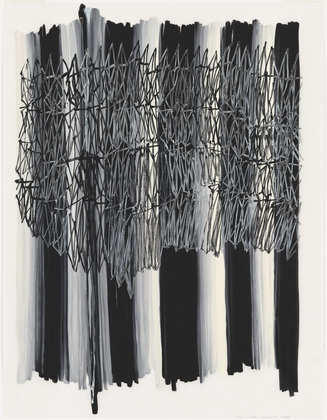
The image "Untitled” accompanying today’s post by Harvey Tulcensky (1997).

08/21/2013 (12 Moons Solo Project Day 233)

image

12 Moons Solo Saxophone Project Day 233

Date: 08/21/2013

Instrument: Soprano saxophone

Location: Beside a tributary while hiking out of the Necklace Valley.   North Cascade range in WA state.

From August 18th-21st I hiked into the Necklace Valley with my friend and fellow musician Cameron Peace.  In total, we covered approximately 30 miles of very strenuous backpacking, including well established hiking trails, game trails, rock scrambling, and short crossings over alpine glaciers.  The three recordings from August 19th-21st detailed my experiences in some of the locations we visited.

Day 3: August 21st.  Hiking out of the valley

Notes:

On the 9 mile march out of Necklace Valley, we stopped alongside a tributary to rest and eat some food.  The tributary itself flows into the East Foss River.  The raging river below us created a thicket of sound that inspired me, despite being very tired, to pull out my horn and improvise along side it.  

During this improvisation I wanted to capture both the persistent drone of the river, but also the individual punctuations of sound that occur within it.  During this piece I would stare at a boulder, old log or waterfall and try to hone in on the sound in that small bit of this river environment.  This was reflected in my improvisation, in that I would use tiny recurring melodies, and try to incorporate the drone of the river and my own “drone” within them.  My drone in this piece was firing up a deluge of sound in my horn, including high whistle tones and clusters of undulating sounds.

-Neil

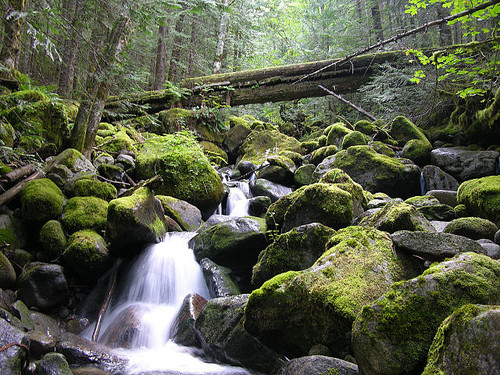
The image accompanying today’s post a tributary flowing into the East Foss River.  

08/20/2013 (12 Moons Solo Project Day 232)

image

12 Moons Solo Saxophone Project Day 232

Date: 08/20/2013

Instrument: Soprano saxophone

Location: Some distance into the woods near Locket Lake.  Located in the Necklace Valley and part of the North Cascade range.  WA state.

From August 18th-21st I hiked into the Necklace Valley with my friend and fellow musician Cameron Peace.  In total, we covered approximately 30 miles of very strenuous backpacking, including well established hiking trails, game trails, rock scrambling, and short crossings over alpine glaciers.  The three recordings from August 19th-21st detailed my experiences in some of the locations we visited.

Day 2: August 20th.  Second full day in the valley.

Today we explored the floor of Necklace Valley and the high mountains above it.  We hiked to the far side, coming almost a stones throw from an enormous glacial cirque.  We then forged our own path up the mountain, using the map to walk and climb over 2 miles of a rock slide.  We emerged at the top to find lake after lake, with gorgeous views of the North Cascades all around us.  

After returning to camp at Locket Lake, I walked some distance into the woods and set up my mic at the base of a large Doug Fir.  A creek running out of nearby Al Lake can be heard in the foreground.  I recorded this improvisation first thing in the morning before the sun had fully permeated this part of the forest.  I found a warm patch of sunlight to practice in, and began the process of arriving at this improvisation.  

In today’s piece I wanted to explore the persistent change of the forest.  In what can look like a permanent, unevolving environment, there is of course a torrent of action taking place at all times.  I explored this dynamic environment by using a single fingering with a repetitive, medium tempo pacing, and using my embouchure to uncover sound within the horn.  The fingering was as follows:

(Left Hand) B-A keys, Low Bb // (Right Hand) F-E-D keys, Low C

-Neil

The image accompanying today’s post is a trail leading up to the Necklace Valley.  WA state.

08/19/2013 (12 Moons Solo Project Day 231)

image

12 Moons Solo Saxophone Project Day 231

Date: 08/19/2013

Instrument: Soprano saxophone

Location: Beside Locket Lake, located in the Necklace Valley and part of the North Cascade range.  WA state.

Notes:

From August 18th-21st I hiked into the Necklace Valley with my friend and fellow musician Cameron Peace.  In total, we covered approximately 30 miles of very strenuous backpacking, including well established hiking trails, game trails, rock scrambling, and short crossings over alpine glaciers.  The three recordings from August 19th-21st detailed my experiences in some of the locations we visited.

Day 1: August 19th.  First full day in the valley.

Locket Lake is only accessible by foot, and the trail leading to it is very tenuous at best.  The lake can only really be reached by prior knowledge of its existence from a map, and then using the map as a guide to locate it.  Locket is a medium sized, crystal clear alpine lake fed by visible glaciers in the mountains above it.  It’s tucked neatly within steep-walled mountains of earth and rock.  On my second day of the trip and our first full day at this location, I played alongside the lake.  I was amazed by the extraordinary reverberation of my horn across the landscape.  I played for at least an hour, exploring this natural echo, the likes of which I’ve never heard before.  Lines on the horn seemed to suspend in time, only to come back in full-blocked chords that rang and rang around the lake.  Today’s improvisation was an energy piece that explored this reverberation.  Unfortunately, there was an error in recording and the delay in this improvisation in inaudible.  This is a shame, but the audio captured here can be perceived an an “unfinished” improvisation, and the missing spaces once filled in with overlapping reverb can become true again in the listeners imagination.  It still rings clearly in my ears.

-Neil

The image accompanying today’s post is Locket Lake in the Necklace Valley.  WA state.