08/14/2013 (12 Moons Solo Project Day 226)

image

12 Moons Solo Saxophone Project Day 226

Date: 08/14/2013

Instrument: Tenor saxophone

Location: A park across the street from Chief Sealth High School in White Center.  Seattle, WA

Notes:

This morning I recorded in a recently created park across the street from Chief Sealth High School.   The park is built atop the grounds of what used to be Denny Middle school and is now a series of large, open grass fields, baseball diamonds and small islands of manufactured natural landscapes, such as rockeries with cattails, maple trees alongside ornamental grasses and varieties of shrubs and herbs.  These islands are pleasent but look strikingly artificial given the cement pathways that carve through them and the lush, lime green grass that surrounds everything in sight.  I recorded in the park because I craved to play outdoors and was looking for a more natural landscape to become a part of.  I ended up improvising today’s piece hunkered down underneath the branches of a small maple tree in the middle of one of these simulated environments.

I began playing around 8:30am, and because of the early time I played as quietly as possible so as not to disturb any sleeping neighbors.  Curious joggers and Mom’s with kids stared at me as they went by, and eventually a police car parked a hundred or so yards away, and the officer stared me down for a good half hour.  It occurred to me how strange a reality this was, that a police officer was called by a concerned neighbor due to the presence of a person playing the saxophone in the park. And I, the saxophonist was witnessed by the officer as a man hunched underneath a tree at 8:30am in the middle of a cluster of plants with a saxophone in hand.   In recording this improvisation I opened myself to the reality around me.   I looked for the solitude of nature while in the city and found a strange little manufactured bit of it inside this park. 

This improvisation does not use any particular compositional model or any preconceived material, but was a piece inspired by my surroundings, the hour of the day, and my experience in this place.

-Neil

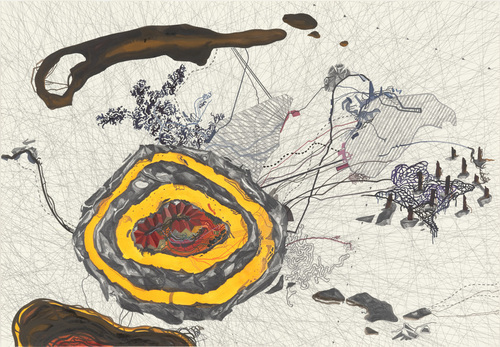
The image “a: funken 4z, b: funken 13z” accompanying today’s post by Carsten Nicolai (2003)

08/13/2013 (12 Moons Solo Project Day 225)

image

12 Moons Solo Saxophone Project Day 225

Date: 08/13/2013

Instrument: Tenor saxophone

Location: Home studio in Clinton, WA (Whidbey Island)

Notes:

I spent a great deal of time working on my improvisation recording today.  The coming together of this piece was a culmination of many dead end concepts and recorded attempts. Some days an improvisational focus seems to come effortlessly to me, and in others it is a slow, gradual process.  

I began by recording pieces with colorful, melancholic chord progressions.  There was one two-chord series that was just begging me to record it.  The sound was so evocotive of my mood, but I could not find the right method of expressing it through sound.  After many attempts, my ears were yearning for an absence of chords.  I began improvising melodic pieces where I worked to develop very strict tonal centers with individual pitches.  The melancholic state in the previous series of chordal pieces seemed to be a fleeting feeling in me, and I worked to overcome it by filling my improvisations with joyful songs.  This included several recorded attempts with the Major Pentatonic scale.  In this scale I stayed strictly on the 5 pitches, but freed myself to explore in any octave.  In my last recorded attempt with the pentatonic scale, I explored folk-like melodies with slight phrasing interruptions by occasionally using double tonging.  The simple concept of “interruption” from the pentatonic piece led me towards my final concept.  

In today’s improvisation I used sliding low octave pitches, double-tonging and a swiping of the pitches indeterminately.  Within these textures I began adding upper octave interruptions.  Except for a few select multiphonics, there is no actual harmony taking place here, but rather the illusion of overlapping sound.  Beyond the described attributes for the piece stated above, the material was fully improvised.

-Neil

The image “Poster For National Bunraku Theatre” accompanying today’s post by Tadanori Yokoo.

08/12/2013 (12 Moons Solo Project Day 224)

image

12 Moons Solo Saxophone Project Day 224

Date: 08/12/2013

Instrument: Tenor saxophone

Location: Home studio in Clinton, WA (Whidbey Island)

Notes:

I decided today to make reference to the use of singing through my horn from the 12 Moons project a few days ago.  In day 217, I sang a fixed pitch or “drone” through my horn and altered my fingerings to create new textures with a common thread of harmony within.  In today’s piece I instead used a fixed low Bb fingering and adjusted the pitches I chose to sing.  In this improvisation I wanted to create a wide variety of moods and textures.  To explore the polar ends of this spectrum, I balanced the use of singing through the horn (again with the fixed fingering) dovetailed with freely improvised single note melodies that broke away from the low Bb.  Unlike many of my other improvisations, there are no multiphonic fingerings used in this piece, but there are however a multiplicity of pitches sounding simultaneously, particularly when singing through the horn on the overtone rich low Bb fingering.

In this improvisation, I wanted to cull up dramatic transitions between sections.  This accounts for the  sometimes starkly vacant sounds of the single note melodies, or at other points densely packed melodies or widely stacked chords on the Low Bb.  Of the sung pitches with the Low Bb fixed fingering, I sang a full octave span between the Low and Middle Bb pitches.  I gravitated towards the Ab (in the tenor key), creating a kind of Dominant 7th chord sound, and the G, which along with the overtones sounded a beautiful Eb Major chord.  But again, I gave myself the liberty of snaking above, below and between these two pitches to create a variety of other textures and chord shapes.  Played at various other points during the piece, the Eb chord stated above concludes the improvisation. 

-Neil

The image “Portrait of Gala” accompanying today’s post by Salvador Dali (1935)

08/11/2013 (12 Moons Solo Project Day 223)

image

12 Moons Solo Saxophone Project Day 223

Date: 08/11/2013

Instrument: Tenor saxophone

Location: The rec room of my childhood home.  Edmonds, WA

Notes:

While practicing this afternoon, the saliva and condensation moving through my horn welled up a bit in my Palm F key, causing a momentary delay in sound.  This would occur when the key was opened, generally when done so slowly, but also occasionally when opened quickly.  A bubbling effect would take place, and the sound could barely escape from the tone hold because the saliva would expand out, forming a bubble between the tone hole and the leather pad.  This happens quite often, but generally a player will blow the spit out so as not to cause any delay in the action of the sound or any undesired ambient noise.  Today I decided to work with the sound variation this bubbling would create.

I used a single fingering during this improvisation, which was as follows:

(Left Hand) Fork F, C key, Octave, Low B // (Right Hand) F-E keys, Side F# key.

Because the Fork F only opens the Palm F key about 50%, initially when I would use the above fingering the bubble would happen nearly every time.  Eventually however it came pass more infrequently because the saliva was beginning to move out of the key cup.  I then noticed that the pitch was going down as a result of this.  I intentionally welled up more saliva onto the pad, and the pitch went up.  It settled around a Concert G.  This G would speak when air was initially forced into the horn and the bubble would expand, causing a surprising amount of back-pressure in my body.  Once the bubble would burst, the Concert G shifted down to a Concert Eb, which was also just one in a series of pitches within a mutliphonic.  The bursting of the bubble can clearly be heard on the recording when the pitch shifts down.  The sound then expands and pops out naturally.  Because of my mic placement, there is also a great deal of key clacking that can be heard throughout this improvisation.

-Neil

The image “Untitled (Mental Map: Peak Season” accompanying today’s post by Franz Ackermann (2003)

08/10/2013 (12 Moons Solo Project Day 222)

image

12 Moons Solo Saxophone Project Day 222

Date: 08/10/2013

Instrument: Tenor saxophone

Location: Home studio in Clinton, WA (Whidbey Island)

Notes:

Last night in briefly rained for only the second time in over a month.  This is one of the driest summers in my memory.  It didn’t rain hard but the jolting difference in soundscape pulled me from my sleep several times last night.  After waking this morning I walked outside, the air felt clear and clean, and the wind blowing from the South brought the smell of the ocean with it.  While practicing and improvising this morning I felt like the rain wanted to speak through my horn.  I decided to record a joyful, quiet piece with continuous flows of resonant sound.  There is a steadiness to the rain that I wanted to impart in this improvisation.  My attempt at this was through two complimentary major chord shapes with a quiet, understudied drone beneath.

In the simplicity of these chord shapes, I wanted to explore cyclic patterns of both rhythm and harmony, and to focus on the interrelationships of sound.  I considered sound in very broad terms here, those being the beauty of the chords, slight changes in low octave difference tones, and pitches that wanted to “speak” more than others depending on how I interpreted a rhythm, among others characteristics.  For me the creation of beauty in this piece was a delicate balance in the mechanics of the fingerings, and ultimately the sounds they produced.  There is something extraordinary about finding equal beauty in both sides.   

In this improvisation I focused on two chord shapes.  I began by presenting each of these in their “pure” state, that being the point from which they were initially executed while practicing.  These “pure” states are in the rhythms and pitches written below.  Then I would introduce rhythmic variations and new cycles with these chords.  During various points in the piece, I would let the sound settle into only the common bottom most notes in each of the chords, the wonderful Concert Eb drone that rang throughout the entire improvisation.  The two chord shapes were as follows (written in the tenor key of Bb):

Chord shape 1

Rhythm: 1 e & a 2—-

Pitches: F (drone) C#, F

Fingering: B-A keys, Octave, Palm Eb, Low B  //  (Right Hand) Low C

Chord shape 2

Rhythm: 1 e & a 2 3—–

Pitches: F (drone) Eb

Fingering: B-A keys, Octave, Palm Eb, Low B  //  (Right Hand) F key, Low C

To create the full cycles I also used the alternate F# fingering, F key, and C fingering.  In various combinations with the fingerings above, these created the bulk of the pitch material in this improvisation.

-Neil

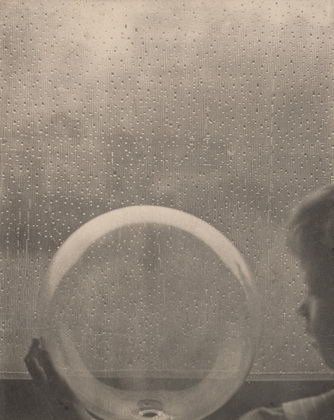
The image “Drops of Rain” accompanying today’s post by Clarence H. White (1903).