07/30/2013 (12 Moons Solo Project Day 211)

image

12 Moons Solo Saxophone Project Day 211

Date: 07/30/2013

Instrument: Alto saxophone

Location: My car, in the Madison Neighborhood East of Capital Hill.  Seattle, WA

Notes:

A strange but familiar spot for me to practice has always been my car.  Whether camping, stuck in a ferry boat line, or between points of travel during the day, my horn is almost always with me.  I recently purchased a new car and realized today that I haven’t practiced in it yet.  This afternoon I decided to ready the space by recording an improvisation that used the dead, isolated sound of the car’s interior.  I recorded in a quiet neighborhood next to a shaded tree in the Madison neighborhood, East of Capital Hill.  I improvised a piece that focused on cross-fading three primary areas of the horn within two separate fingerings.  The fingerings were as follows:

(Left Hand) B-A-G keys, Low Bb // (Right Hand) F-E-D keys

(Left Hand) B-A-G keys, Low Bb // (Right Hand) F-E-D keys, Low Eb

While exploring sound color within the constraints of these two fingerings, I also focused heavily on developing a melodic shape.  I used very little articulation, but used the pitch changes between the two chords to punctuate the movement between them.  The three constraints I focused on included: 1. Lower octave multiphonic with a second wide oscillating multiphonic.  2.  Two upper octave single pitches.  3.  Two multiphonics in the upper register with very similar, tight oscillating tone color.  The first of the two chords in no. 3 rings a very clear major chord sound.

-Neil

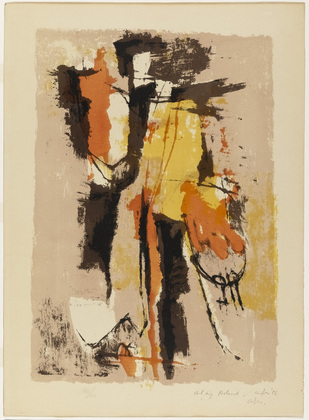
The image “Untitled” accompanying today’s post by Afro (Afro Basaldella) 1956
07/29/2013 (12 Moons Solo Project Day 210)

image

12 Moons Solo Saxophone Project Day 210

Date: 07/29/2013

Instrument: Tenor saxophone

Location: Home studio in Clinton, WA (Whidbey Island)

Notes:

This past year or so I’ve become more interested in directly incorporating key clacking within a melodic-based composition.  To explore this idea, today I maintained a continuous roll which acts as a kind of percussive drone beneath the pitches that were played.  To make the listener subconciously aware of its use, I made a simple melodic figure with the high C# that overwhelms the percussive sound, but still allows it to be quietly audible.  The clacking roll has very little room for dynamic shaping, versus the C# which can range from whisper soft to blatantly loud.  The C# figure opens the improvisation, and it’s application was for use as both a melodic figure, but also a simple point of focus to almost draw more attention to the continuous roll beneath it once the C# finally disapears.  

After the first minute or so I abruptly abandoned the C# melodic figure in favor of the clacking only.  Though the C# figure does fade back in verbatim, this initial dropping out signals a change in the piece, and from this point forward the new melodic material is more diverse in range, volume and sound textures explored.

The fingering system used during this improvisation was as follows:

(Left Hand) Bis Bb key only, Octave // (Right Hand) Rapidly trill the upper right hand clutch key.

The upper octave tones, as well as the pitch bends were then created by slowly opening and closing the Fork F key (about ¾ the way open in total) in the Left Hand.  The slight trill interruptions which begin near the end of the piece were done by quickly flicking open and closed the F Palm key in the Left Hand as well.

-Neil

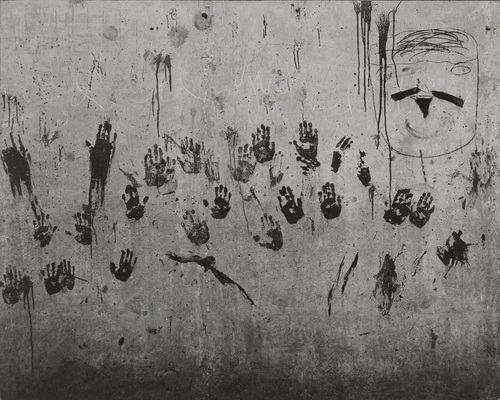
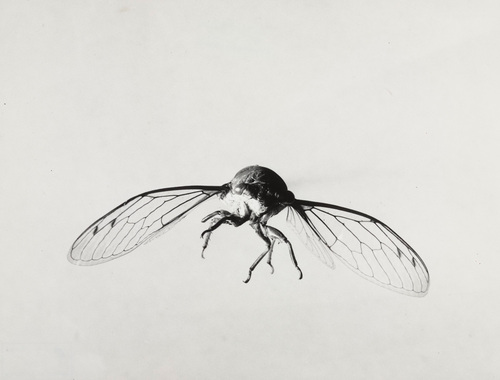
The image “Cicada” accompanying today’s post by Dr. Harold E. Edgerton (1939 or before).

07/28/2013 (12 Moons Solo Project Day 209)

image

12 Moons Solo Saxophone Project Day 209

Date: 07/28/2013

Instrument: Tenor saxophone

Location: Home studio in Clinton, WA (Whidbey Island)

Notes:

During my practice session I focused on the pairing of very specific, yet diverse regions of the instrument.  This led me to explore in this improvisation a broad center of sound with three primary developmental aspects and one secondary aspect.  Each occupies a unique place within the sound spectrum and were played at will.  I placed each aspect next to another, thought the execution was paced somewhat slowly as I tried to move from one aspect to another in an unhurried way.  The primary developmental aspects included: 

1.  The use of and extremely wide range spanning three octaves with the pitches low Bb and altissimo C.

2.  Indeterminate pitches within the upper middle register, played in tight pairing with one another.

3.  A multiphonic with an increasing level of volume.  Fingered as follows: (Left Hand) B-A-G keys, Octave, Low B // (Right Hand) F-E-D keys, Low C

The secondary developmental aspect included:

4.  The Low B fingering, played as an oscillating chord with an evenly paced wave form.  

-Neil

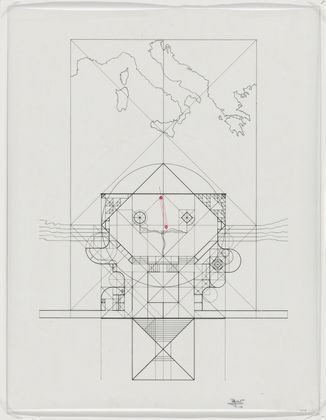
The image “Fountain House, Generative Geometries, project, Plan” accompanying today’s post by Rodolfo Machado and Jorge Silvetti (1942).

07/27/2013 (12 Moons Solo Project Day 208)

image

12 Moons Solo Saxophone Project Day 208

Date: 07/27/2013

Instrument: Soprano saxophone

Location: The rec room of my childhood house.  Edmonds, WA

Notes:

For reasons of a personal nature, this was a very difficult day for me.  As this series has progressed my improvisations have more and more taken on an critical role in helping me understand these days.  I decided to confront my reality with a more uplifting piece.  This improvisation was of the kind that I could embrace for use as my medicine, in the astounding way art is able to fully transform us, if even for a small period.  This brief, very active improvisation centered around the Concert C major triad, and a multiphonic with three diatonic tones inside of it.  The multiphonic was fingered as follows:

(Left Hand) B-A-G keys, Octave, Low B // (Right Hand) F# key

This fingering created the middle octave tones E,D and the upper register C.  Though they were a bit flat in intonation, I would balance these diatonic pitches primarily against the C major triad.  In the upper register, I also developed an improvised figure with the pitches E-F-E-C— which I would interject between the split tones and the arpeggios.

-Neil

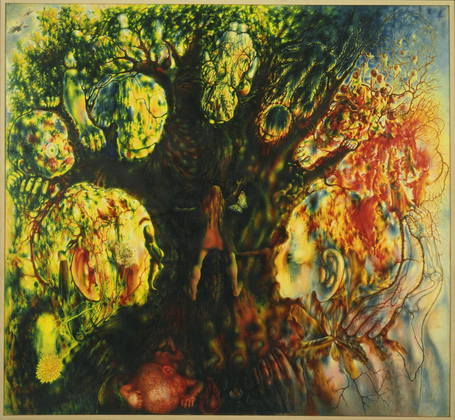
The image “Hide and Seek, Derby, Vermont June 1940-June 1942 and New York” accompanying today’s post by Pavel Tchelitchew

07/26/2013 (12 Moons Solo Project Day 207)

image

12 Moons Solo Saxophone Project Day 207

Date: 07/26/2013

Instrument: Tenor saxophone

Location: Home studio in Clinton, WA (Whidbey Island)

Notes:

After two separate recording attempts today that led to limited results, I decided to consider a firmer approach to a piece.  I improvise based on the unfolding of sound within a repeating fingering system.  During my practice session I focused on wide vibrato as a base approach to every pitch I played.  I tried to eliminate the use of pure tone to make the more animated vibrato sound the dominant voice.  This eventually influenced my recorded improvisation in that I applied the concept of pliable pitch centers in a broader context, by using this as the true improvisatory element and the repeating fingering system as the more concrete composition.

In this improvisation the initial muted gesture that opens the piece becomes the springboard for exploring the width of tone bending.  As my embouchure spreads the pitch, the intonation begins to drift sharp and flat, eventually reaching a breaking point at which altissimo tones enter the field.  This particular fingering system also allowed for multiphonic chords, which were achieved by applying more pressure against the reed while repeating the fingering system.  Other split tones, particularly those in the extreme upper register, were done instead by applying very little pressure on the tip of the reed.  The improvisation uses changes in dynamic range as well as tempo to further explore the bending of pitches and elaboration of sound textures.  

-Neil

The image “Untitled” accompanying today’s post by Ishimoto Yasuhiro (c. 1950)