Tomorrow’s 12 Moons post will be delayed until Sunday. I’m off to camp in the woods on Orcas Island and won’t have an internet connection. Expect some maddening recording from the wild!
-Neil
06/28/2013 (12 Moons Solo Project Day 179)
12 Moons Solo Saxophone Project Day 179
Date: 06/28/2013
Instrument: Tenor saxophone
Location: Home studio in Clinton, WA (Whidbey Island)
Notes:
While practicing this morning, and during my recorded improvisation today, I worked on orchestration within dense clusters of sound. I explored several fingering systems before arriving at the one used here. I was particularly interested in this system because of the half step clusters that were placed at various points throughout the registers. The piece centers around the upper to extreme upper register of the horn. While improvising I looked for markers in the sound–those being particular colors, melodies or rhythms that caught my ear and then became developmental tools. An example of this is the upper octave Concert Bb pulse that is used in repetition at various points. The pulse also became a recurring theme in sections of the improvisation where upper register bright tones were the focus.
I worked to maintain a tight sense of control over the sound clusters, but at certain points I would loosen my embouchure to allow extreme upper register tones to enter into the field. These pitches are much more unstable than the lower tones, but are also more flexible in how they can be bent or combined together in tight groupings. During these events I would then pull down the lower tones in volume, or cross fade back into the lower tone clusters after exploring the upper tones for some time. My fingers kept a fairly regular cycle of movement throughout, even in the areas of the piece that were much lighter in texture. While improvising a piece like this, I often try to detach myself from the fingering cycle taking place, and even let it evolve a bit into a slightly new rhythmic feel. To detach my brain from my fingers allows me to focus more on sound. To work on doing live orchestration in an improvisation like this, I’ll often let my mind latch onto a sound and see if I can combine it, or let it interact with other sounds of interest. In this way orchestration feels compositionally central to the improvisation, even when the overall sounds are abstract in nature.
The core fingering system used below was flexible in rhythm, and to which keys could be trilled at any given time:
(Left Hand) Fork F, C keys, Octave, Low B // (Right Hand) F-D keys, Low C
Trill options: Fork F, Side Bb, Side C, Low F#.
-Neil
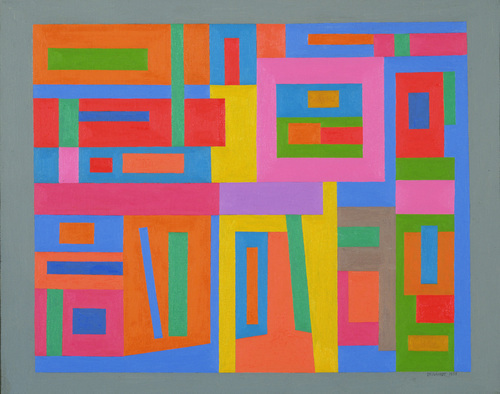
The image “Untitled" accompanying today’s post by Ad Reinhardt (1938)
06/27/2013 (12 Moons Solo Project Day 178)
12 Moons Solo Saxophone Project Day 178
Date: 06/27/2013
Instrument: Tenor saxophone
Location: A forest between Maxwelton Road and Highway 522. Langley, WA (Whidbey Island)
Notes:
I welcomed the transition from afternoon to evening with this improvisation. After teaching and rehearsing for the bulk of the day, on the way home I stopped at a pullout in the forest. It looked to be an old logging road that cut up into a now very overgrown forest–nature is taking it back. The forest was somewhat thinned out, but plenty of mature douglas fir and cedar remained all around me. I recorded this improvisation with the mic gain turned extremely high, and played at a whisper soft volume. Though the setting was very tranquil, the busy highway could be heard only a few hundred yards away. It was a reminder that the river of car noise could become part of the beauty of my experience.
During this improvisation I worked with a delicate texture. The full melody used two fingerings, each with the same sustained drone beneath. The improvisation opens at the highest point of volume and introduces the major 7th interval, which I resolved up to nearly meet the bottom pitch an octave higher. But like my surroundings, the figure was imperfect. I could not fully reach the true second octave. Even in this very consonant resolution, there is the smallest amount of ever present dissonance. I tried to create a texture as subtle as the fading afternoon around me, and I truly felt a part of that natural transition. Also of note, near the end of the improvisation there is a high pitched buzzing. This was a mosquito!
The fingerings used were as follows:
(Left Hand) Fork F, A key, Octave // (Right Hand) F key, Side F#
Eb quarter step high drone with D in upper register.
(Left Hand) Fork F, A key, Octave // (Right Hand) F-E keys, Side F#
Eb quarter step high drone with Eb semi tone flat in upper register.
-Neil
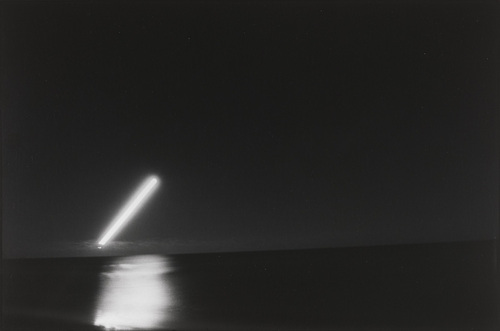
The image “Observation: The Sun-1” accompanying today’s post by Hiroshi Yamazaki
06/26/2013 (12 Moons Solo Project Day 177)
12 Moons Solo Saxophone Project Day 177
Date: 06/26/2013
Instrument: Tenor saxophone
Location: Home studio in Clinton, WA (Whidbey Island)
Notes:
My improvisation today was inspired by bird songs. On a recent radio program, I listened to common and exotic bird calls slowed down with the pitches maintained. As they say about a powerful melody, a great song works at any tempo. I was particularly fascinated by my own reaction to hearing the slowed-down and natural tempo bird calls set against one other. There always seemed to be a definite connection between the two for me, though when I stepped back and thought about it, I’m fairly certain that if I were give a “blindfold” test and the various calls were mixed up, I would have a very difficult time making the connections between slow and at tempo. With this in mind, I practiced a repetitive melodic sequence–my own personal bird call, at tempos ranging from extremely slow to as fast as possible for me to play.
The differences from extremely slow to extremely fast are very apparent, but there is a subtlety to the lines that seems to be lost when comparing between tempos. Just like the bird calls I listened too, each tempo seemed to occupy it’s own sound world but was fundamentally connected to the bigger picture. I should also mention how remarkably consistent the pitch was in the bird calls with each repetition. I suppose that comes from a literal lifetime of singling the same melody over and over. The fingerings used for this 6-pitch sequence were as follows:
Pitch 1 (Concert Bb)
(Left Hand) B-A-G keys, Octave, Low B (Right Hand) F-E-D keys, Side C
Pitch 2 (Concert C)
(Left Hand) B-A-G keys, Octave, Low B (Right Hand) F-E-D keys
Pitch 3 (Concert Bb semi tone sharp)
(Left Hand) A-G keys, Octave, Low B (Right Hand) F-E-D keys
Pitch 4 (Concert Db)
(Left Hand) B-A-G keys, Octave, Low B (Right Hand) F-E-D keys, High F key
Pitch 5 (Concert C). Same as Pitch/Fingering 2
(Left Hand) B-A-G keys, Octave, Low B (Right Hand) F-E-D keys
Pitch 6 (Concert Bb semi tone sharp). Same as Pitch/Fingering 3.
(Left Hand) A-G keys, Octave, Low B (Right Hand) F-E-D keys
-Neil
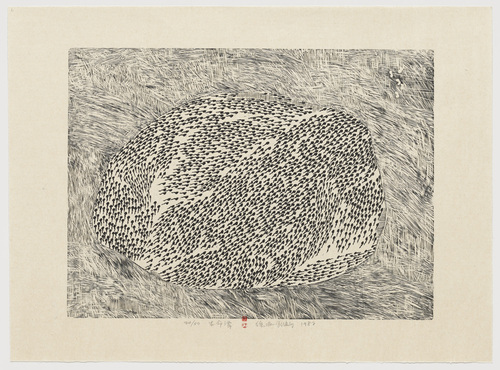
The image “Life Pond” from “Series of Repetitions” accompanying today’s post by Xu Bing
06/25/2013 (12 Moons Solo Project Day 176)
12 Moons Solo Saxophone Project Day 176
Date: 06/25/2013
Instrument: Tenor saxophone
Location: Home studio in Clinton, WA (Whidbey Island)
Notes:
My wife and I spent the day up at our small, one room cabin in the cascade mountains. It’s located off Highway 2 on the West side of the pass. It rained most of the day, so we sat by the fire and kept it burning for several hours. I came home this afternoon with such a clearer mind than I left with this morning. Though I was tempted to record at the cabin, I decided to wait for my familiar practice space back at home. The result was a piece not directly inspired by mood or place, but more the state of my mind.
I practiced for about an hour before recording this improvisation. The current condition of my reed lent itself towards double-tonging, and I decided to sculpt a piece around this use of this technique. The improvisation covers a medium range on the tenor, from the low F# to the high F#. I used the initial figure as a springboard for chromatic and whole-step actions in lower register. This used the following fingering:
(Left Hand) B-A-G keys, Low B // (Right Hand) E-D keys. Trill open and close the low C in the right hand and the G key in the left hand.
In the mid point of the improvisation I departed from the chromatic action to play a scalar figure that ascended up two octaves and stopped on the high F#. I would also occasionally play the same scale and stop on the middle octave A, or I would combine this scale with the longer version and the lower octave chromatic action. During this improvisation I also explored the pacing of pitches. I would try to give the impression that melodies were speeding up or slowing down despite the fact that the articulation remained static.
-Neil
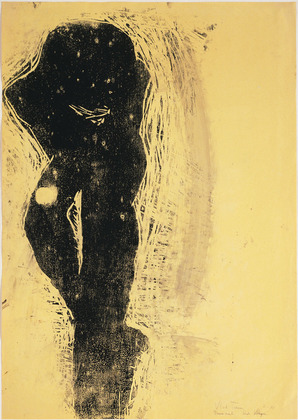
The image “Vlad Tcepec (Paper Mask) plate VII from the series Prints for the Counter Chronicle” accompanying today’s post by Gustav Kluge (1984)