06/22/2013 (12 Moons Solo Project Day 173)

image

12 Moons Solo Saxophone Project Day 173

Date: 06/22/2013

Instrument: Tenor saxophone

Location: Home studio in Clinton, WA (Whidbey Island)

Notes:

I spent several hours this morning and afternoon working on a new piece for large ensemble, which I’ll debut at the Racer Sessions in July.  In my writing I worked on atonal chorale figures that have bluesy melodies played on top of them, or at times buried inside the melody of the chorale itself.  With this in mind today I improvised a blues inflected piece that had a recurring harmonic theme, which a complimentary melody within it.  However, the melody is full of nonsequitur rhythms and phrasing that has no single approach, but rather an overall feeling of forward momentum.  The chords themselves have a slightly de-tuned quality, and even though they do have a strong sound of dominant–tonic, they also have instability in their nature.  

I tried to give this piece an unfinished quality, and I began it as though I were caught in mid phrase.  This consonant tonality explored in this improvisation is played by centering on two multiphonics with the following fingerings and pitches:

Pitches:High D, Middle Octave E, Low Octave G

(Left Hand) B-A-G, Octave // (Right Hand) E-D

Pitches: High D, Middle Octave F, Low Octave G quarter step high.

(Left Hand) B-A-G, Octave // (Right Hand) E-D, Side F#

The melodic figures in the piece often overlap with the multiphonic fingerings, so there is a feeling at times that the harmony sits inside the melody.  This is because the mutliphonic chords speak two or more pitches, but also have strong single pitch sounds at their core.  To help differentiate the chords from the melody I struck closely to the rhythm (1&–2) when playing the harmony.

-Neil

The image “Drawing-Asymmetry #7” accompanying today’s post by post by Jackson Mac Low (1961)
06/21/2013 (12 Moons Solo Project Day 172)

image

12 Moons Solo Saxophone Project Day 172

Date: 06/21/2013

Instrument: Tenor saxophone

Location: Home studio in Clinton, WA (Whidbey Island)

Notes:

Today I worked on sound clusters with a hidden internal melody.  This melody then becomes the focus of action.  I recorded this piece at a medium volume and used a very tight, closed-off air flow while growling into the horn.  I had two primary goals in mind: create continuous gritty sound textures while maintaining an internal E to Eb melody, and to phase these sounds evenly into the E to Eb melody.  During the improvisation I established the busy atmosphere of the sound clusters and tried to evenly cross fade the melody into the forefront.  I then worked to evening phrase the gritty textures back in while masking the melody.  Later on in the improvisation I abruptly cut to the middle octave humming sound, and again tried to evenly phase back into the sound clusters, and finally the melody alone.

The fingering used was as follows:

(Left Hand) For F, B-G keys, Low B // (Right Hand) F-E keys, Low C.  

To create the E to Eb melody within the sound clusters, also add and then take away the Low Bb key in the left hand.  When this melody is played by itself, a Db drone natural occurs because of the fingering system.

-Neil

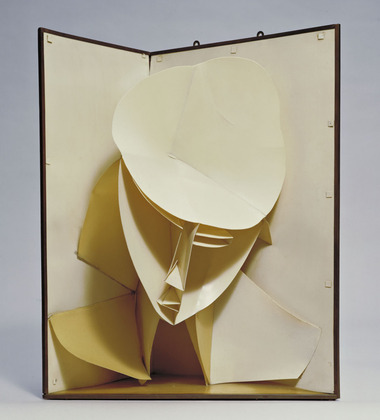
The image “Head of a Women” accompanying today’s post by Naum Gabo (1917-20)

06/20/2013 (12 Moons Solo Project Day 171)

12 Moons Solo Saxophone Project Day 171

Date: 06/20/2013

Instrument: Tenor saxophone

Location: Practice Room B at South Whidbey High School.  Langley, WA (Whidbey Island)

Notes:

I spent about an this afternoon working on a specific set of sounds I had been exploring earlier this morning.  I captured a solid take of an improvisation using the end result, but there was something indescribably off about the finished product.  Despite doing a transcription of what I played and a written description of my process, I walked away from the piece feeling very hollow.  Towards the end of my teaching day I had an unanticipated bit of time, and went back into the practice space to try a very different kind of piece.  The end result is the improvisation captured here, which was a multifaceted response to my mood, the horn, and the room–this piece represented a holistic cycle.

This improvisation centers around an Ab drone.  The fingering that created this pitch held a special resonance in the room, filling it without a real need for volume.  Fluctuations in air flow brought out a fullness that seemed to encompass my entire body.  During this piece I began to focus heavily on when to take my next breath.  The breath created a momentary lapse in the flow of air, and began an anticipated cycle of sound–breath–sound–breath, etc.  After some time I began “flicking” the low D, breathing before doing so.  This took the focus away from the natural breath cycle and created a very new kind of cycle in the piece.  I introduced the gentle multiphonics to become part of this new secondary cycle near the end of the improvisation.

The fingering used to create the Ab was as follows:

(Left Hand) B-A-G keys, Low Bb // (Right Hand) F-E keys, Side Bb, Low C.  The small sound punctuations were created by “flicking” the D key momentarily in the right hand.  The multiphonic was created by an adjustment in embouchure pressure with the above Ab fingering.

-Neil 

The image “Untitled” accompanying today’s post by Leni Riefenstahl (1936)

06/19/2013 (12 Moons Solo Project Day 170)

12 Moons Solo Saxophone Project Day 170

Date: 06/19/2013

Instrument: Tenor saxophone

Location: Home studio in Clinton, WA (Whidbey Island)

Notes:

I spent nearly my entire practice session with the colors explored in this improvisation.  I have from time to time stumbled on fingerings that produce very quiet, hidden bends with contrary motion.  The sounds captured on this improvisation are only possible at an extremely low volume with a very focused air flow.  I struggled to properly capture this piece today because of the fragile nature of its parts.  Even the quietest of whispy air sounds, saliva crackles or high pitch pockets of air escaping my embouchure would upset the structure of things and rob the gesture of its natural beauty.  I have explored this particular set of sounds and fingering combinations before, but the conditions with my body and reed selection were perfect for it today.

I used a fixed fingering action during this piece, slowly opening and closing the F key in the right hand, but never fully closing it on the tone hole.  This fingering was as follows:

(Left Hand) B-A-G keys, Octave, Fork F, Low B // (Right Hand) E-D keys.  Slowly open and close the Low F in the Right Hand.

With this fingering action, two separate pitch bends would occur.  The first was a gentle ascending bend from a Concert D to E, and the second a gentle descending bend from a Concert C to a Bb.  To achieve this a quiet, very focused air stream must be used.  I had a medium strength reed, and while doing the bends a high amount of back-pressure is felt in the body.  In order to avoid having the sound “explode” into high volume, the air flow must be carefully regulated depending on which bend is being played–ascending or descending.  In this way there is a momentary, subconscious shift in pressure that my body needed to become comfortable executing through an hour or so of practice before attempting to record the improvisation.  In the upper register, I held, or occasionally pulsed a Concert D.  This was done with the embouchure in the midst of focusing on the two contrary motion bends going on beneath it.

-Neil

The image “Mystery of the Street” accompanying today’s post by Umbo (Otto Umbehr) 1928.

06/18/2013 (12 Moons Solo Project Day 169)

12 Moons Solo Saxophone Project Day 169

Date: 06/18/2013

Instrument: Tenor saxophone

Location: Performance hall at Chief Sealth High School.  Seattle, WA

Notes:

Today I felt like exploring color in my sound, held within a tight range of the horn.  On 06/16/2013 I used a 3 figure gesture, the 3rd of which had a specific fingering that created a minor third chord.  On that day I used this chord in a fixed, block position without any kind of alteration of it’s overall sound.  Today I decided to re-visit this chord and focus more on ornamentation.  The fingering used was as follows:

E/C: each a quarter step high.  (Left Hand) B-A keys, Octave, Palm Eb

I had a brief period of access to the performance hall at Chief Sealth this morning before beginning my teaching day.  I used this time to create a very focused atmosphere with this fingering.  I worked to create melodic and harmonic themes, adding and taking away specific keys, including the High F, Side C, Fork F, and the momentary removal of the Palm Eb key.  I continuously referred back to a melodic figure with a much slower tempo and pace of action than the work being explored around it.  The dichotomoy between density of notes and tempo became a recurring theme as I worked on this improvisation.

-Neil

The image “Friedrichstrasse Skyscraper Project, Berlin-Mitte, Germany, Exterior perspective from North accompanying today’s post by Ludwig Mies van der Rohe (1921)