06/19/2013 (12 Moons Solo Project Day 170)

12 Moons Solo Saxophone Project Day 170

Date: 06/19/2013

Instrument: Tenor saxophone

Location: Home studio in Clinton, WA (Whidbey Island)

Notes:

I spent nearly my entire practice session with the colors explored in this improvisation.  I have from time to time stumbled on fingerings that produce very quiet, hidden bends with contrary motion.  The sounds captured on this improvisation are only possible at an extremely low volume with a very focused air flow.  I struggled to properly capture this piece today because of the fragile nature of its parts.  Even the quietest of whispy air sounds, saliva crackles or high pitch pockets of air escaping my embouchure would upset the structure of things and rob the gesture of its natural beauty.  I have explored this particular set of sounds and fingering combinations before, but the conditions with my body and reed selection were perfect for it today.

I used a fixed fingering action during this piece, slowly opening and closing the F key in the right hand, but never fully closing it on the tone hole.  This fingering was as follows:

(Left Hand) B-A-G keys, Octave, Fork F, Low B // (Right Hand) E-D keys.  Slowly open and close the Low F in the Right Hand.

With this fingering action, two separate pitch bends would occur.  The first was a gentle ascending bend from a Concert D to E, and the second a gentle descending bend from a Concert C to a Bb.  To achieve this a quiet, very focused air stream must be used.  I had a medium strength reed, and while doing the bends a high amount of back-pressure is felt in the body.  In order to avoid having the sound “explode” into high volume, the air flow must be carefully regulated depending on which bend is being played–ascending or descending.  In this way there is a momentary, subconscious shift in pressure that my body needed to become comfortable executing through an hour or so of practice before attempting to record the improvisation.  In the upper register, I held, or occasionally pulsed a Concert D.  This was done with the embouchure in the midst of focusing on the two contrary motion bends going on beneath it.

-Neil

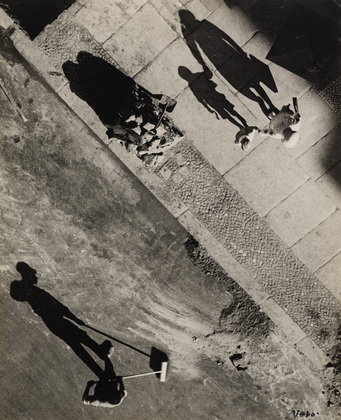
The image “Mystery of the Street” accompanying today’s post by Umbo (Otto Umbehr) 1928.
06/18/2013 (12 Moons Solo Project Day 169)

12 Moons Solo Saxophone Project Day 169

Date: 06/18/2013

Instrument: Tenor saxophone

Location: Performance hall at Chief Sealth High School.  Seattle, WA

Notes:

Today I felt like exploring color in my sound, held within a tight range of the horn.  On 06/16/2013 I used a 3 figure gesture, the 3rd of which had a specific fingering that created a minor third chord.  On that day I used this chord in a fixed, block position without any kind of alteration of it’s overall sound.  Today I decided to re-visit this chord and focus more on ornamentation.  The fingering used was as follows:

E/C: each a quarter step high.  (Left Hand) B-A keys, Octave, Palm Eb

I had a brief period of access to the performance hall at Chief Sealth this morning before beginning my teaching day.  I used this time to create a very focused atmosphere with this fingering.  I worked to create melodic and harmonic themes, adding and taking away specific keys, including the High F, Side C, Fork F, and the momentary removal of the Palm Eb key.  I continuously referred back to a melodic figure with a much slower tempo and pace of action than the work being explored around it.  The dichotomoy between density of notes and tempo became a recurring theme as I worked on this improvisation.

-Neil

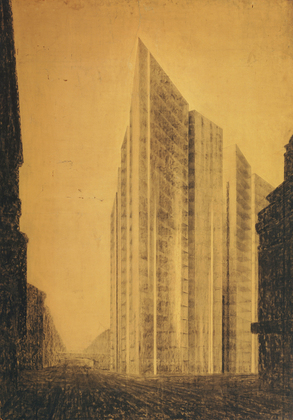
The image “Friedrichstrasse Skyscraper Project, Berlin-Mitte, Germany, Exterior perspective from North accompanying today’s post by Ludwig Mies van der Rohe (1921)

"messy, manic, bubbling over..."

“As the crowd formed, Welch began a startling solo. It was an onslaught of rapid-fire notes, messy, manic, bubbling over and subsiding on repeat. Welch was absorbed, trance-like, in his sound, which first resembled the cry of an excited animal and soon dissolved into a loop of unapologetic shrieking. Finally, it petered into a slow succession of guttural blows. Though a repeating single note, the sound was not stagnant. It was set to the counterpoint of the audience slapping mosquitos against their skin, of dogs barking in response from far away, and of birds caw-cawing.”

Kaia Chessen, The Stranger


image 

06/17/2013 (12 Moons Solo Project Day 168)

12 Moons Solo Saxophone Project Day 168

Date: 06/17/2013

Instrument: Tenor saxophone

Location: Practice Room B at South Whidbey High School

Between students this afternoon I spent a bit of time inside the Practice Room B at South Whidbey High School.  On the drive over to the school a Coltrane recording of “Gee Baby Ain’t I Good to You” was on the radio.  The piece opens with a two chord figure in the horns, with tenor, trumpet and trombone playing a repetitive blues figure over and over before Coltrane begins playing the melody.  I haven’t heard this recording in years and the honest blueness of it stayed with me into this improvisation.  This improvisation was balanced around a central split tone, which I found to be amazingly melancholic and inspired me to create a bluesy atmosphere around it.

The central split tone figure creates the Concert pitches E and F (quarter step flat), which is only produced with an extreme amount of back-pressure while playing.  I used mostly pitches from the common Blues Scale on this improvisation, but relied on the power of the split tone to create rhythmic cycles and colors around it.  The fingering was as follows:

Concert E and F (quarter step flat) (Left Hand) B-A-G keys, Octave, Low B // (Right Hand) F# key, Low C

-Neil

The image “Bleeding Takari II” accompanying today’s post by El Anatsui.

06/16/2013 (12 Moons Solo Project Day 167)

image

12 Moons Solo Saxophone Project Day 167

Date: 06/16/2013

Instrument: Tenor saxophone

Location: The rec room in my childhood home.  Edmonds, WA

This morning I visited with my Mom back at my family home in Edmonds.  I had just a few minutes to warm up and found myself inspired by a story I had heard on NPR on the drive over.  An interviewee presented a case that 1963 was the most artistically influential and critical year of development for the Beatles.  It was interesting to hear that they had over 40 in-studio performances for the BBC that year, and for some reason I walked away with the song “Fool on the Hill” semi-permanently implanted in my brain throughout the day, even though that song appeared several years later.  I decided to explore a very tonal, lyrical melody with an accompanying split tone chord to pay homage to my day-long obsession with this song.

The series of upper register pitches were done with traditional fingerings, albeit the tenor High F was played using the Fork fingering, which produced more of a muted sound on my horn.  The chord played each time after the two upper pitches produces a minor third with the tenor pitches E and C, each approximately a quarter step high.  To punctuate the overall melodic color, I began slightly altering the broader sound by incorporating occasional dots by striking the Side High F key.  The occasional rapid cycles were played by moving my index and middle fingers in a trilling fashion against the High Side F# key.  The brief held pitches were created by then holding the Side High F key down.  The rhythm “1–2&– 3–4&–5–6” played near the 2/3 point in the improvisation was accomplished by putting down and then removing this same Side F key while continuing the original sound cycle.  

The fingerings:

Gesture 1: Altissimo G

Gesture 2: Fork F

Gesture 3: E/C: each a quarter step high.  (Left Hand) B-A keys, Octave, Palm Eb

-Neil

The image accompanying today’s is the Beatles.