06/09/2013 (12 Moons Solo Project Day 160)

12 Moons Solo Saxophone Project Day 160

Date: 06/09/13

Instrument: Tenor saxophone

Location: The rec room in my childhood home.  Edmonds, WA

Notes:

This morning I unexpectedly had to be on a 6:30am ferry back to the mainland, and found myself at my childhood house, horn in hand and fully ready for the day by 7:30.  During this time I worked on quiet, controlled gestures, scales and long tones.  I ended my practice session by working with three false fingerings on the tenor pitches “D-E-F."  This minor gesture became the fulcrum of my improvisation today.  During this piece I cycled the three pitches at a steady tempo and included the use of flutter-tonguing to punctuate the pitches.  As the improvisation evolved I began slightly adjusting my lower lip position, taking in just a bit less of the thick part of the lip and balancing more on the thinner outer part.  This technique allows for the core pitch to sound as well as extreme upper register chirping tones.  I worked to phase between the traditional pitches and the pairing of traditionally and chirped tones.  The fingerings were as follows:

Tenor pitch D: (Left Hand) Middle C, Octave // (Right Hand) Low C

Tenor pitch E: (Left Hand) Middle C, Octave // (Right Hand) F-E keys, Low C

Tenor pitch F: (Left Hand) Middle C, Octave // (Right Hand) F-E keys, Side C, Low C

-Neil

The image "Two Nudes on Purple Canvas” accompanying today’s post by Robert Beauchamp

06/08/2013 (12 Moons Solo Project Day 159)

12 Moons Solo Saxophone Project Day 159

Date: 06/08/2013

Instrument: Tenor saxophone

Location: Home studio in Clinton, WA (Whidbey Island)

Notes:

This morning I learned about the passing of saxophone legend Bert Wilson (1939-2013).  A pioneer of multiphonics as a course of study, Bert was a deeply soulful and thoughtful player.  He inspired countless musicians across a career that spanned decades.  I had the great fortune to spend about 4 hours with Bert earlier this year.  That afternoon being my first and last time hearing him play in person and listening about his storied career as an innovator and saxophone master.  What a joyous man.  What a beautiful man.  

I found myself thinking today that I don’t celebrate people enough while they’re here.  Fortunately, during Bert’s later years there were so many people that were close to him and collaborated with him.  I’m certain this must have added so much happiness to his life. My improvisation today is inspired by a bit of the conversation I had with Bert.  We had a very interesting talk about the importance of melodicism in music, and coming from Bert I wasn’t at all surprised to hear him talk about the importance of melody as the core component of why we listen to music.  When I first heard Bert I was deeply inspired by his ability to play multiphonic chords in such a soulful and melodic way.  A rainbow of love streamed from Bert’s instrument and I’m so fortunate to have spent even a few brief hours in his presence.  As Bert told me, “The more you know the more you blow."  Great teachers are always great students themselves, and Bert radiated this with every note he played.

-Neil

The image accompanying today’s post is of Bert Wilson live in action.

06/07/2013 (12 Moons Solo Project Day 158)

12 Moons Solo Saxophone Project Day 158

Date: 06/06/2013

Instrument: Tenor saxophone

Location: A bathroom on the second floor at Benaroya Hall.  Seattle, WA

Notes:

Tonight I participated in a concert with saxophone great Roscoe Mitchell, performing several renditions of his seminal composition “Nonaah."  Roscoe performed a solo set tonight which nearly brought me to tears with its beauty, power and commitment to the moment.  I truly felt for the first time in my life that I was inside this man’s instrument, breathing, exploring and pushing along with him.  I even found that my breathing starting to coincide with his while he played, and I would become physically strained when it was clear to me that Roscoe was pushing himself to the point of discomfort.   It was truly an inspirational night for me.

I recorded this improvisation during the down time before out concert.  I could not find a room on the second floor that was free from the sound of musicians sound checking or warming up.  It was a welcome problem to have, and I eventually found my sonic respite in a bathroom on the second floor of the performance hall.  There was no compositional model to this piece, though my mind was heavily invested in the thematic development of Roscoe’s composition "Nonaah,” and this certainly influenced my train of through and artistic choices while sculpting this improvisation.

-Neil 

The image “Red and Blue Composition” accompanying today’s post by Ad Reinhardt (1941)

06/06/2013 (12 Moons Solo Project Day 157)

image

12 Moons Solo Saxophone Project Day 157

Date: 06/06/2013

Instrument: Tenor saxophone

Location: Practice Room B at South Whidbey High School.  Langley, WA (Whidbey Island)

Notes:

I decided to wait until the end of my teaching day to record, and after a long and productive teaching session that stretched into the early evening I stepped into a different practice room to record this improvisation.  The space called me towards recording a piece focused around a busy, cyclic fingering pattern.  My fingers settled into a 11 motioned pattern with only 4 distinct shapes.  I decided to completely maintain the fingering system and articulate at an even pace with each of the 11 motions.  The reverberant room and nature of the fingerings created a wide swatch of colors in the space and the horn itself.  I maintained the consistent sextuplet articulation but decided to gradually slow the tempo slightly as the piece progressed.

I approached this improvisation from an inside–out perspective, beginning the piece with a very strict sound pattern, and gradually fracturing my ideas until reaching a point of pure sound exploration at the conclusion of the piece.  The fingering system used was as follows:

a.  (Left Hand) B-A-G keys, Octave, Low B // (Right Hand) F-E-D keys, Low C

b.  (Left Hand) B-A-G keys, Octave, Side Bb, Low B // (Right Hand) F-E-D keys, Low C

a.  (Left Hand) B-A-G keys, Octave, Low B // (Right Hand) F-E-D keys, Low C

b.  (Left Hand) B-A-G keys, Octave, Side Bb, Low B // (Right Hand) F-E-D keys, Low C

a.  (Left Hand) B-A-G keys, Octave, Low B // (Right Hand) F-E-D keys, Low C

b.  (Left Hand) B-A-G keys, Octave, Side Bb, Low B // (Right Hand) F-E-D keys, Low C

a.  (Left Hand) B-A-G keys, Octave, Low B // (Right Hand) F-E-D keys, Low C

b.  (Left Hand) B-A-G keys, Octave, Side Bb, Low B // (Right Hand) F-E-D keys, Low C

c.  (Left Hand) B-G keys, Octave, Side Bb, Low B // (Right Hand) F-E-D keys, Low C

d.  (Left Hand) B-G keys, Octave, Side Bb, Low B // (Right Hand) F-D keys, Low C

c.  (Left Hand) B-G keys, Octave, Side Bb, Low B // (Right Hand) F-E-D keys, Low C

-Neil

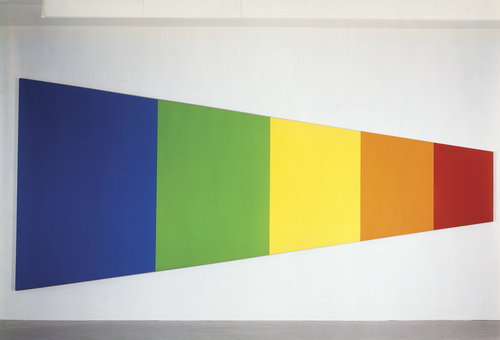
The image “Blue Green Orange Yellow Red” accompanying today’s post by artist Ellsworth Kelly (1968)

06/05/2013 (12 Moon Solo Project Day 156)

12 Moons Solo Saxophone Project Day 156

Date: 06/05/2013

Instrument: Tenor saxophone

Location: Home studio in Clinton, WA (Whidbey Island)

Notes:

This afternoon I spent my practice session working strictly on free improvisation, and decided to take the day off from any etudes, long tones or scales that normally make up a part of my routine.  Life is so busy at the moment and it felt good just to play the horn without any kind of agenda attached to it.  I came to settle on a particular hexatonic scale with a series of false fingerings that ornamented it in a very vibrant way.  I used this scale in my improvisation today, recording several improvised takes before capturing the mood I was interest in.  The scale was as follows:

(Concert Key) Eb, G, Ab, Bb, Cb, Db.   

During this improvisation I tried to focus on a high level of ornamentation and melodicism simultaneously, and I used double-tonguing to help bring out more percussive colors with the fingerings.  Throughout the improvisation I referred back to the Concert G many times at a significantly lower volume than the material around it.  I feel extreme dynamics of this sort played a large role in shaping the piece.  Though the scale as written above has a Concert Eb at its base, I played this pitch only once at the bottom of the scale, and once at the top respectively, using the power of this fundamental to punctuate the melodic landscape created by the scale.

The fingerings used in this piece all had the Low B and Low C depressed.  Traditional fingerings were used as the melodic starting point, and the Side C, Bis Bb, 1 and 1 Bb fingerings created microtones and split tones around them.  The only exception were the pitches Bb and Cb, which simultaneously (as a split fingering) used the following fingering:

(Left Hand) C key, Low B, Octave // (Right Hand) F-E keys, Low C

-Neil 

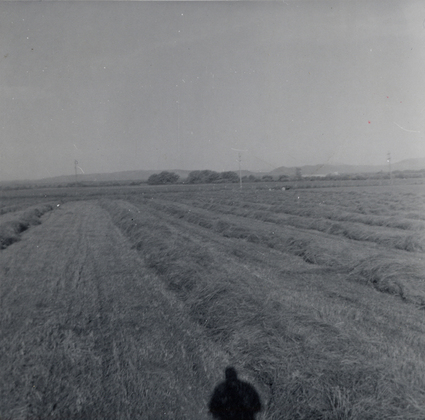
The image “untitled” accompanying today’s post by an unknown author.