06/06/2013 (12 Moons Solo Project Day 157)

image

12 Moons Solo Saxophone Project Day 157

Date: 06/06/2013

Instrument: Tenor saxophone

Location: Practice Room B at South Whidbey High School.  Langley, WA (Whidbey Island)

Notes:

I decided to wait until the end of my teaching day to record, and after a long and productive teaching session that stretched into the early evening I stepped into a different practice room to record this improvisation.  The space called me towards recording a piece focused around a busy, cyclic fingering pattern.  My fingers settled into a 11 motioned pattern with only 4 distinct shapes.  I decided to completely maintain the fingering system and articulate at an even pace with each of the 11 motions.  The reverberant room and nature of the fingerings created a wide swatch of colors in the space and the horn itself.  I maintained the consistent sextuplet articulation but decided to gradually slow the tempo slightly as the piece progressed.

I approached this improvisation from an inside–out perspective, beginning the piece with a very strict sound pattern, and gradually fracturing my ideas until reaching a point of pure sound exploration at the conclusion of the piece.  The fingering system used was as follows:

a.  (Left Hand) B-A-G keys, Octave, Low B // (Right Hand) F-E-D keys, Low C

b.  (Left Hand) B-A-G keys, Octave, Side Bb, Low B // (Right Hand) F-E-D keys, Low C

a.  (Left Hand) B-A-G keys, Octave, Low B // (Right Hand) F-E-D keys, Low C

b.  (Left Hand) B-A-G keys, Octave, Side Bb, Low B // (Right Hand) F-E-D keys, Low C

a.  (Left Hand) B-A-G keys, Octave, Low B // (Right Hand) F-E-D keys, Low C

b.  (Left Hand) B-A-G keys, Octave, Side Bb, Low B // (Right Hand) F-E-D keys, Low C

a.  (Left Hand) B-A-G keys, Octave, Low B // (Right Hand) F-E-D keys, Low C

b.  (Left Hand) B-A-G keys, Octave, Side Bb, Low B // (Right Hand) F-E-D keys, Low C

c.  (Left Hand) B-G keys, Octave, Side Bb, Low B // (Right Hand) F-E-D keys, Low C

d.  (Left Hand) B-G keys, Octave, Side Bb, Low B // (Right Hand) F-D keys, Low C

c.  (Left Hand) B-G keys, Octave, Side Bb, Low B // (Right Hand) F-E-D keys, Low C

-Neil

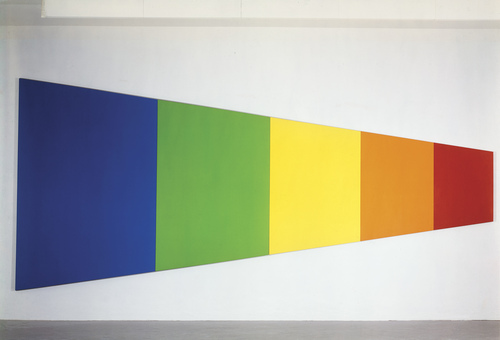
The image “Blue Green Orange Yellow Red” accompanying today’s post by artist Ellsworth Kelly (1968)
06/05/2013 (12 Moon Solo Project Day 156)

12 Moons Solo Saxophone Project Day 156

Date: 06/05/2013

Instrument: Tenor saxophone

Location: Home studio in Clinton, WA (Whidbey Island)

Notes:

This afternoon I spent my practice session working strictly on free improvisation, and decided to take the day off from any etudes, long tones or scales that normally make up a part of my routine.  Life is so busy at the moment and it felt good just to play the horn without any kind of agenda attached to it.  I came to settle on a particular hexatonic scale with a series of false fingerings that ornamented it in a very vibrant way.  I used this scale in my improvisation today, recording several improvised takes before capturing the mood I was interest in.  The scale was as follows:

(Concert Key) Eb, G, Ab, Bb, Cb, Db.   

During this improvisation I tried to focus on a high level of ornamentation and melodicism simultaneously, and I used double-tonguing to help bring out more percussive colors with the fingerings.  Throughout the improvisation I referred back to the Concert G many times at a significantly lower volume than the material around it.  I feel extreme dynamics of this sort played a large role in shaping the piece.  Though the scale as written above has a Concert Eb at its base, I played this pitch only once at the bottom of the scale, and once at the top respectively, using the power of this fundamental to punctuate the melodic landscape created by the scale.

The fingerings used in this piece all had the Low B and Low C depressed.  Traditional fingerings were used as the melodic starting point, and the Side C, Bis Bb, 1 and 1 Bb fingerings created microtones and split tones around them.  The only exception were the pitches Bb and Cb, which simultaneously (as a split fingering) used the following fingering:

(Left Hand) C key, Low B, Octave // (Right Hand) F-E keys, Low C

-Neil 

The image “untitled” accompanying today’s post by an unknown author.

06/04/2013 (12 Moons Solo Project Day 155)

12 Moons Solo Saxophone Project Day 155

Date: 06/04/2013

Instrument: Tenor saxophone/harmon mute

Location: Performance hall at Chief Sealth High School.  Seattle, WA

Notes:

I taught at Chief Sealth high for most of the day and I couldn’t resist practicing with a harmon mute that I found sitting on a music stand in the choir room.  I’ve recorded one other time during this project with a harmon mute, but today I worked to explore deeper sonic textures with this unique tool.  As was the case the last time around, I had to carefully balance the mute in my bell to avoid having it fall out from the pressure built up while blowing through the horn, but also to let it float around enough to vibrate against the bell.  

During this improvisation I worked with the natural, stuffy tones the mute insisted on.  Specific fingerings would create bright, crisp sound waves, as was the case at the beginning of the piece.  Other fingerings, and particularly those that used the low “bell” keys, would create fuller, more vibrant chords that allowed the mute to actually shake in the bell and rotate a bit in a circle.  During this piece I phased in and out the pinched tones created by the mute, as well as the dripping sounds created by opening and closing specific keys while the mute response to changes in the sound waves.  I used a range spanning the middle register to extreme altissimo.

-Neil

The image accompanying today’s post is of artist Joan Mitchell, by Cora Cohen and Betsy Sussler (1986).

06/03/2013 (12 Moons Solo Project Day 154)

image

12 Moons Solo Saxophone Project Day 154

Date: 06/03/2013

Instrument: Tenor saxophone

Location: Home studio in Clinton, WA (Whidbey Island)

Because of mechanical troubles with my horn requiring an unexpected trip back to the mainland today, followed by major mechanical issues with my car while on the other side, I found myself with several hours to read.  I’m nearing the end of Hemingway’s For Whom the Bell Tolls, one of my favorite books.  The characters are currently engaged in fighting with the “Maquina” (Machine Gun) and the author’s descriptive language with this tool is simply amazing, using words like “sound” or “speak” to almost anthropomorphize the machine in the context of its terrible use in battle.  This language and images of battle in my mind influenced this improvisation today.

During this piece I worked to maintain a constant flow of sixteenth notes at a medium fast tempo, though I inadvertently dragged the tempo considerably as the improvisation went on.  I used the following base fingering as a point of departure:

(Left Hand) B-A-G keys, Low B // (Right Hand) F-E-D keys, Low C, Side Bb

I tried to envision this terrifying machine being used in battle sweeping across a landscape, and the evolution in sound which must take place depending on the direction it is being fired.  To simulate this sweeping back and forth I tried to create a “panning” sound by slowly opening and closing the Low E and Low C to phase the pitches up and down.  I tried to create the perspective of the machine in use from a distance versus up close.  At two points during the piece I settled on a Low B to Low Bb, this being the only time a singular pitch was maintained during the piece.  In these moments I imagined a soldier firm on a target.

-Neil

The image accompanying today’s post is a US Government World War II soldier in action.

06/02/2013 (12 Moons Solo Project Day 153)

image

12 Moons Solo Saxophone Project Day 153

Date: 06/02/2013

Instrument: Tenor saxophone

Location: A small wetland preserve in Bothel, WA.

Notes:

Immediately after leaving a student’s house this afternoon I drove past a small cement trail that led into a patch of greenery.  It had a sign above the entrance that read “Bothell Wetland Preserve."  I pulled the car over and walked down the path a little ways, never really finding an ideal spot to record.  I set up shop on edge of the cement path a few hundred feet into the trail.

During this improvisation I was very conscious of my surroundings. The preserve was against a busy, 40 mile per hour road with housing developments and residential homes surrounding it.  My ears were filled with the sounds of traffic, kids occasionally shouting and birds chirping in the trees.  I maintained my melodic action tightly within the range in which I began the piece.  I worked with false fingerings to create a variety of rhythmic cycles and one-off melodic ideas, being very careful to balance these two contrasting areas.  I focused on combining muted tones with more resonant ones and found myself constantly referring back to a specific fingering that had a muted split-tone.  This tone did not seem to want to clearly speak the second pitch, but there were tiny traces of it that my ear was drawn too and helped to focus the improvisation.

-Neil

The image "Red Circle on Black” accompanying today’s post by Jiro Yoshihara