04/23/2013 (12 Moons Solo Project Day 113)

12 Moons Solo Saxophone Project Day 113

Date: 04/23/2013

Instrument: Tenor saxophone

Location: Performance Hall at Chief Sealth High School.  Seattle, WA

Notes:

My energy centered on harmonic language with a consonant sound today.  I worked for some time in Chief Sealth’s main performance hall before developing this improvisation.  In this piece, I created cycles that balanced the use of melodicism with the percussive sounds possible through combining traditional and false fingerings at a fast tempo.  The improvisation uses one primary gesture which I tried not to stray too far from.  As the improvisation took shape, the original melodic figure becomes augmented, adding or taking away pitches in the cycle, and therefore also adjusting the rhythms at play.

The piece uses a root finger cycle that creates 3 separate two-note chords, each focusing more volume on the highest  note of the two.  I also added the side C, or trilled the B (left hand) or low F (right hand) keys.  On the 3rd chord, I would also at times play a secondary chord which is notated as 3.a below.

1.  (Left Hand) B-A-G keys, Octave, Low B  // (Right Hand) High F#.  This creates (in the tenor key) a middle octave E and upper octave F

2.  (Left Hand) B-A-G keys, Octave, Low B.  This creates a middle octave G# and upper octave Eb.

3.  (Left Hand) B-A-G keys, Octave, Low B //  (Right Hand) E-D keys.  This creates a middle octave F# and upper octave C#.

3.a  Left Hand) B-A-G keys, Octave, Low Bb //  (Right Hand) E-D keys.  This creates a middle octave F# and upper octave D (quarter step sharp).

-Neil
04/22/2013 (12 Moons Solo Project Day 112)

12 Moons Solo Saxophone Project Day 112

Date: 04/22/2013

Instrument: Tenor saxophone

Location: Large practice room at South Whidbey High School.  Langley, WA (Whidbey Island)

Notes:

This improvisation is a response to violence.  Earlier today in my neighborhood, a man and women were arguing and accosting each other outside their house.  My wife and I have heard these two arguing before, screaming at one another in their yard or in the road.  But today the women was in the street with a baby stroller in her hands, screaming at her man as he screamed back at her.  They carried their rage around the block as they tried to get away from one another.  The women would shove or punch the man and he would wait until she had walked some distance away and charge at her, all the while their baby watched from the stroller.  The scene ended with police troopers in the neighborhood.  

Today marks one week since the Boston Marathon bombings, and I have yet to address the event during this project.  It’s difficult for me to understand why, but until today the tragedy felt very distant from me.  I’ve listened, read and talked about the bombing, the heroic stories and devastating loses, but I’ve experienced it peripherally.  Until I witnessed the rage of the two people in my neighborhood this morning, I could not experience the human tragedy of the bombing.  These two people have a child that will grow up in a world defined by their hateful parents.  I don’t believe that rage is born into people, I believe it developed within them.  My heart weeps for the people in Boston, those living in fear around the world, and those living with so much rage inside them.

-Neil

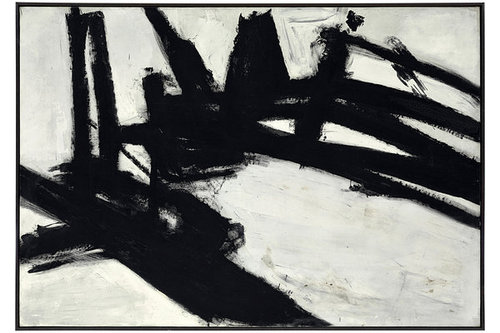
The “Untitled” painting by Franz Kline (1957)

04/21/2013 (12 Moons Solo Project Day 111)

12 Moons Solo Saxophone Project Day 111

Date: 04/21/2013

Instrument: Alto saxophone

Location: Lecture Room 331 in the University of Washington School of Music.  Seattle, WA

Notes:

This is my first improvisation in the 12 Moons series that was specifically inspired by the music of another musician.  I spent about an hour with my friends and fellow saxophonists Ivan Arteaga and Jacob Zimmerman beginning work on Roscoe Mitchell’s composition Nonaah, scored for 4 saxophones.  The percussive, driving nature of Nonaah has always greatly inspired me, and the quartet adaptation features a wonderful variety of tempos and material.  I recorded this improvisation immediately after leaving the rehearsal, and I felt inspired me to carry Roscoe’s compositional model into the recording space.  

In Roscoe’s composition Nonaah, there is a very defined melody that is worked and reworked and re-tooled during each of his performances.  The melody itself is very rhythmically disjunct and covers a range spanning about 3 octaves.  In my improvisation today I explored the model of disjunct melodies with a very tight center of rhythmic gravity.  I approached the improvisation with no particular melody in mind, but very much like Nonaah I leaned heavily on chromaticism displaced by octaves.  I divided the improvisation into 4 sections, those being: 1.  Short, percussive melodies in wide range with little space between pitches.  2.  Short, percussive melodies in wide range using more space between pitches.  3.  Long, chorale-like melodies in wide range moving from one pitch to the next.  4.  Low octave, sweeping pitches that dovetailed one pitch into the next.

-Neil 

04/20/2013 (12 Moons Solo Project Day 110)

12 Moons Solo Saxophone Project Day 110

Date: 04/20/2013

Instrument: Tenor saxophone

Location: Home studio in Clinton, WA (Whidbey Island)

I’ve recently become interested in studying the technique of rhythmic abandonment.  With this idea, an exploration of non-sequirter rhythmic cycles became a theme in my practice session today.  I would immediately chart a path of exploration on a single rhythm and then abruptly abandon it for something new.  It then become a great challenge to find a way to stitch a current idea with the one to come, particularly when they might be so fundamentally different from one another.  Using a common melodic statement became a center-point for the  stitching of ideas.  In this improvisation I worked with the two pitches Concert Bb and Concert G.

Partially to create the variety of rhythms and melodies, I used false fingerings against the Concert Bb and G, and combined them with different articulation styles.  I used the absence of sound more as an element for articulation than for silence.  

-Neil